



International visitors flock to Beijing for 2026 Spring Festival
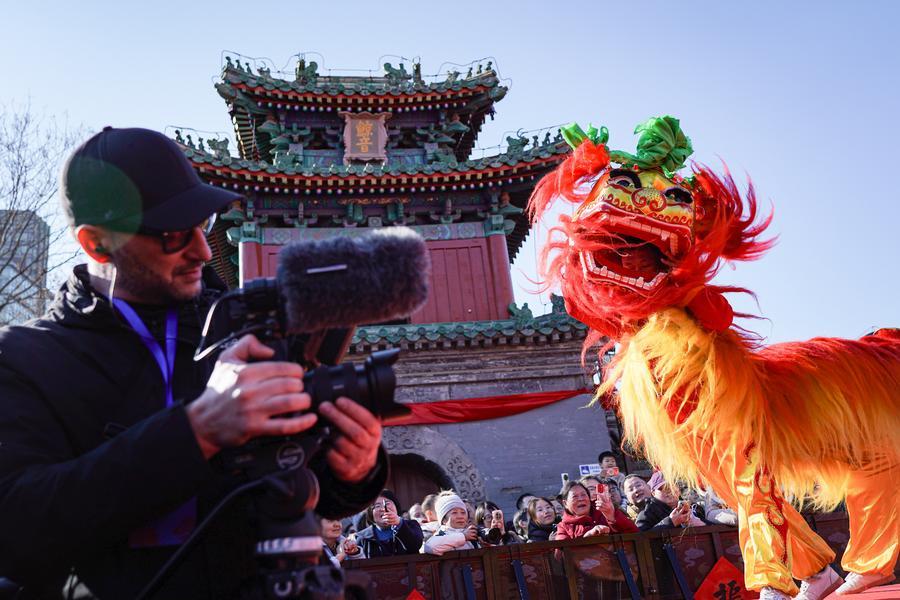
A foreigner films the lion dance performance at a temple fair in Beijing, capital of China, Feb. 17, 2026. (Xinhua/Chen Zhonghao)
China's Spring Festival proved an irresistible draw for international travelers this year, as large numbers of foreign visitors arrived to ring in the Year of the Horse the Chinese way.
During the 2026 Spring Festival holiday, which ran from Feb. 15 to 23, bookings for domestic flights made on non-Chinese passports rose nearly 20 percent year on year.
Beijing, Shanghai and Guangzhou emerged as the top destinations for overseas visitors. In Beijing alone, figures from Alibaba's travel branch Fliggy showed that ticket orders jumped 136 percent, hotel reservations rose over 60 percent, and tour package bookings climbed 42 percent year on year during the Spring Festival holiday.
The city's rich intangible cultural heritage and time-honored Spring Festival traditions proved a powerful magnet for international visitors, who ventured deep into ancient hutongs, explored intangible cultural heritage sites, and flocked to well-known scenic areas, immersing themselves in the distinctive charm of the Chinese New Year.
With deep cultural roots, varied tourism offerings and attentive visitor services, Beijing cemented its status as a popular destination for foreign visitors to experience China's Spring Festival, while injecting fresh momentum into the country's inbound tourism market.
Travelers from Spain, Peru, Brazil and beyond were among those drawn to the capital. In addition to the iconic Great Wall and Palace Museum, many ventured into cultural heritage venues to soak up the lively atmosphere and experience the richness of Chinese civilization.
On Feb. 13, the Beijing Intangible Cultural Heritage Center in Dongcheng district buzzed with excitement. The venue, set within a courtyard dating to the late Qing Dynasty (1644-1911), came alive with cultural activities. Visitors from various countries posed for photos in front of a wall featuring the iconic Lord Rabbit, known as Tu'er Ye in Chinese, a traditional festive clay toy for children. They also tried their hand at making dumplings, writing the character "Fu" (good fortune), blowing sugar figurines and playing the guqin, a seven-string traditional Chinese musical instrument.
Early on Feb. 20, a welcome ceremony for 60 Australian tourists was held at the Drum Tower on the northern end of the Beijing Central Axis, a UNESCO World Heritage Site. Their arrival marked the opening of a tourism promotion program aimed at bringing 10,000 Australians to Beijing in successive groups, giving a strong boost to the capital's inbound tourism market in 2026.
A Tai Chi performance at the foot of the Drum Tower drew the Australian visitors in, with many stopping to join in and get a hands-on taste of traditional Chinese culture.
Guo Huaigang, director of the Beijing Municipal Bureau of Culture and Tourism, extended Spring Festival greetings to the group.
"The ancient bells and drums of the Bell and Drum Towers signal a new chapter of friendship between China and Australia," Guo said. "Beijing is opening its arms wide, offering world-class services to welcome visitors from every corner of the globe to marvel at the grandeur of our central axis and feel the warmth of life in hutongs."
Visitors received a Spring Festival gift pack from the bureau, which included traditional items such as "Fu" characters, Chinese knots, lanterns and tanghulu, a traditional Chinese snack of candied fruit. The pack also included a list of the top five inbound tourism experiences in Beijing for the 2026 Spring Festival, 10 recommended routes, a hotel guide and a tax refund handbook for departing visitors.
"Beijing is incredibly welcoming — we can really feel the hospitality of the Chinese people," said a first-time visitor from Melbourne, Australia, who was touring the city with his wife.
The capital welcomed a large influx of overseas visitors during the Spring Festival period, drawing travelers not only from traditional markets such as Europe and the Americas but also from emerging ones, including Southeast Asia and Russia, said Zheng Fang, deputy director of the Beijing Municipal Bureau of Culture and Tourism.
To help foreign visitors better experience both local and Chinese culture, the bureau unveiled a suite of themed tourism products and routes.
"We specifically launched a 'top five must-visit' list and 10 premium routes tailored for international visitors," Zheng said.
Temple fairs, lantern fairs and garden galas topped Beijing's inbound tourism offerings for the holiday. The city hosted traditional temple fairs at Longtan, Ditan and Changdian, alongside newer formats such as a sci-tech temple fair, an opera-themed temple fair and an art temple fair.
The deep integration of intangible cultural heritage into tourism was another defining feature of Beijing's tourism market during the Spring Festival holiday. A newly launched route focused on intangible cultural heritage brought together more than 30 experience sites across the city, according to Zheng.
Beijing welcomed 5.48 million international tourist visits in 2025, up 39 percent year on year, according to the Beijing Municipal Bureau of Culture and Tourism. Tourism revenue hit 50.56 billion yuan ($7.36 billion), up 44.7 percent year on year. Both figures set all-time records, boosting Beijing's development as an international exchange center.
The year 2026 marks a critical juncture in Beijing's push to establish itself as a world-class tourism destination and a premier stop for global travelers in China. The city will continue to promote the development of inbound tourism by focusing on three priorities: upgrading the quality of its tourism products, raising the international standard of its services, and diversifying its promotional outreach.
Photos



Related Stories
Copyright © 2026 People's Daily Online. All Rights Reserved.
