



Woodblock Chinese New Year paintings thrive in village in C China's Henan
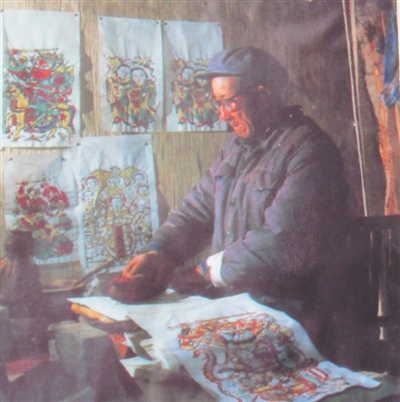
Zhang Yi prints woodblock Chinese New Year paintings in his workshop in Zhaozhuang village, Zhuxian town, Kaifeng, central China's Henan Province, 1987. (File photo)
Zhaozhuang village in Zhuxian town, Kaifeng, central China's Henan Province, has long been a center for the craft of woodblock Chinese New Year paintings. Zhang Tingxu, a national intangible cultural heritage inheritor, works with his son Zhang Chenyun to fulfill orders for these festive artworks.
At the height of the Ming and Qing dynasties (1368–1911), more than 300 workshops were producing woodblock Chinese New Year paintings. At the craft's lowest point, however, only a handful of workshops remained.
According to Zhang Tingxu, the craft was once simply a means of making a living; today, it is being preserved and promoted as a tool for rural revitalization.
The younger generation is also helping to modernize the industry.
Zhang Yi, born in the 1990s, runs a store selling woodblock Chinese New Year paintings in a scenic area. She has a sharp business instinct, noting that this year's Spring Festival alone brought in what used to take six months to earn.
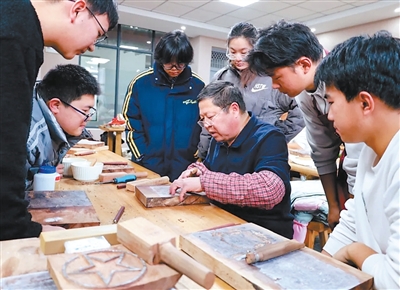
Zhang Jizhong, a provincial representative inheritor of the craft of woodblock Chinese New Year paintings, shows how to make woodblocks at Kaifeng Vocational College in Kaifeng, central China's Henan Province. (Photo/Zhang Yiquan)
In 2025, Zhaozhuang village and its surrounding areas welcomed over 80,000 study tours, generating more than 1.1 million yuan (about $160,500) in sales revenue. That same year, the woodblock painting industry's annual output value exceeded 40 million yuan.
In addition to woodblock Chinese New Year paintings, Zhaozhuang village has also expanded into over 220 derivative products, with designs spanning contemporary themes from aerospace to rural revitalization. The products are sold through e-commerce platforms to more than 20 countries, including France, the UK and Russia.
Locals are also expanding the industry by hosting study tours.
"We want children to experience the craft firsthand and feel the pulse of our culture," said Shi Jing, who oversees the village's study tour operations.
A collaborative model bringing together heritage workshops, universities and cooperatives has introduced valuable resources to the village, attracting not only visitors but also fresh designs and new ideas.
Photos



Related Stories
Copyright © 2026 People's Daily Online. All Rights Reserved.
