



Greening a reef: quiet ecological revival of Xishazhou in Hainan

Photo shows Xishazhou Island. (Photo provided by the publicity department of Sansha)
Fisherman Zhan Dafeng hauled in his nets, started his engine, and departed from Xishazhou Island in Hainan province, southern China. His boat carried no fish this time -- only marine debris collected from the ocean.
Once dedicated to planting trees on the island, local fishermen now patrol the expansive waters to safeguard this transformed reef. What was once barren is now a thriving maritime oasis.
Xishazhou Island lies in Sansha, China's southernmost prefecture-level city, located in Hainan province. Situated at the westernmost edge of the Qilian Yu, a subgroup of islands in the Xisha Islands, Xishazhou Island was once little more than a desolate sandbank.
Today, over 90% of the island is verdant with vegetation. Coastal she-oak groves mingle with coconut palms, Morinda citrifolia, and Strophanthus divaricatus, creating a lush haven emerging from the sea.
"Only scattered trees existed here before," recalled Zhan. "The island gradually transformed after we began planting." In 2013, local fishermen established Xishazhou's first saplings.
Getting trees to the island was no easy task. Saplings were shipped from Hainan Island, traveling more than 180 nautical miles over a journey of 20-plus hours. With no navigable channels around the reef, supplies could only be landed at high tide. Fishermen improvised floating rafts, hoisted the saplings from transport vessels onto rafts, then hauled them ashore by hand and carried them across the island.
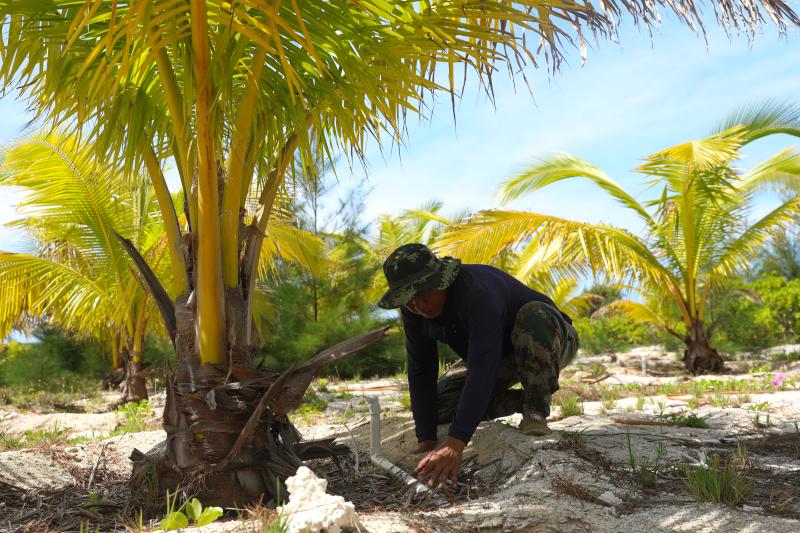
Irrigation pipelines are installed to water coconut palms on Xishazhou Island. (Photo/Wu Yatie)
Planting proved equally demanding. Scorching heat, saltwater erosion and typhoons frequently withered or uprooted new plantings, requiring persistent reforestation efforts.
Through trial, error, and expert consultation, Zhan and fellow fishermen developed effective techniques. They selected salt-tolerant native species to improve survival rates. To combat the coral sand's poor water retention and nutrient deficiency, they pioneered an innovative bottle-planting technique to nourish roots.
How did it work?
Discarded glass bottles filled with water held saplings, allowing roots to draw moisture both inside and outside the container. Roots submerged in water eventually decayed, while those extending into the sand absorbed nutrients. Remarkably, one bottle sustained a sapling for a year.
"The earth conditions here are quite similar to deserts in northern China," Zhan explained. "We learned the bottle-planting technique from forestry workers in Ordos, Inner Mongolia autonomous region, and adapted it to local conditions." As the method proved effective and was gradually refined, more fishermen joined the island greening effort.
In the early days, freshwater for irrigation had to be shipped from Hainan Island or Zhaoshu, the main island of the Xisha Islands, or collected from rainfall. These limited sources made large-scale greening difficult. The sandy terrain also lacked nutrients, requiring soil to be transported from Hainan Island.
To overcome water shortages, desalination equipment now provides irrigation and drinking water. Sansha City built a simple pier for transporting soil and supplies. Over a decade, 138,000 trees were planted with a 95% survival rate.
"The trees now sustain themselves," Zhan noted. The thriving ecosystem stabilizes dunes, consolidates land, retains moisture, and enriches biodiversity. Mature trees exceed 10 meters in height. Decomposing leaves beneath she-oaks transform sand into soil, supporting vines and undergrowth.
Wildlife has returned: sea turtles nest here, and migratory birds like great crested and sooty terns breed on the island. "I welcome them wholeheartedly," said Zhan, who now serves as an "island custodian," patrolling reefs with fellow fishermen to protect these new residents.
Back at Zhaoshu, Zhan delivered the collected debris to an environmental station. Inside, rows of plastic bottles -- washed ashore by monsoons -- testified to ongoing cleanup efforts. After sorting, the waste is shipped to Hainan for recycling.
Protecting island ecosystems requires both greening efforts and pollution control. On Yongxing Island, where the Sansha's municipal government is based, fishermen help maintain nurseries that supply saplings to nearby islands. Across the archipelago, officials, workers and local communities conduct regular marine cleanup operations, circling the islands by boat to clear debris from beaches and surrounding waters.
"We will continue promoting island greening and marine sanitation efforts, ensuring tangible improvements in environmental protection and visible changes to the islands' appearance," said Chen Yifen, head of the Qilian Yu ecological office.
Photos

Related Stories
- Inbound tourism heats up in China's Hainan FTP
- China's Lecheng emerges as medical tourism destination, innovation hub
- China's Hainan reports surging imported zero-tariff goods
- Hainan FTP's 1st month of island-wide special customs boosts passenger convenience
- Hainan FTP's first month of island-wide special customs operations boosts economic vitality, sets global benchmark
- Hainan Science and Technology Museum kicks off trial operation
- China's Hainan witnesses booming wave of inbound travelers
- Hainan's tourism boom continues as Spring Festival approaches
- Registered foreign trade entities in Hainan FTP exceed 100,000
- China's Hainan reports surging green electricity trade in 2025
Copyright © 2026 People's Daily Online. All Rights Reserved.
