



World's first low-altitude wind tunnel launched in S China
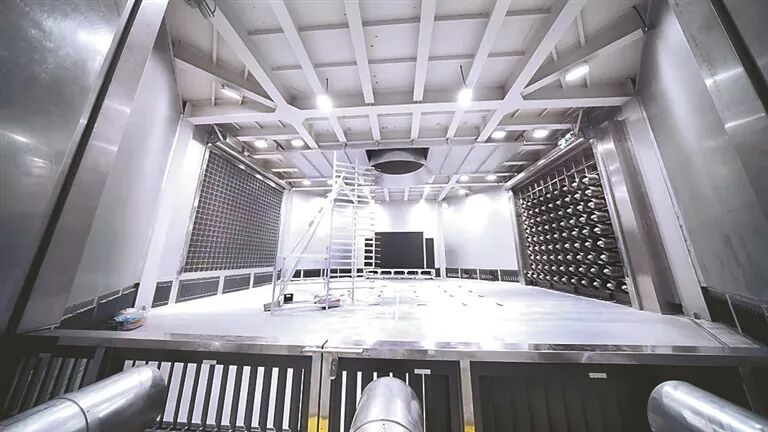
Photo shows the world's first low-altitude wind tunnel facility in Longhua district of Shenzhen, south China's Guangdong province. (Photo from the website of the government of Longhua district, Shenzhen, south China's Guangdong province)
For more than a century, humanity has pursued the dream of flight. Traditionally, aircraft have primarily operated in the stratosphere or over open areas, where airflow conditions are relatively straightforward. However, with the rise of the low-altitude economy, the troposphere below 1,000 meters above the ground is fast becoming a key arena for future transportation and industrial transformation.
Recently, the world's first low-altitude wind tunnel facility was completed and inaugurated in Longhua district of Shenzhen, south China's Guangdong province. Inside the state-of-the-art facility, 81 high-powered fans generate powerful gusts while a quadcopter drone undergoes rigorous testing, shaking under simulated level-8 wind conditions. Real-time data from load sensors feed directly into monitoring screens, offering valuable insights.
Developed by the Shensi Lab of the Shenzhen Institute for Advanced Study, University of Electronic Science and Technology of China, the facility is being hailed as the "ultimate test field" for low-altitude aircraft.
Low-altitude aircraft face significant engineering challenges due to the complex environmental conditions of the troposphere. According to Yang Jun, head of the Shensi Lab, "Commercial aircraft typically operate in the stratosphere, around 10,000 meters, where wind directions are more uniform. In contrast, the wind patterns in the troposphere are highly variable, with severe convective weather making flights below 1,000 meters particularly difficult." Despite these challenges, the troposphere is vital for emerging applications, including logistics delivery, emergency response, and urban transportation.
The aviation industry has long adhered to the principle: "No wind tunnel, no flight." Since the Wright brothers built their first wind tunnel in 1901, wind tunnels have played an essential role in flight testing. Yet, among over 1,000 wind tunnels worldwide, few are capable of replicating the dynamic, complex atmospheric conditions of low-altitude urban environments. To evaluate the wind resistance and flight performance of low-altitude aircraft in turbulent, real-world conditions, engineers have often had to rely on chasing storms.
To address this gap, the Shensi Lab developed the world's first low-altitude wind tunnel facility capable of precisely simulating urban wind conditions, including street-canyon winds, heat island effects, wind shear, and downbursts. This provides scientific support for defining safe operational boundaries for low-altitude aircraft.
The facility consists of two chambers: an outer chamber with a diameter of 18 meters and an inner chamber measuring 10 meters. Aircraft with wingspans up to four meters can be tested for aerodynamic characteristics, flight-control performance, and safety across a range of scenarios including vertical takeoff and landing, cruising, and hovering. The wind tunnel features a "fan matrix" design, incorporating three fan arrays arranged in different directions, along with a bottom-flow array. It can generate wind speeds of up to 60 meters per second, with a response time of under two seconds.
Additionally, the facility can control temperature and humidity and simulate rain, snow, and hail, offering a comprehensive reproduction of urban low-altitude weather for safety testing. Since its launch, the wind tunnel has supported the research and development of small and micro low-altitude aircraft for several companies.
Looking ahead, low-altitude aviation holds vast development potential. Imagine booking a "custom flight" to travel 100 kilometers in just half an hour at speeds of 200 to 300 kilometers per hour. Envision commuting not by walking down to the street but by taking off from the rooftop. Point-to-point urban travel, once thought to be the stuff of science fiction, may soon be a reality.
"The low-altitude economy is not about isolated technologies. It depends on the coordinated efforts of the entire industrial chain," Yang said. With no unified global standards yet established for urban low-altitude flight, original research is necessary to create independent scientific and industrial systems, positioning China to become a global leader and standard-setter in this field.
Looking to the future, the Shensi Lab plans to develop an even larger low-altitude environmental simulation facility, with an outer chamber diameter of 65 meters and an inner chamber diameter of 45 meters. This facility will support studies, validation, and testing for medium- and large-sized low-altitude aircraft, including drone swarms, with wingspans of up to 17 meters. Once completed, it will complement the existing wind tunnel, forming a complete testing ecosystem for the development of low-altitude aircraft.
Photos




Related Stories
- Tunnel along Xining-Chengdu railway completed
- China's largest tunnel boring machine enters testing phase for world's longest underwater highway tunnel construction
- Taixingshan tunnel drilled through in Shaanxi
- Chinese researchers develop unmanned system for tunnel emergency rescue
- Chinese contractor achieves breakthrough of last tunnel of Nepal's major fast-track package 2 project
- China's tunnel boring machine industry achieves leapfrog development
- New undersea tunnel sets record
- Shenzhen-Zhongshan undersea tunnel connected
- China completes cutting medium- and low-speed maglev tunnel with shield tunneling machine
- Drill-through of two-way river-crossing passway in central China
Copyright © 2026 People's Daily Online. All Rights Reserved.
