

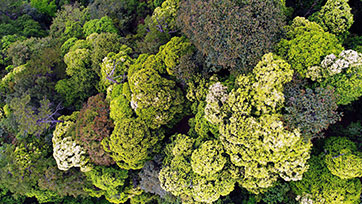
BEIJING, Oct. 7 -- Chinese scientists have discovered the mechanism regulating the coexistence of species in subtropical forests, providing a reference for ecosystem restoration in these areas.
The research was led by the Institute of Botany under the Chinese Academy of Sciences. Researchers have spent more than 10 years monitoring 100 species and 25,000 woody plant seedlings in a 24-hectare experimental zone in Zhejiang Province on east China's seaboard. They collected soil around the roots of 322 trees from 34 species and sequenced the DNA of fungi from the samples.
Results revealed the role of different functional soil fungi in driving the biodiversity of subtropical forests. The research has uncovered for the first time that the trees' intraspecific interactions are determined by both harmful pathogenic fungi and beneficial mycorrhizal fungi, offering a new model of tree diversity analysis.
Published in the journal Science, the research will help support China's efforts in protecting and restoring biodiversity in subtropical forests.

 Award-winning photos show poverty reduction achievements in NE China's Jilin province
 People dance to greet advent of New Year in Ameiqituo Town, Guizhou
 Fire brigade in Shanghai holds group wedding
 Tourists enjoy ice sculptures in Datan Town, north China
 Sunset scenery of Dayan Pagoda in Xi'an
 Tourists have fun at scenic spot in Nanlong Town, NW China
 Harbin attracts tourists by making best use of ice in winter
 In pics: FIS Alpine Ski Women's World Cup Slalom
 Black-necked cranes rest at reservoir in Lhunzhub County, Lhasa
 China's FAST telescope will be available to foreign scientists in April