

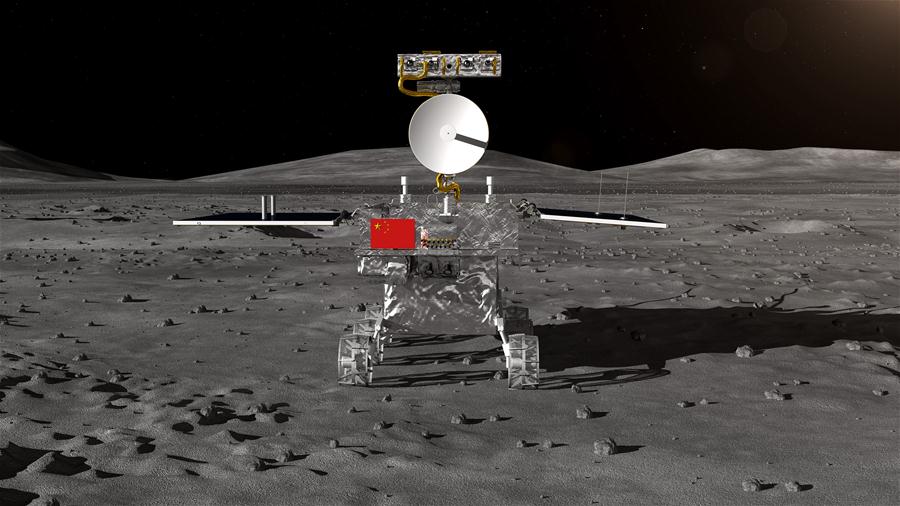
Photo provided by State Administration of Science, Technology and Industry for National Defense shows the image of the rover for China's Chang'e-4 lunar probe. China's moon lander and rover for the Chang'e-4 lunar probe, which is expected to land on the far side of the moon this year, was unveiled Wednesday. The global public will have a chance to name the rover. (Xinhua)
China's Chang'e-4 probe decelerated and entered the lunar orbit Wednesday, completing a vital step on its way to make the first-ever soft landing on the far side of the moon, the China National Space Administration (CNSA) announced.
After flying about 110 hours from earth, an engine on the probe was ignited when it was 129 km above the surface of the moon, in line with instructions sent from a control center in Beijing at 4:39 p.m., and then the probe slowed and entered an elliptical lunar orbit with the perilune at about 100 km at 4:45 p.m., said CNSA.
The probe, including a lander and a rover, was launched by a Long March-3B carrier rocket last Saturday from the Xichang Satellite Launch Center in southwest China's Sichuan Province, opening a new chapter in lunar exploration.
As the rocket was able to send the probe into orbit precisely as planned, the control center only adjusted the probe's orbit once on Sunday and also canceled two pre-planned orbit trimmings before the near-moon deceleration, CNSA said.
Next, the control center will adjust the probe's orbit around the moon and test the communication link between the probe and the relay satellite "Queqiao," which is operating in the halo orbit around the second Lagrangian (L2) point of the earth-moon system.
Afterward, the control center will choose a proper time to land the probe on the far side of the moon, according to CNSA.
Since the moon's revolution cycle is the same as its rotation cycle, the same side always faces the earth. The other face, most of which cannot be seen from earth, is called the far side or dark side, not because it's dark, but because most of it remains unknown.
The Chang'e-4 mission will be a key step in revealing the mysterious far side of the moon.
The scientific tasks of the Chang'e-4 mission include low-frequency radio astronomical observation, surveying the terrain and landforms, detecting the mineral composition and shallow lunar surface structure, and measuring the neutron radiation and neutral atoms to study the environment on the far side of the moon, according to CNSA.
China has promoted international cooperation in its lunar exploration program, with four scientific payloads of the Chang'e-4 mission developed by scientists from the Netherlands, Germany, Sweden and Saudi Arabia.

 Award-winning photos show poverty reduction achievements in NE China's Jilin province
 People dance to greet advent of New Year in Ameiqituo Town, Guizhou
 Fire brigade in Shanghai holds group wedding
 Tourists enjoy ice sculptures in Datan Town, north China
 Sunset scenery of Dayan Pagoda in Xi'an
 Tourists have fun at scenic spot in Nanlong Town, NW China
 Harbin attracts tourists by making best use of ice in winter
 In pics: FIS Alpine Ski Women's World Cup Slalom
 Black-necked cranes rest at reservoir in Lhunzhub County, Lhasa
 China's FAST telescope will be available to foreign scientists in April