The first shipment of liquefied natural gas (LNG) from the Yamal LNG project in the Arctic arrived in Jiangsu Province in eastern China on Thursday, reports thepaper.cn.
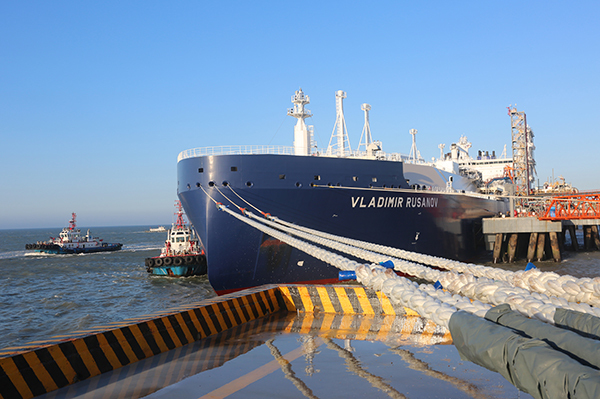
The Vladimir Rusanov, carrying liquefied natural gas (LNG) from the Yamal LNG project in the Arctic, arrives in Jiangsu Province on Thursday, July 19, 2018.[Photo: China National Petroleum Corporation]
The maiden voyage to China of the Vladimir Rusanov, a 172,000-cubic-meter LNG carrier, was commemorated by a ceremony attended by Nur Bekri, the director of the National Energy Administration of China, and Alexander Novak, Russia's minister of energy.
The LNG carrier traveled to China via a 10,700-kilometer-long northern sea route, which is about 13,400 kilometers shorter than the traditional eastern shipping route via the Suez Canal and the Strait of Malacca. The new route could cut more than 20 days from the voyage, according to thepaper.cn.
The Yamal LNG project operated by JSC Yamal LNG is a joint-venture with Russia's largest independent natural gas producer NOVATEK. The China National Petroleum Corporation and the Silk Road Fund are both major stakeholders.
The LNG extraction project on the Yamal Peninsula is still under construction. When fully complete, the gas it produces will be shipped to the Asia-Pacific and European markets. This includes more than three million tons of LNG that will be imported annual to China for the China National Petroleum Corporation starting next year.

 Award-winning photos show poverty reduction achievements in NE China's Jilin province
 People dance to greet advent of New Year in Ameiqituo Town, Guizhou
 Fire brigade in Shanghai holds group wedding
 Tourists enjoy ice sculptures in Datan Town, north China
 Sunset scenery of Dayan Pagoda in Xi'an
 Tourists have fun at scenic spot in Nanlong Town, NW China
 Harbin attracts tourists by making best use of ice in winter
 In pics: FIS Alpine Ski Women's World Cup Slalom
 Black-necked cranes rest at reservoir in Lhunzhub County, Lhasa
 China's FAST telescope will be available to foreign scientists in April