

 |
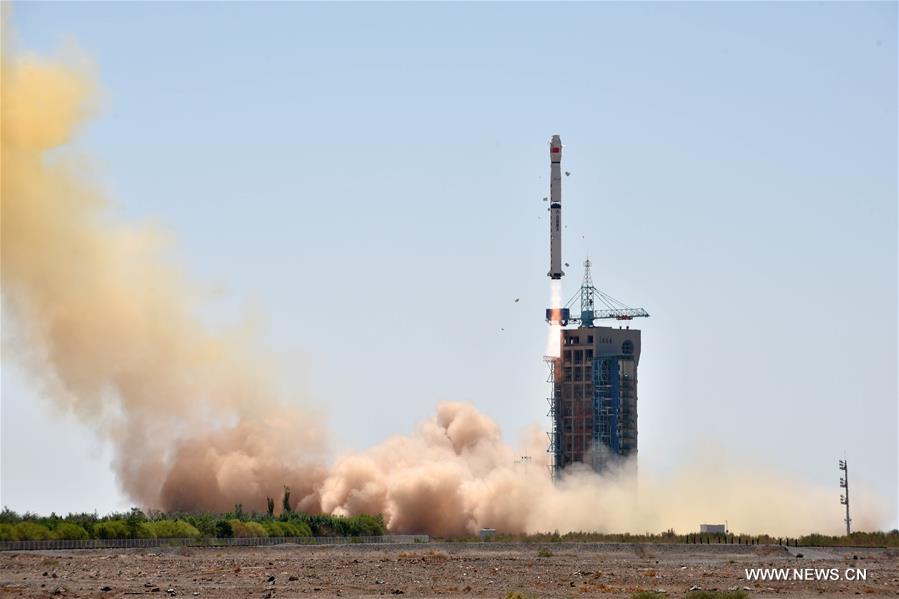
| A Long March-4B rocket carrying X-ray space telescope to observe black holes, pulsars and gamma-ray bursts blasts off from Jiuquan Satellite Launch Center in northwest China's Gobi Desert, June 15, 2017. (Xinhua/Zhen Zhe) |
JIUQUAN, June 15 (Xinhua) -- China launched its first X-ray space telescope to observe black holes, pulsars and gamma-ray bursts, via a Long March-4B rocket from Jiuquan Satellite Launch Center in northwest China's Gobi Desert at 11 a.m. Thursday.
The 2.5-tonne Hard X-ray Modulation Telescope (HXMT), dubbed Insight, was sent into an orbit of 550 kilometers above the earth to help scientists better understand the evolution of black holes, and the strong magnetic fields and the interiors of pulsars.
Through the telescope, scientists will also study how to use pulsars for spacecraft navigation, and search for gamma-ray bursts corresponding to gravitational waves.
The result of the wisdom and efforts of several generations of Chinese scientists, Insight is expected to push forward the development of space astronomy and improve space X-ray detection technology in China.

 Award-winning photos show poverty reduction achievements in NE China's Jilin province
 People dance to greet advent of New Year in Ameiqituo Town, Guizhou
 Fire brigade in Shanghai holds group wedding
 Tourists enjoy ice sculptures in Datan Town, north China
 Sunset scenery of Dayan Pagoda in Xi'an
 Tourists have fun at scenic spot in Nanlong Town, NW China
 Harbin attracts tourists by making best use of ice in winter
 In pics: FIS Alpine Ski Women's World Cup Slalom
 Black-necked cranes rest at reservoir in Lhunzhub County, Lhasa
 China's FAST telescope will be available to foreign scientists in April