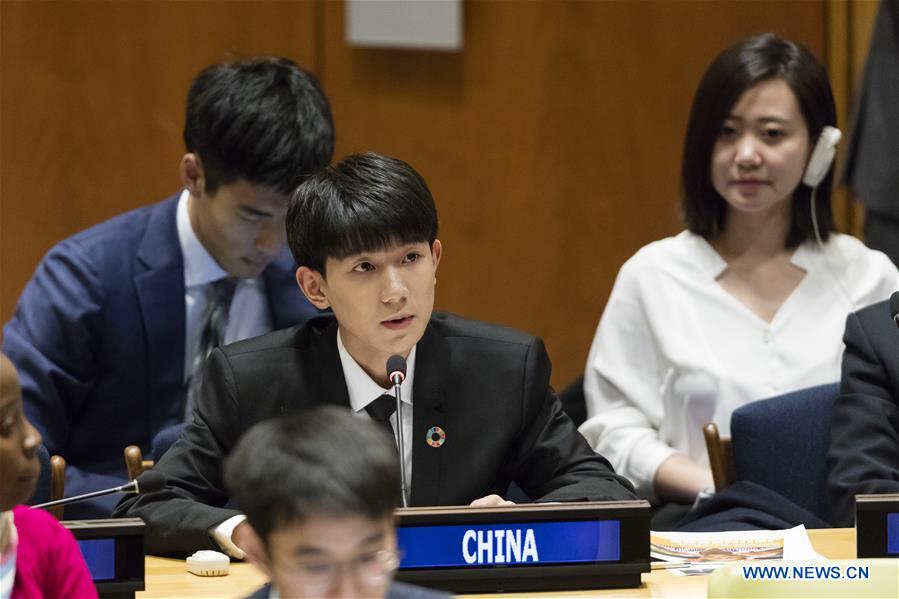
Yuan Wang (C), member of the famous Chinese boy band TFBOYS, addresses a UN youth forum at the United Nations headquarters in New York, on Jan. 31, 2017. Wang on Tuesday spoke here at the UN youth forum and called for equal access to quality education for young people worldwide. (Xinhua/Li Muzi)
A popular Chinese teenage star Yuan Wang on Tuesday spoke here at a UN youth forum and called for equal access to quality education for young people worldwide.
Wang, member of the famous Chinese boy band TFboys, told the crowd that China has 278 million young people, the second largest youth population in the world, and he is fortunate to work with the UN to inspire China's young generation to promote a set of global goals aiming to end poverty, promote gender equality and combat climate change.
The goals, know as sustainable development goals (SDGs), are outlined in the UN-facilitated 2030 Agenda for Sustainable Development. There is one goal asking for complete free, equitable and quality primary and secondary education by year 2030.
"My passion for 2030 is that every young person can access good quality education; girls have the same potential to achieve amazing things as boys," said Wang.
The Jan. 30-31 youth forum is aimed at trying to involve the efforts of youth to eradicate poverty and promote prosperity across the world. It brings youth leaders worldwide and gives them an opportunity to engage with police-makers and civil society representatives to discuss on the SDGs.

 Award-winning photos show poverty reduction achievements in NE China's Jilin province
 People dance to greet advent of New Year in Ameiqituo Town, Guizhou
 Fire brigade in Shanghai holds group wedding
 Tourists enjoy ice sculptures in Datan Town, north China
 Sunset scenery of Dayan Pagoda in Xi'an
 Tourists have fun at scenic spot in Nanlong Town, NW China
 Harbin attracts tourists by making best use of ice in winter
 In pics: FIS Alpine Ski Women's World Cup Slalom
 Black-necked cranes rest at reservoir in Lhunzhub County, Lhasa
 China's FAST telescope will be available to foreign scientists in April