

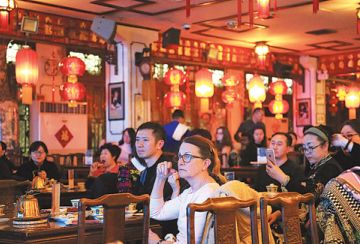
Customers watch performances at Laoshe Teahouse. [Photo by Liu Xuan/provided to China Daily]
Zhou Xin, a 26-year-old woman living in Beijing, said: "I'm eager to go to the teahouse because I love drama so much. I think this is a part of Beijing culture and I want to experience it."
Opened in 1988, Laoshe Teahouse has become not just a travel destination in the capital, but a showcase of Chinese culture, especially Beijing-style culture, which attracts visitors.
Laoshe Teahouse has been luckier than the fictional Yutai Teahouse, a place in playwright Lao She's drama Teahouse, which had to close due to revolutionary volatility.
However, 20 years ago, Yin could not have expected the now-thriving teahouse market, as there were only a few visitors, with most of them age 50 or even older.
After China's reform and opening up, various forms of Western entertainment entered the country. This new foreign culture continued to draw Chinese, especially the younger generation, to discos or karaoke lounges, rather than teahouses. Under this Western cultural influence, traditional Chinese culture started to lose its attraction.
 |  |
 Fire brigade in Shanghai holds group wedding
 Tourists enjoy ice sculptures in Datan Town, north China
 Sunset scenery of Dayan Pagoda in Xi'an
 Tourists have fun at scenic spot in Nanlong Town, NW China
 Harbin attracts tourists by making best use of ice in winter
 In pics: FIS Alpine Ski Women's World Cup Slalom
 Black-necked cranes rest at reservoir in Lhunzhub County, Lhasa
 China's FAST telescope will be available to foreign scientists in April
 "She power" plays indispensable role in poverty alleviation
 Top 10 world news events of People's Daily in 2020
 Top 10 China news events of People's Daily in 2020
 Top 10 media buzzwords of 2020
 Year-ender:10 major tourism stories of 2020
 No interference in Venezuelan issues
 Biz prepares for trade spat
 Broadcasting Continent
 Australia wins Chinese CEOs as US loses