

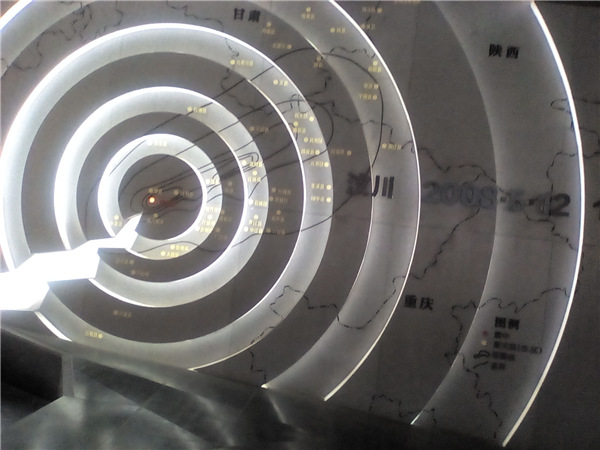
Computer simulation of quake epicenter in museum.[Photo provided for people.cn]
Standing on the oval platform simulating the tremor of death and disaster in the belly of the tunnel in Wenchuan, Sichuan Province that memorialize the calamity which struck on the afternoon May 12, 2008 was simply a sad memory.
On November 6, a team of 35 African and South Asian journalists with Chinese officials paid a visit to the site.
The gallery of tears is built at the crater created at the epicenter of the quake of 8.0m on the Richter scale. Scientists said the crater is exactly the point of greatest impact of the quake. The force that creates quakes is located underneath the earth surface and down at the subterranean spot, the point of impact is called the hypocenter, and above the hypocenter on the surface is the epicenter.
No doubt, most of the people that experienced the quake that day or had their loved ones buried in that disaster would not come close to that memorial. But standing there watching the simulation of the crumbling world, walls of the mountains and buildings and trees, and the heavy vibration of the platform that throws, staggers and jolts you amid the melee of the maze of the screen display on the wall round the dark cubicle makes one feel there was real earthquake going on. It is definitely not a sight or scene for the fainthearted, or a good recall for those that experienced it in real life.
However, all those were set up to give tourists the feel of the seismic belch and upset that swallowed down over 70,000 human beings and 18,000 others whose remains are still missing till date, and over 4.8 million displaced.
Disaster and sorrow were the fate of Wenchuan on that fateful day when nature’s misstep and disorder hit China direct at the heart. It was 32 years after China had its worst earthquake in recorded history in Tangshan District of the Hebei Province in 1976 where the country lost over 260,000 people in the quake whose 40th anniversary held last July.
That phenomenal quake in Tangshan made the earlier worst seismic disaster that struck in Messina of the Sicily and Calabria regions of Italy on December 28, 1908 that had hitherto been the worst look little.
The Wenchuan quake lasted just some 120 seconds and with over 70 aftershocks in 24 hours. It was during that short spell that it wrecked that havoc of monumental proportions and left the nation reeling deep in pains.
The surface beneath our feet is made of blocks or slabs of earth arranged end to end and all stand on a fluid mantle or core that facilitates its spin on its axis. Liken it to slices of bread laid out on your dining table and linked at the ends with each other by a form of lubrication like say butter in between the slices. These are called the tectonic plates and some number of them makes up the earth crust. At the points they meet, there is constant thermal or heat-facilitated hydraulic action. Whenever the rocking between the plates get violent or cook up undue heat, they could go into collision, cause a tilt of one below the other, an overlap or pulling apart from each other. Any of these result in earthquake. So earthquake occurs when two ends of the plates collide, or one slides below, as the simulation of the Wenchuan quakes showed to be the cause, or when the ends pull apart.
The slight jolt in Wenchuan caused calamities that fateful day. But the Chinese government and that of the Sichuan Province rose to the occasion to save the situation and provide succor to the victims even though the relics and scars of the disaster are still plastered all over Wenchuan. Climbing the steep slope to the epicenter museum, there is a road tunnel to the right that is barricaded from use at both ends close to the bank of a river. That tunnel was the road until the quake struck and the road had to be diverted.
Wenchuan is a strip of mountain ranges, a very rugged topography, the southern extension of the Himalayan mountains ranges that continues from Tibet. Of course, even the population of Wenchuan is made of a good percentage of Tibetans. So here, roads through tunnels in the belly of the mountains are very common and some of the tunnels were affected by the quake that threw down so many things, including vehicles that were on the roads when the quake struck. Among the relics displayed at the museum is a police vehicle mangled and beaten flat. Some many others were also involved as the exhibition has an ample cache of some of the pieces picked from the chaos including items from homes and personal effects of victims.
Down the valley overlooking the epicenter of the quake, life has returned to normal. There are hundreds of brand new homes for the natives constructed by the Chinese government to rehabilitate victims. And another park and mausoleum is set up among the residential quarters in the valley for the victims of the quake where the journalists and other tourists laid flowers at midday in the memory of the victims. It was a solemn brief celebration that triggers emotions.
The people ordinarily live like there was no such incident in the near past until one is told the story of what happened there and that the buildings – homes, shopping plazas, recreation parks and squares were built after the tremor by the government.
About 15km away from Wenchuan and towards the historic and antique city of Dujiangyan is a small town of Jiulong. The name means Nine Dragons. Dragons are positive mythical animals in Chinese myths and the people were affected by the quake with about 30% of the buildings thrown down. But the villagers were so happy that no lives were lost. However, they believe the nine dragons associated with their town saved them from overt calamity as I spoke with the natives on their survival.
A lot of them gathered at the front of their new homes built for them in resettlement quarters by the government after the quakes. They excitedly told the story of their survival and recalled how dreadful that day of disaster was.
Huang Lifei, 45, told me that on the day of the quake he was away in his farm with his wife and his little boy in school. Bad enough, the people of the town never heard of a history of any earthquake so they were all caught off guard by the incident.
He said confusion was the order in the town when the quake hit. He had to run back home to know what had become of their house, dashed to the village square to see his aged parents, ascertained that they were safe before heading off to the child’s school to fetch him. Also, his child and other school children who were in the care of the teachers, was safe too.
One after the other, the natives recalled how trauma and frenzy and confusion ran at fever pitch on the day of the incident and also expressed their gratitude to the governments of China for a quick rescue and rehabilitation that brought their lives back to normal.
Like yesterday never existed, the villagers of Jiulong and those of Wenchuan wear their smiles once again and praying that this angry visitor and agent of death never calls again.
Emewu, senior editor of The Sun Newspaper, Nigeria, Fellow of the China Public Diplomacy, and of the China Africa Press Centre, Beijing was also an intern with the People’s Daily (ikeroyalemewu@yahoo.com)
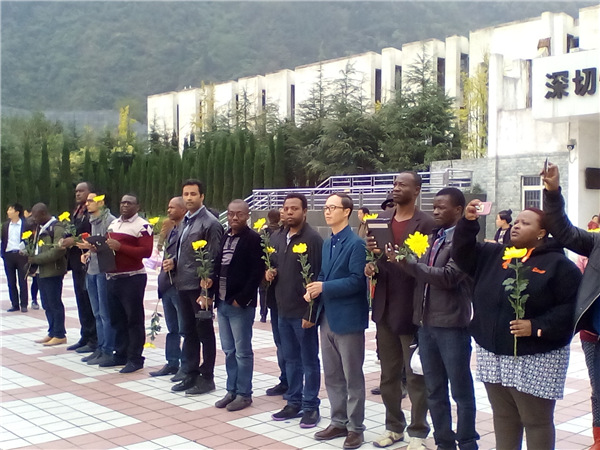
African journalists lay flowers at mausoleum for quake victims.[Photo provided for people.cn]
 |
 Fire brigade in Shanghai holds group wedding
 Tourists enjoy ice sculptures in Datan Town, north China
 Sunset scenery of Dayan Pagoda in Xi'an
 Tourists have fun at scenic spot in Nanlong Town, NW China
 Harbin attracts tourists by making best use of ice in winter
 In pics: FIS Alpine Ski Women's World Cup Slalom
 Black-necked cranes rest at reservoir in Lhunzhub County, Lhasa
 China's FAST telescope will be available to foreign scientists in April
 "She power" plays indispensable role in poverty alleviation
 Top 10 world news events of People's Daily in 2020
 Top 10 China news events of People's Daily in 2020
 Top 10 media buzzwords of 2020
 Year-ender:10 major tourism stories of 2020
 No interference in Venezuelan issues
 Biz prepares for trade spat
 Broadcasting Continent
 Australia wins Chinese CEOs as US loses