
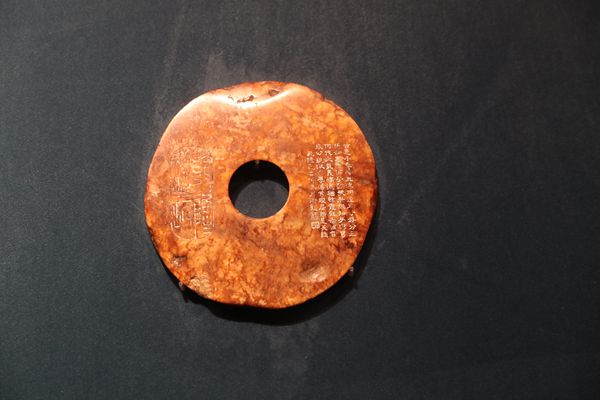
A jade bi article inscribed with a handwritten poem by Emperor Qianlong.[Jiang Dong/China Daily]
Abundant legacies
The reasons why the Liangzhu state faded into obscurity are still unknown. Although speculation suggests that flooding might have played a part, Li Boqian, an archaeology professor at Peking University, thinks that the jade itself might have been one reason for its downfall.
"So much wealth and so many resources were put into jade production," he says. "Once they were exhausted, the stability of society (could have) collapsed."
Nevertheless, Gao adds that Liangzhu Culture did not "die".
"We would rather describe it as having blended into other cultures," he says.
Gao explains that jade from the Liangzhu Culture was once widely found across half of what is now modern-day China, reaching as far as Shaanxi, Sichuan and Guangdong provinces, as archaeological discoveries demonstrate.
"We still need further research to say whether it spread due to trade or as simply as trophies of war," he says. "However, their popularity reflects the huge influence that Liangzhu Culture had at that time.
"Jade is the main contribution made by Liangzhu Culture on Chinese civilization," Gao says. "Its legacy lasted throughout Chinese history until the Qing Dynasty."
 |  |

 Award-winning photos show poverty reduction achievements in NE China's Jilin province
 People dance to greet advent of New Year in Ameiqituo Town, Guizhou
 Fire brigade in Shanghai holds group wedding
 Tourists enjoy ice sculptures in Datan Town, north China
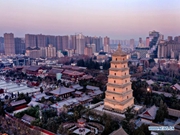 Sunset scenery of Dayan Pagoda in Xi'an
 Tourists have fun at scenic spot in Nanlong Town, NW China
 Harbin attracts tourists by making best use of ice in winter
 In pics: FIS Alpine Ski Women's World Cup Slalom
 Black-necked cranes rest at reservoir in Lhunzhub County, Lhasa
 China's FAST telescope will be available to foreign scientists in April