



Hanging Temple endures as ancient architecture meets modern technology
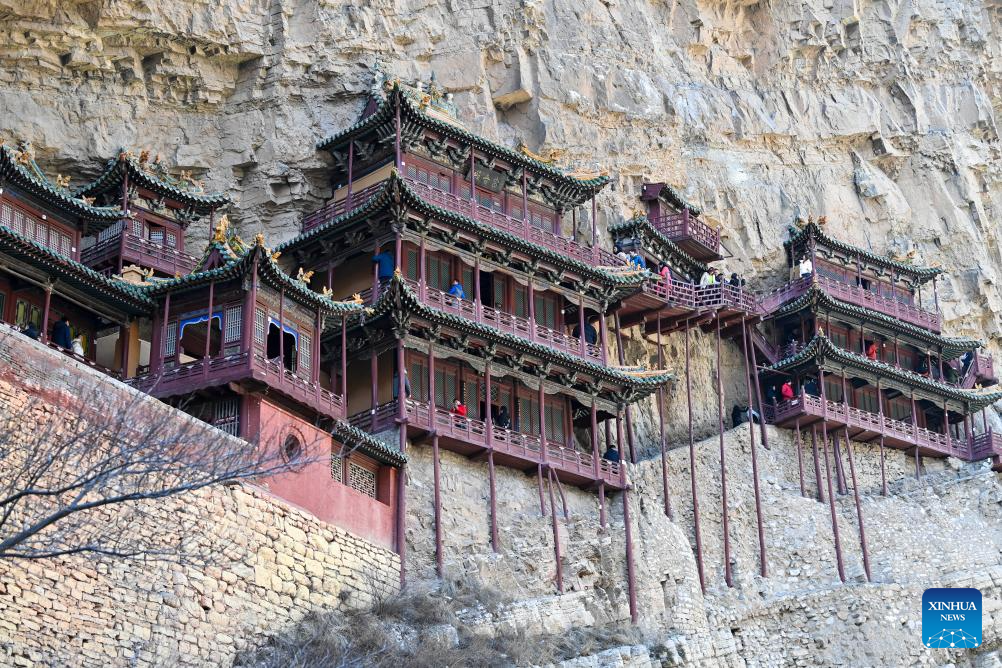
This photo taken on Feb. 28, 2025 shows the Hanging Temple, or Xuankong Temple, in Hunyuan county, Datong city in north China's Shanxi Province. (Xinhua/Yang Chenguang)
Perched halfway up a cliff in Jinlong Gorge of Hengshan Mountain in Hunyuan county, Datong, north China's Shanxi Province, the Hanging Temple, or Xuankong Temple, appears to float in midair, its red halls and tiered eaves tucked into a natural rock recess.
First built during the Northern Wei Dynasty (386-534), the temple is one of China's few structures to house Buddhist, Taoist and Confucian shrines. It has undergone restorations over the centuries and now has a history spanning more than 1,500 years. In 1982, it was named a key historical and cultural site under national-level protection.
Built entirely around the cliff's contours, its halls and plank walkways embody the traditional Chinese architectural principle of harmony between man and nature.
Up close, the walkways are barely wide enough for one person to pass, with a sheer drop just beyond the railings.
Yue Lifang, head of the temple's management office under the Hengshan Mountain Scenic Spot Management Center, has worked at the site since 1993 and still marvels at it.
She said the temple's "suspended" design reflects careful site selection, structural ingenuity and material choice: 27 tapered beams of rot-resistant hemlock, soaked in tung oil, are wedged two-thirds of the way into the limestone cliff and locked in place by wooden pegs. The slender columns that appear to hold up the halls are largely decorative rather than load-bearing. No nails or rivets were used — the structure relies entirely on interlocking mortise-and-tenon joints, reinforced by the cliff's natural shelter, allowing it to withstand centuries of weathering and several earthquakes.
Li Xiangkui, a cultural researcher at the Hengshan Mountain Scenic Spot Management Center, said the "suspended" design also reflects military, geographic, religious and disaster-prevention considerations: it offered protection from raids during a war-torn era, avoided a flood-prone valley below, and let an overhanging rock shelf shield the wooden halls from rain, wind and sun.
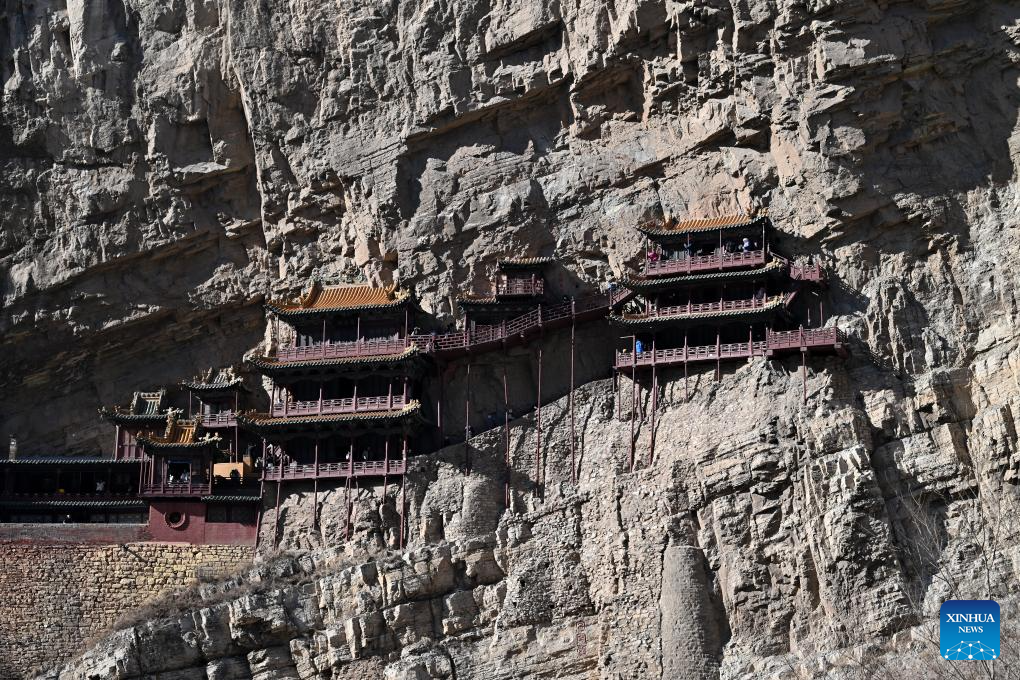
This photo taken on Feb. 28, 2025 shows the Hanging Temple, or Xuankong Temple, in Hunyuan county, Datong city in north China's Shanxi Province. (Xinhua/Yang Chenguang)
"That a handful of cantilever beams have carried this structure for over 1,000 years without decay is nothing short of a miracle," said Yang Yi, head of Hunyuan county's cultural relics protection and research center.
The ancient structure now faces modern strain, from peak-season crowds and nearby construction vibrations to weathering and earthquake risk in the Datong basin.
In April 2026, workers installed a distributed fiber-optic sensing system on the temple's key beams and columns.
The system is like implanting a "sensory nerve" in the ancient structure and fitting it with a "stethoscope" — without disturbing the building itself, it monitors in real time the minute stresses caused by earthquakes, industrial vibrations and foot traffic, providing a scientific basis for structural health risk warnings and visitor flow management, said Gao Xiao, deputy head of the temple's management office.
The temple has also installed a multifunctional infrared detector designed for ancient buildings, which uses AI-powered, high-definition visible-light imaging to detect fire risk. It tracks real-time temperature changes across the structure, catching smoldering fires before they can spread.
At night, the temple transforms into a canvas for a breathtaking light show, "Why Hanging Temple Endures," projected across more than 37,000 square meters of cliff face to reveal its construction process.
A mixed-reality experience allows visitors to don headsets to virtually soar above the temple's halls and view relics — including Tang Dynasty (618-907) statues and Ming Dynasty (1368-1644) clay sculptures — up close.
"Seeing it in person was even more astonishing than in documentaries — it's as delicate as a piece of art hanging off the cliff," said a tourist from north China's Hebei Province.
Photos




Related Stories
- Tianjin University team explores how ancient buildings withstand earthquakes
- Ancient architectural painting becomes thriving industry in north China's Shanxi
- Paper models preserve the soul of Qing architecture
- Chinese architect Liu Jiakun awarded 2025 Pritzker Architecture Prize
- 'Dougong Grandpa' devotes over 50 years to conservation of ancient Chinese buildings
- Chinese expertise helps restore damaged monument in Nepal
- British host explores the nine-century old Yingxian Wooden Pagoda, Luban Lock technique that made it possible
- 74-year-old 'Dougong Grandpa' popularizes ancient Chinese architecture through short videos
- Trending in China | Stilt houses: Diaojiaolou
- Architects collaborate with rural artisans to build, improve wooden architectures in SW China's Guizhou
Copyright © 2026 People's Daily Online. All Rights Reserved.
