



Tianjin University team explores how ancient buildings withstand earthquakes

A picture of the Guanyin Pavilion at the Dule Temple in Jizhou district, north China's Tianjin Municipality, drawn by Ma Ruishan.
The Guanyin Pavilion at the Dule Temple in Jizhou district, north China's Tianjin Municipality, continues to draw visitors eager to witness a marvel of ancient Chinese engineering. Originally built during the Tang Dynasty (618-907), the temple's main structures — the main gate and the Guanyin Pavilion — were reconstructed in 984. The pavilion ranks among China's oldest surviving multi-story wooden structures.
What makes it even more remarkable is that over the past millennium, the pavilion has survived more than 20 earthquakes.
"Ancient buildings are frozen moments in time, embodying the essence of traditional Chinese culture," said Ding Yao, head of the Architectural History and Heritage Conservation Research Team at Tianjin University.
For years, the team has been dedicated to protecting ancient architecture. Their work focuses on studying the seismic resistance of ancient buildings and exploring how to preserve these structures while keeping them accessible to the public.
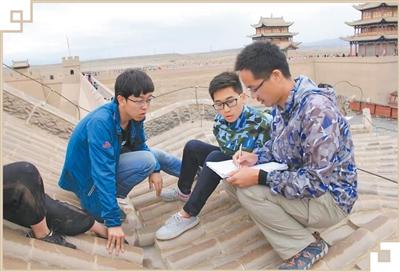
Students from Tianjin University's School of Architecture conduct a field survey of ancient buildings. (Photo courtesy of Tianjin University)
When the devastating 1976 Tangshan earthquake struck, the seven-story Guanyin Pavilion emerged virtually unscathed. But according to Ding, that was not even the pavilion's greatest test. Local records document a Qing Dynasty (1644-1911) earthquake that researchers now estimate may have reached magnitude 8.0.
Through on-site measurements and structural analysis, the research team discovered that the pavilion's overall design endows it with exceptional seismic resilience.
Zhang Fengwu, a team member and professor, explained that the pavilion conceals numerous diagonal braces within its walls, transforming unstable quadrilateral frames between columns into stable triangular structures. This reinforces the integrity and stability of the column network. The load-bearing columns are arranged not in a single row but as 18 outer columns and 10 inner columns, creating a double-layer grid resembling concentric squares. Beams, rafters and bracket sets connect these columns, preventing the tops and capitals from shifting.
These columns are not perfectly vertical either. They tilt slightly inward toward the building's center, a deliberate design that allows controlled movement without immediate collapse, better absorbing seismic shocks, according to Ding.
Other design features further strengthen the pavilion's seismic resistance. For example, wooden components joined through mortise-and-tenon joinery enhance the structure's stability. These components allow appropriate gaps and tolerance for deformation, creating natural "shock absorbers," Ding said. During earthquakes, slight movements between components generate friction that dissipates seismic energy, reducing the impact on the overall structure.
With modern technology, researchers can now precisely measure and analyze how ancient wooden structures resist earthquakes. In recent years, the team has incorporated 3D laser scanning, low-altitude remote sensing and other technologies into the surveying of ancient buildings.
"Modern technology allows us to better understand and verify ancient construction concepts, quantify the seismic performance of ancient wooden structures, and provide systematic technical support for preventive conservation," Zhang said.
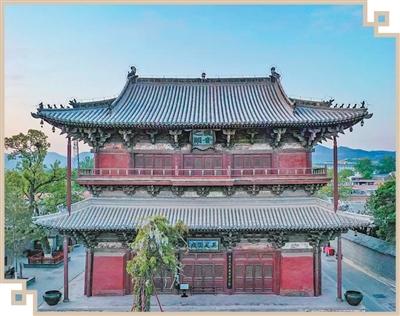
Photo shows the Guanyin Pavilion at the Dule Temple in Jizhou district, north China's Tianjin Municipality. (People's Daily/Wu Shaomin)
In recent years, the team has employed total stations, 3D laser scanning, photogrammetry, ground-penetrating radar and non-destructive testing equipment to conduct systematic investigations of numerous wooden structures from the Ming (1368-1644) and Qing dynasties. They have performed material, mechanical, and structural analyses to identify defects that threaten the building's safety, providing a basis for targeted conservation measures.
The team's interdisciplinary research has been applied to multiple conservation projects. For instance, their "Ming Great Wall Image and 3D Database" combines 3D modeling, AI recognition, and regular image comparison to help safeguard more than 8,800 kilometers of the ancient fortification.
Since 2007, the team has participated in restoration projects involving wooden structures, gradually developing complete workflows and a four-stage technical framework: detection, modeling, assessment and intervention.
"We need to understand not only the historical value of ancient buildings, but also apply modern scientific methods to decode how they work and implement precise monitoring and early warning systems," Ding said. "Only then can we truly achieve minimum intervention and maximum protection."
Photos



Related Stories
- Ancient architectural painting becomes thriving industry in north China's Shanxi
- Paper models preserve the soul of Qing architecture
- Chinese architect Liu Jiakun awarded 2025 Pritzker Architecture Prize
- 'Dougong Grandpa' devotes over 50 years to conservation of ancient Chinese buildings
- Chinese expertise helps restore damaged monument in Nepal
- British host explores the nine-century old Yingxian Wooden Pagoda, Luban Lock technique that made it possible
- 74-year-old 'Dougong Grandpa' popularizes ancient Chinese architecture through short videos
- Trending in China | Stilt houses: Diaojiaolou
- Architects collaborate with rural artisans to build, improve wooden architectures in SW China's Guizhou
- Art season launched to showcase Beijing's ancient architecture
Copyright © 2026 People's Daily Online. All Rights Reserved.
