



Wheat cultivated on saline-alkali fields grows into thriving industry in N China's Hebei
In midsummer, more than 2 million mu (about 133,333 hectares) of wheat on the saline-alkali land in eastern Cangzhou, north China's Hebei Province, has yielded a bumper harvest.
The roar of harvesters echoes over Xianzhuang village in Jiucheng town, Huanghua city, a county-level city administered by Cangzhou. Standing on the edge of a wheat field, villager Zhang Jie picks up a handful of freshly harvested grains.
"Look how plump these grains are!" Zhang said. In the past, his fields produced only around 100 kilograms per mu. This year, the yield is expected to triple.
This year, Huanghua has promoted high-quality varieties across the region. In the Xianzhuang area, standardized cultivation through cooperatives has lifted the average yield to 300 kilograms per mu, up more than 20 percent year on year.
At a drying yard in Houdiao village, Gaowan town, Haixing county, golden wheat grains blanket the ground. Seventy-year-old villager Xing Chengfu crouches at the edge of the yard, gathering scattered grains. In the past, the harvest from his few mu of poor-quality land could barely cover the yard. Today, after joining a cooperative, he still farms the same land, but the towering piles of grain have given him newfound confidence.
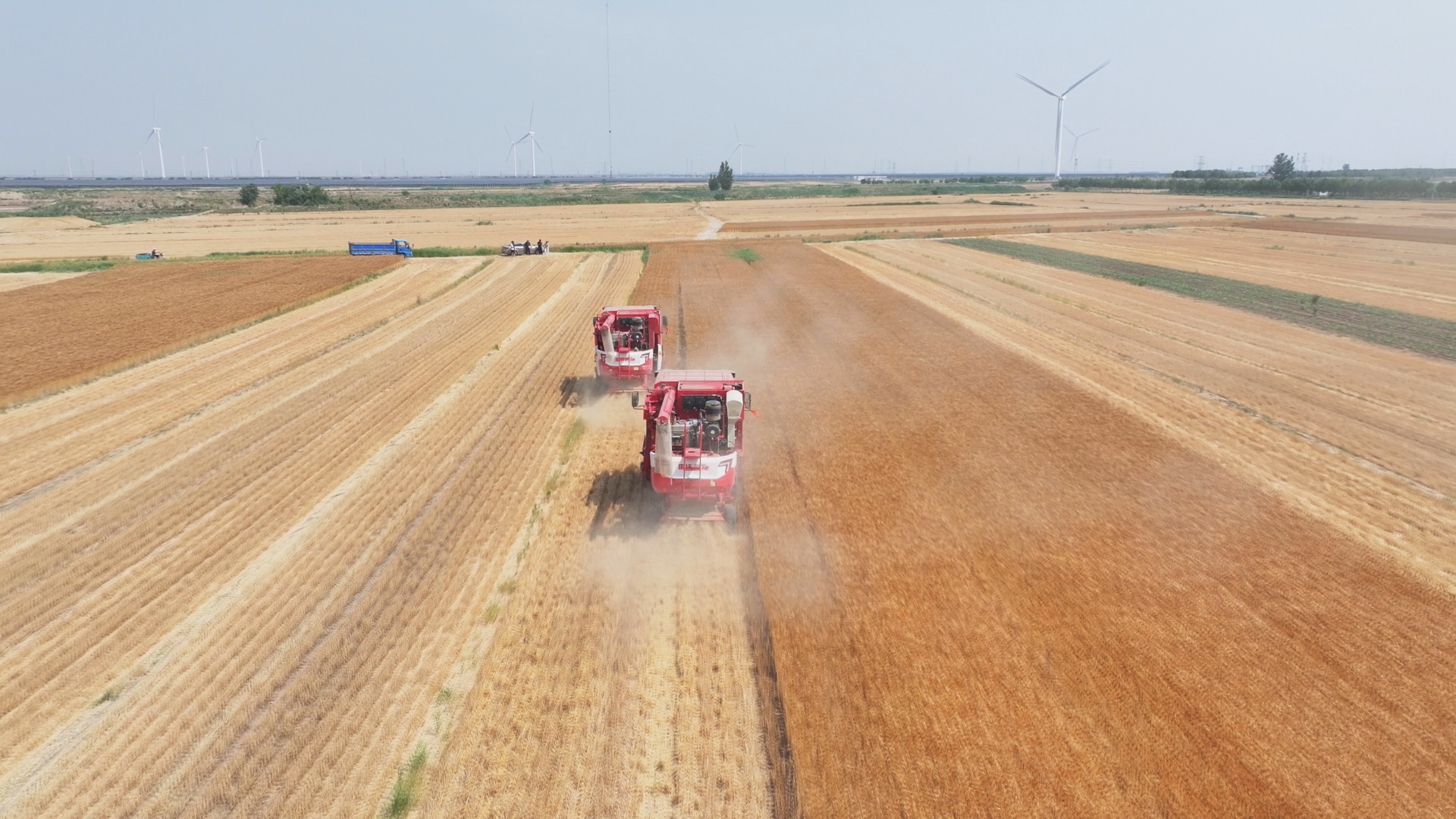
Harvesters reap wheat on saline-alkali fields in Houdiao village, Gaowan town, Haixing county, Cangzhou, north China's Hebei Province. (Photo/Liu Guobin)
In 2026, wheat grown on Cangzhou's saline-alkali fields yielded an average of 305.4 kilograms per mu, with total output reaching 628,600 tonnes. The average yield surpassed 300 kilograms per mu for the first time.
Behind the bumper harvest lies years of scientific research.
In July, only neat rows of wheat stubble remained in the experimental fields of the Cangzhou Academy of Agriculture and Forestry Sciences. Wang Weiwei, head of the academy's crop genetics and breeding institute, pulled a root sample of "Cangmai 33" from the soil. Its dense, long roots resembled a tightly clenched fist.
"This variety took 12 years to develop," Wang said. Those years involved selecting and comparing tens of thousands of plant materials and individual wheat ears each season. The effort paid off: "Cangmai 33" achieved a measured yield of 473.6 kilograms per mu.
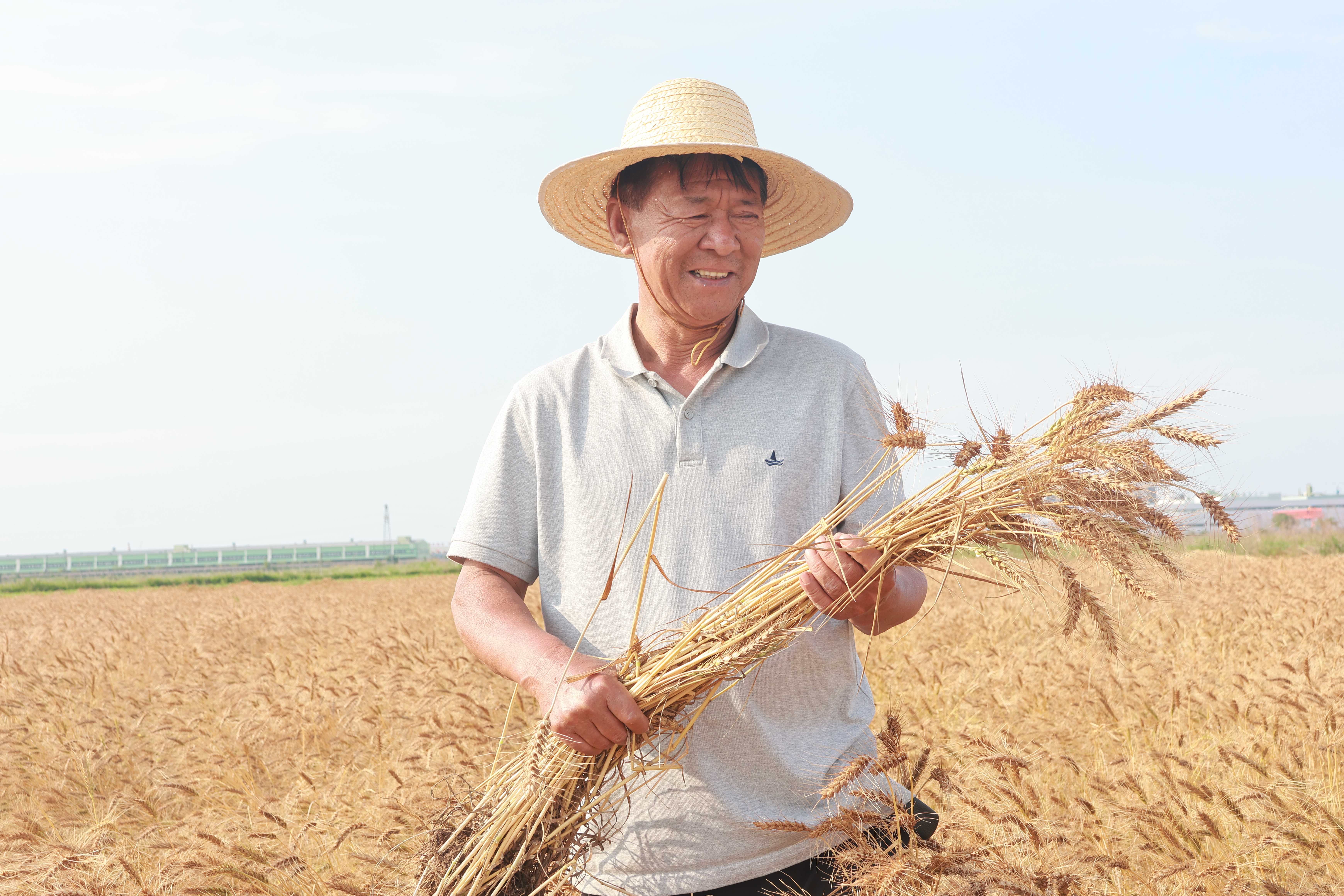
A farmer checks on the growth of wheat in Huanghua city, a county-level city administered by Cangzhou, north China's Hebei Province. (Photo/Ren Zhenyu)
Higher yields are only the first step. Turning quality wheat into high-value products is the key to further development.
At Dijian Food Co., Ltd., automated dough making equipment runs at full speed. After traditional hand processing, the dough is steamed into dough sculptures. In the past, the dough sculptures could only be stored for one or two days at room temperature. The company teamed up with the Institute of Food Science and Technology under the Chinese Academy of Agricultural Sciences to develop a low-microbial processing method, extending the shelf life to more than 15 days.
According to Fang Yan, head of the company's sales department, the company now offers a portfolio of more than 70 products made from wheat grown on saline-alkali land, ranging from traditional handmade pastries to noodles, grain-based staples, specialty snacks and festival gift boxes.
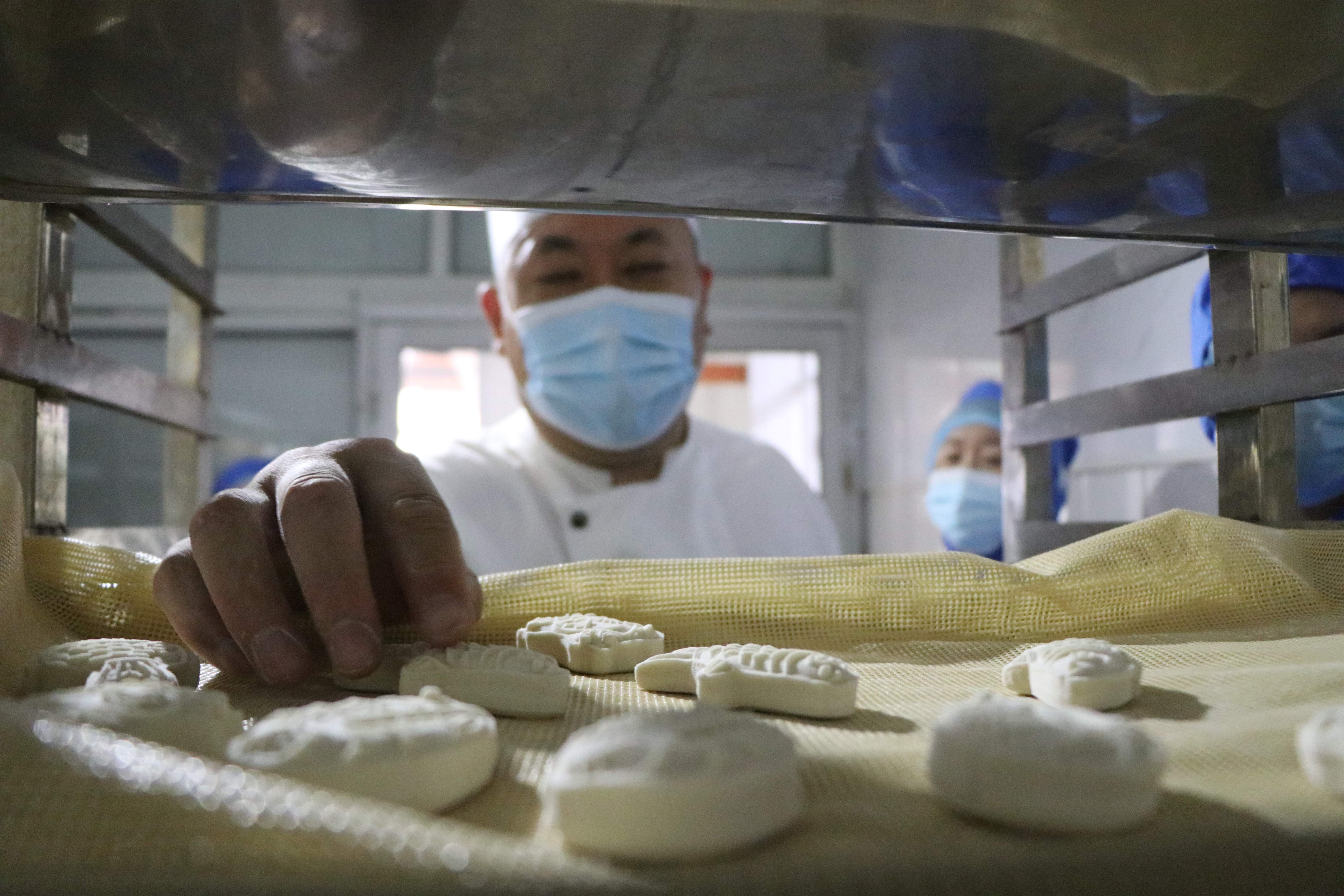
A worker checks the steaming process of dough sculptures at the production workshop of Dijian Food Co., Ltd. in Cangzhou, north China's Hebei Province. (Photo/Ren Zhenyu)
Photos

Related Stories
- Henan's wheat feeds a supply chain
- N China's Cangzhou turns saline-alkali land into productive wheat fields
- China ramps up summer wheat harvest with advanced machinery
- Chinese, British scientists retrieve lost wheat genetic diversity, empowering modern breeding
- Drone lighting helps wheat farmers in race against time in C China's Henan
- Golden wheat field in Henan waits to be harvested
- View of wheat fields in Shandong, E China
- Agricultural expert devotes more than 60 years of his life to developing new wheat varieties
- Lab-cultivated winter wheat harvested in Gansu
- Agricultural machines sow seeds of winter wheat in Xingtai, N China
Copyright © 2026 People's Daily Online. All Rights Reserved.
