



China's mangrove area expands to 31,700 hectares
China's mangrove area has reached 31,700 hectares, up 44 percent from the beginning of this century, according to the National Forestry and Grassland Administration.
China is now one of the few countries in the world to achieve continuous growth in mangrove coverage.
Mangroves are globally important coastal wetland ecosystems, playing an irreplaceable role in protecting shorelines, preserving biodiversity and strengthening resilience to climate change.
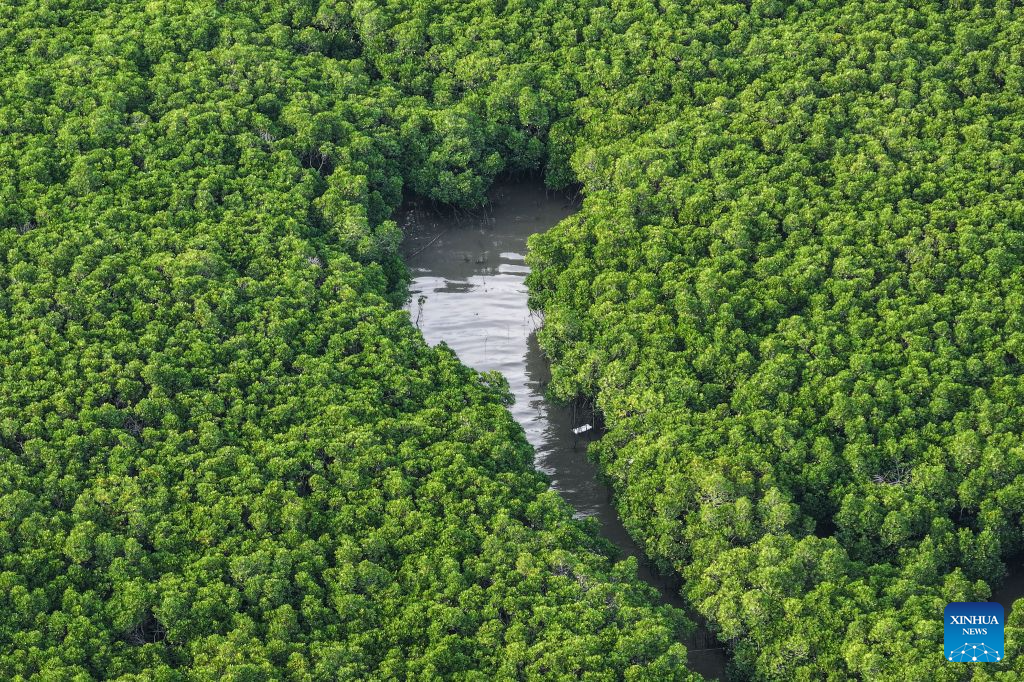
An aerial drone photo taken on July 24, 2026 shows a view of the Shankou Mangrove Nature Reserve in Hepu county of Beihai, south China's Guangxi Zhuang Autonomous Region. (Xinhua/Cao Yiming)
On July 26, the International Mangrove Center held its first council meeting and unveiling ceremony in Shenzhen, south China's Guangdong Province, marking its transition from a global initiative to a fully operational international organization—reflecting the Chinese government's practical role in advancing intergovernmental cooperation on mangrove protection worldwide.
China proposed the International Mangrove Center at the 14th Meeting of the Conference of the Contracting Parties to the Ramsar Convention on Wetlands (COP14) in 2022. The center now has eight member states and 13 signatory countries, covering major mangrove distribution areas across Asia, Africa and the Americas.
As the world's first intergovernmental organization dedicated to mangrove conservation and cooperation, the center aims to advance global collaboration on mangrove conservation, restoration and sustainable use, participate deeply in global ecological governance, and safeguard the planet's precious mangrove resources.
The Ramsar Convention secretariat praised China's role in establishing the center. Chinese representatives said the government would work with member states on joint research, training and demonstration projects to help countries improve mangrove management, while jointly contributing to global biodiversity conservation, climate change response and the achievement of sustainable development goals.
Since the implementation of China's Special Action Plan for the Conservation and Restoration of Mangrove Forests (2020-2025) launched in 2020, the country has planted about 11,600 hectares of new mangroves. Over 90 percent of China's mangroves are now protected under the country's ecological protection red line, a zoning mechanism that restricts development in ecologically sensitive areas.
At the same time, China's legal and standards framework for mangrove protection continues to improve.
The Ministry of Natural Resources and the National Forestry and Grassland Administration plan to issue a special action plan for mangrove protection (2026-2030), providing guidance for local governments on mangrove protection and restoration while promoting both the high-level protection and high-quality development of mangroves.
Relevant regions are adapting their approaches to local conditions and continuously reinforcing their mangrove protection efforts.
Guangdong Province, home to nearly 40 percent of China's mangroves at about 11,600 hectares, has placed 93 percent of them under the ecological protection red line.
To strengthen mangrove protection, the province has refined its provincial and municipal legal and planning framework, added a dedicated chapter for mangrove protection to its provincial wetland regulations, and enacted supporting legislation in Zhanjiang and Zhuhai cities, with all 14 coastal cities now covered by protection plans.
In south China's Guangxi Zhuang Autonomous Region, mangrove conservation has combined restoration efforts with scientific research and improved management. By the end of the 14th Five-Year Plan period (2021-2025), Guangxi's mangrove area had reached 10,800 hectares, exceeding its target of surpassing 10,000 hectares by 8 percent and increasing 47.95 percent from the end of the 12th Five-Year Plan period (2011-2015).
Since 2019, Guangxi's forestry research teams have worked to establish a mangrove germplasm resource bank. The facility now preserves 17 mangrove species, including 124 provenances and 617 germplasm samples, providing support for future restoration and conservation efforts.
The region has also strengthened protection through a comprehensive management system. It has appointed "mangrove forest chiefs," established mangrove resource protection stations at the township level, deployed dedicated patrol officers, and created a coordination mechanism involving forest chiefs, police chiefs and procuratorate officials. Using satellite remote sensing, drone patrols and ground-based video monitoring, Guangxi has built a network for regular inspections, dynamic monitoring and early warning.
Photos
Related Stories
- Thriving mangrove forests bring life to urban landscapes in Quanzhou, SE China
- Mangrove revival brings economic gains in SE China's Fujian
- Hainan's mangrove wetland park becomes home for waterfowl through ecological restoration
- China expands mangrove forest coverage amid conservation efforts
- China establishes global mangrove center in Shenzhen
- China's mangrove forests expand in coverage: minister
- In pics: mangrove forest in Zhanjiang City, S China's Guangdong
- Pic story: conservator at Shankou Mangrove Nature Reserve in Hepu County, S China
- More than half of China's mangroves effectively protected: official
- China achieves notable results in mangrove forest protection and restoration
Copyright © 2026 People's Daily Online. All Rights Reserved.
