



Clued-in | NATO's Ankara summit masked deep divisions beneath show of unity
The NATO leaders' summit, held July 7 to 8 in Ankara, capital of Türkiye, was a show of unity masking deep divisions.
Upon arriving in Ankara, U.S. President Donald Trump told the media that he was "very disappointed with NATO."
"If it weren't held in Türkiye ... it's possible that I wouldn't have attended," Trump said.
The reason is simple: Since the start of Trump's second term, U.S. relations with its allies have repeatedly come under strain over defense spending, his bid to buy Greenland, escort missions in the Strait of Hormuz and the withdrawal of U.S. troops from Europe.
During the summit, NATO's official website featured a group photo of NATO leaders on its homepage. The image captured a moment at the Ankara summit that reflected the alliance's deep divisions.
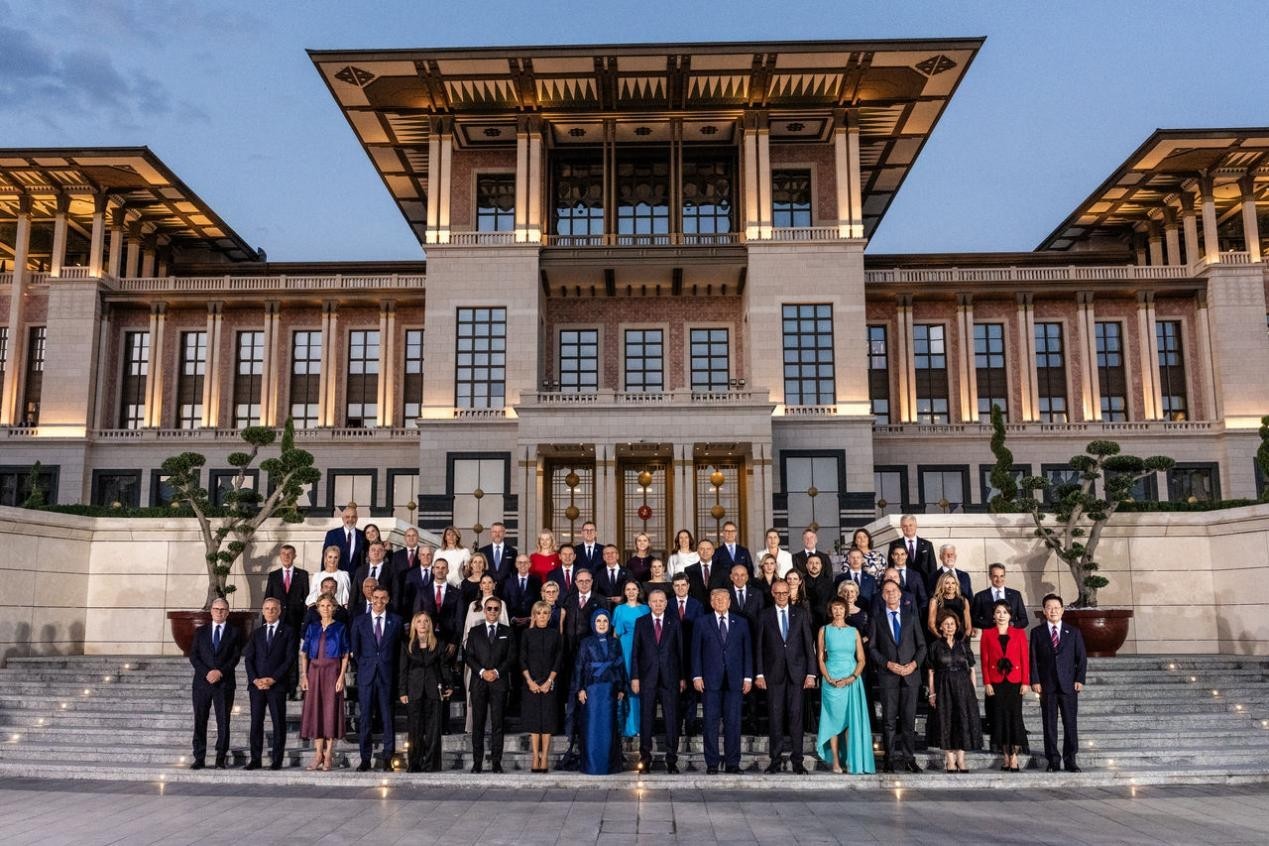
(Photo/NATO official website)
Most participants were dressed in dark formal suits, standing upright with restrained and grave expressions. Turkish President Recep Tayyip Erdogan looked solemn, and Trump appeared ill at ease, while NATO Secretary-General Mark Rutte wore a professional smile.
For some time, Rutte has sought to project the message that "a stronger Europe means a stronger NATO." He has promoted the concept of "NATO 3.0" to encourage Europe to increase defense investment, expand military-industrial capacity and maintain institutionalized support for Ukraine.
The figures appear impressive. In 2025, defense spending among all NATO members surpassed 2 percent of GDP. Poland, Estonia, Latvia and Lithuania had already exceeded 3.5 percent, while Germany's 2026 defense budget topped $120 billion, with plans to raise the figure to 5 percent by 2029. Yet the numbers cannot conceal the divisions.
NATO faces at least four major fault lines.
First, member countries are taking different paths toward meeting defense spending targets. In 2026, the Czech Republic, Hungary and Slovenia could fall back below the 2 percent of GDP threshold, while Spain, Italy and the United Kingdom lack clear long-term roadmaps for meeting the target.
Second, the troop gaps on NATO's eastern flank and Trump's bid to acquire Greenland have highlighted differences between Europe and the U.S. With Trump cutting the U.S. troop presence in Europe, European countries are expected to fill the gap on the eastern flank. Meanwhile, Trump reiterated his claim over Greenland at the Ankara summit.
Third, divisions have emerged over the mechanism for supporting Ukraine. The current arrangement of "Europe providing the funds and the U.S. providing the weapons" was designed in part to preempt Trump's criticism. Yet even under this arrangement, aid to Ukraine has been affected by the conflict involving the U.S., Israel and Iran.
Fourth, NATO's efforts to expand military-industrial capacity face challenges over benefit sharing. Although the summit announced contracts worth over $100 billion, the role of U.S. companies remains unclear.
An even greater uncertainty lies within the U.S. itself.
Trump has called NATO a "bad deal," expressed frustration over opposition to his proposal to acquire Greenland, criticized Europe's refusal to provide escort missions in the Strait of Hormuz, announced cuts to U.S. troop deployments in Europe and even suggested that Washington could consider withdrawing from NATO.
To prevent Trump from undermining "U.S. leadership in NATO," the U.S. Congress has had to establish clear limits through legislation. As early as 2023, Congress enacted the National Defense Authorization Act (2024 NDAA), which provides that the president "shall not suspend, terminate, denounce, or withdraw the U.S. from the North Atlantic Treaty" without the advice and consent of the Senate, with two-thirds of senators present concurring, or pursuant to an act of Congress.
The 2026 NDAA further requires that the number of U.S. troops stationed or deployed to Europe must not fall below 76,000 for more than 45 consecutive days.
All these intense disputes share a deeper systemic cause: NATO, as a collective security alliance, is losing the collective commitment that has underpinned it.
The premise of collective security is that members come to each other's aid. The reality in 2026 is that both sides of the Atlantic need each other, yet neither side is answering the other's calls.
The prolonged Ukraine crisis has prompted Europe to consider "a NATO without the U.S.," while the conflict involving the U.S., Israel and Iran has led Washington to contemplate "a NATO without Europe."
These two irreconcilable unilateral expectations turned the Ankara summit into an institutionalized performance of unity in form but division in substance.
The 32 national flags, contracts worth more than $100 billion and the timeline for reaching the 5 percent target give the appearance of unity on the surface, but the lack of mutual responsiveness between the U.S. and Europe reveals a structural dilemma facing collective security.
The credibility of collective security does not lie in whether all leaders attend a summit, but in whether one side's concerns become the concerns of the other.
What the NATO Ankara summit revealed was precisely a moment of maximum internal tension and minimal shared understanding, a centrifugal moment for the alliance.
The author is a researcher at the Institute of American Studies, Chinese Academy of Social Sciences.

Photos




Related Stories
- NATO needs stop finding fault with China at every turn: spokesperson
- Growing rift
- Mounting strain
- China urges NATO to do serious soul-searching on its role in world peace, stability
- China urges NATO to do serious soul-searching on its role in world peace, stability
- U.S. to "rightsize" NATO force contributions
- U.S. troop drawdown will not affect NATO defense plans, commander says
- Trump slams NATO again for being unhelpful for U.S.
- Danish veterans hold silent march against Trump's remarks on NATO soldiers
- Italian, Norwegian PMs slam Trump's remarks on NATO role in Afghanistan
Copyright © 2026 People's Daily Online. All Rights Reserved.
