



Domestic bike brands gain stronger foothold in global markets
China's bicycle industry produced over 110 million units and exported nearly 49 million in 2025. Cutting-edge technologies are transforming the industry, which has moved from following global trends to leading them through technological innovation and brand upgrading.
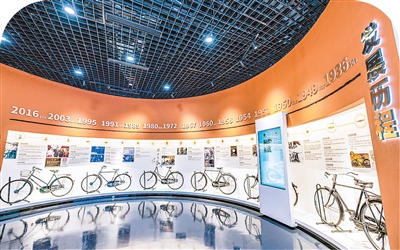
Bicycles on display in the exhibition hall of Tianjin Flying Pigeon Cycle Manufacture Co., Ltd. in Xiqing district, north China's Tianjin Municipality. (People's Daily Overseas Edition/Li Jiading)
Stepping into the exhibition hall of Tianjin Flying Pigeon Cycle Manufacture Co., Ltd. in north China's Tianjin Municipality feels like entering a living chronicle of China's bicycle industry.
In 1950, the factory launched a campaign to build durable, reliable, beautiful and lightweight bicycles.
In the early trials, the bicycles were heavy and difficult to ride due to high resistance.
"After repeated study, we found the problem lay in the rear hub," recalled Sha Yunshu, former general manager of Tianjin Flying Pigeon Cycle Manufacture Co., Ltd. The workers later improved machining precision and reduced the pressure angle, lowering resistance and making the ride smoother.
After decades of development, Flying Pigeon bicycles entered households across China. In the 1980s, Tianjin's bicycle industry maintained steady growth momentum, generating over 6 billion yuan ($888 million) in cumulative profits and taxes. In 1989, Flying Pigeon reached an annual output of 3.68 million units, accounting for one-tenth of China's total bicycle production.
Today, the brand offers more than 2,000 models, ranging from professional racing road bikes and recreational mountain bikes to commuter and children's bicycles.
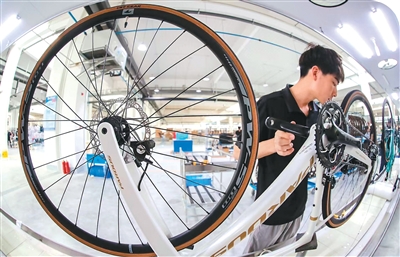
A worker conducts assembly and inspection on the carbon fiber bicycle assembly line of Pardus, a domestic sports bicycle brand, in Laoling city, a county-level city in Dezhou, east China's Shandong Province. (Photo/Jia Peng)
At the workshop of Pardus, a domestic sports bicycle brand in Laoling city, a county-level city in Dezhou, east China's Shandong Province, bicycle frames undergo vibration fatigue testing from early in the morning.
Founded in 2010, the company is a wholly owned subsidiary of Taishan Sports. The lightest carbon fiber frame it produces weighs just 680 grams, and a complete bicycle weighs under 6 kilograms. Prices range from 10,000 to 40,000 yuan for consumer models, and 100,000 to 200,000 yuan for competitive racing bikes.
Innovation was difficult from the outset. At the time of its founding, China's high-end carbon fiber bicycle sector was virtually nonexistent. Materials, processes and standards were all controlled by foreign companies, and high-end carbon fiber technology faced strict restrictions.
In 2015, more than 800 bicycles that the company shipped overseas developed severe paint blistering during sea transport due to prolonged exposure to high temperature and humidity. Customer complaints mounted, putting both reputation and orders at risk.
During that period, Wang Chunqing, general manager of the company, struggled with sleepless nights.
To address these issues, the R&D team moved into the workshop. They monitored every detail of coating, curing and drying, repeatedly adjusting formulas, processes and parameters.
After two months and thousands of tests, they identified the root cause of the coating failure and developed a stable painting process suitable for long-distance maritime transport, achieving fully independent and controllable production technology.
At the 2016 Rio Olympics, Pardus became the first Chinese bicycle brand to appear at the Olympic Games, breaking a century-long Western monopoly. It has since provided equipment for national training teams at the Tokyo and Paris Olympics.
To date, Pardus produces 200,000 carbon fiber bicycles annually, accounting for one-third of China's civilian high-end market.
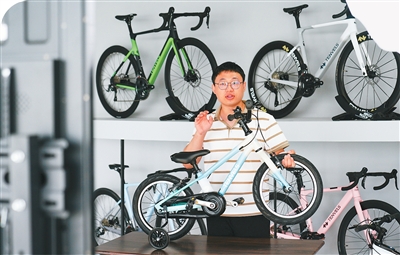
A streamer introduces bicycles to overseas audiences at a shared livestreaming studio in Xingtai Economic Development Zone in Xingtai, north China's Hebei Province. (Photo/Chen Lei)
Recently, at a shared livestreaming studio in Xingtai Economic Development Zone in Xingtai, north China's Hebei Province, host Ren Shuaikun was promoting bicycles from Xingtai to overseas buyers on international e-commerce platforms in fluent English.
Meanwhile, at Hebei Jieming Import and Export Co., Ltd. in Pingxiang county, a foreign buyer had just signed a new order.
Xingtai is a well-known bicycle manufacturing hub in China. The industry originated in the 1970s and is mainly concentrated in Pingxiang and Guangzong counties, extending across surrounding areas.
Today, it has formed a complete industrial chain from components to complete bicycles, with more than 4,500 manufacturing enterprises. Its products are exported to over 100 countries and regions, including Europe, the Middle East and Southeast Asia.
Hebei Xingzheng Vehicle Industry Co., Ltd., a medium-sized enterprise in Pingxiang, exports around 100,000 mountain bikes and road bikes annually to South America. Its general manager, Zheng Xing, said the company mainly secures orders through trading companies and exhibitions. To meet overseas demand, it develops eight to 10 new models every year.
In April this year, the 21st edition of the annual China North (Pingxiang) International Bicycle, Baby Strollers and Toys Fair was held in Pingxiang, attracting more than 1,600 exhibitors and numerous domestic and international buyers. Since its launch in 2014, the expo has continued to expand in scale and international influence.
Photos



Related Stories
- 2026 China Int'l Bicycle Fair held in Shanghai
- China's bicycle ownership on the rise as low-carbon travel takes off
- International cyclists race through Shenzhen in 2024 XDS Cup
- China's bicycle exports expand in Q1
- China has over 350 mln electric bicycles
- 32nd China Int'l Bicycle Fair kicks off in Shanghai
- How children's bikes cross the globe
- Chinese bicycle brand introduces a number of electric models
- China has 200 million bicycles in use: industry association
- China races ahead with smart-bike exports
Copyright © 2026 People's Daily Online. All Rights Reserved.
