



'Seafood' grown in Xinjiang's desert hits local dinner tables
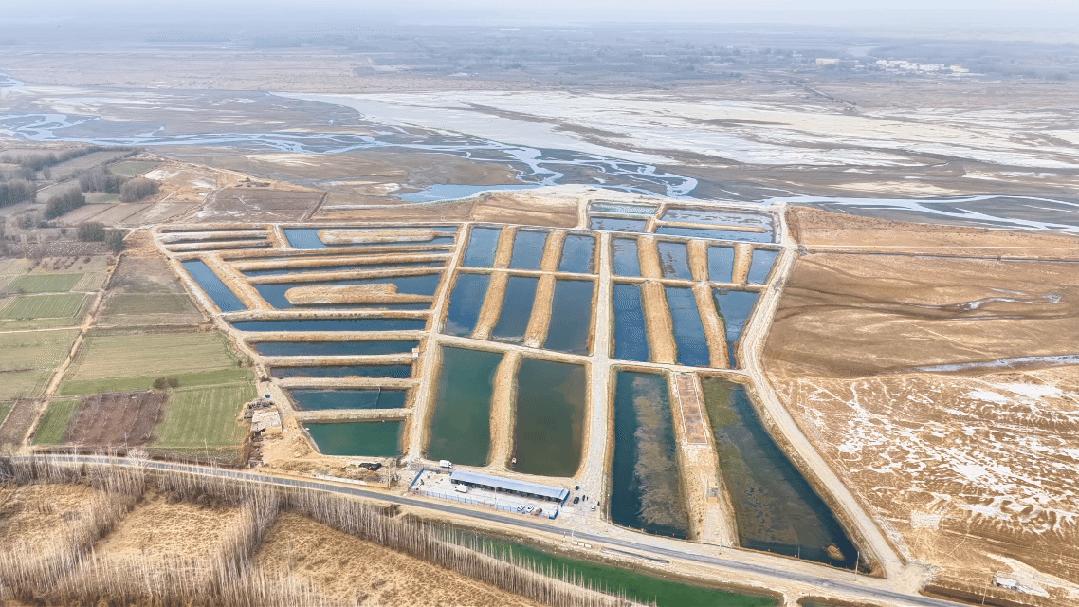
Photo shows an aquaculture base in Yenieryk township, Hetian county, Hetian prefecture, northwest China's Xinjiang Uygur autonomous region. (Photo courtesy of the media center of Hetian county)
Inside a greenhouse, farm workers lift up shrimp shelters from the water, uncovering plump Australian freshwater spiny lobsters scurrying beneath the surface. In nearby holding ponds, Chinese mitten crabs crawl through the water, while bubbles constantly rise to the surface.
This scene takes place not on the coast, but on the southern edge of the Taklimakan Desert, in Hetian county of Hetian prefecture, northwest China's Xinjiang Uygur autonomous region.
"Starting in 2024, we built an aquaculture base covering nearly 67 hectares on saline-alkali desert land, raising species including Chinese mitten crab, whiteleg shrimp, Australian "freshwater lobster," and common perch, mainly to supply local markets," said Wang Hui, head of the aquatic farming base in Tolganj village, Yenieryk township, Hetian county.
"Previously, most aquatic products had to be transported by air from coastal provinces. Now these local products are 15 to 20 percent cheaper, making a wider variety of products available on local people's dining tables," Wang added.
The transformation of desert land into an aquaculture base represents a win-win outcome in both ecological restoration and economic development.
Located south of the Kunlun Mountains, Hetian benefits from rivers fed by melting snow and ice from high mountains, providing a natural water source for aquaculture. To the north, however, the region extends deep into the Taklimakan Desert, with deserts and Gobi areas accounting for 63 percent of its total land area. The natually saline desert soil creates favorable conditions for mitten crab, while abundant sunlight helps promote crab molting.
Nevertheless, creating an environment suitable for a wide range of aquatic species required overcoming the challenge of managing saline-alkali land. Local farmers have improved aquaculture ponds by planting aquatic plants and adding microorganisms and freshwater to reduce salinity and alkalinity. As a result, the pH level of the water has been lowered to between 7.5 and 8.5, an ideal range for fish and shrimp growth.
During periods of abundant water supply, river water from the nearby Yurungkax River is diverted into the ponds. In daily operations, farmers add water rather than replacing it entirely, while aquatic plants and microorganisms help purify the water through natural cycles, creating a balanced ecological system.
To identify species best suited for farming in saline-alkali desert areas, the aquaculture base introduced crablets from Jiangsu, Anhui, Guangdong, and other regions. Through continuous breeding trials and selection, farmers developed crab varieties with stronger tolerance to saline-alkali conditions.
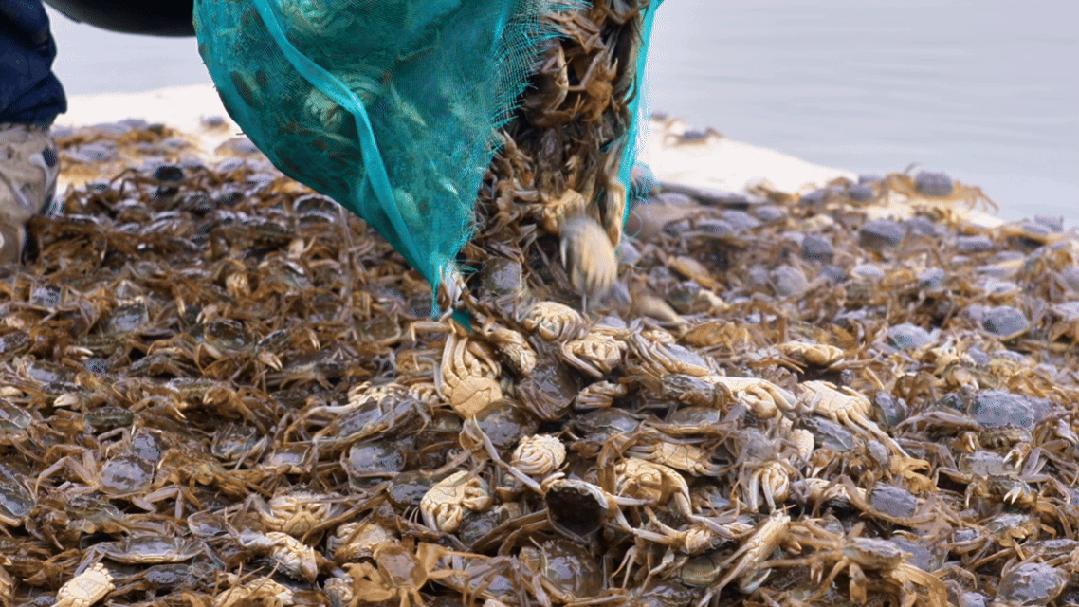
Crablets are released into a pond. (Photo courtesy of the media center of Hetian county)
Trial farming of the selected varieties began in April 2024. A yield of 18 tons of crabs generated nearly 2 million yuan ($147,574) in output value.
"During peak selling season, we average orders for around 200 kilograms of crabs every day on average, and demand often exceeds supply," Wang said.
At another aquaculture base in Chamguluq village, also in Yenieryk township, a different scene is unfolding. Inside the facility, modern aquaculture systems operate efficiently as perch, snakehead fish, and other freshwater species swim in the tanks. In the control room, staff closely monitor water quality indicators, including temperature, pH level, total alkalinity, and total hardness.
"The indoor aquaculture base has built 56 farming tanks and supporting facilities, forming eight complete aquaculture systems. We currently raise about 8 tons of fish, which will soon be released to the market in batches," said the person in charge of the base.
The facility has also established greenhouses for crop cultivation, making full use of organic matter from fish waste to provide nutrients for flowers such as roses, creating a model of integrated ecological farming.
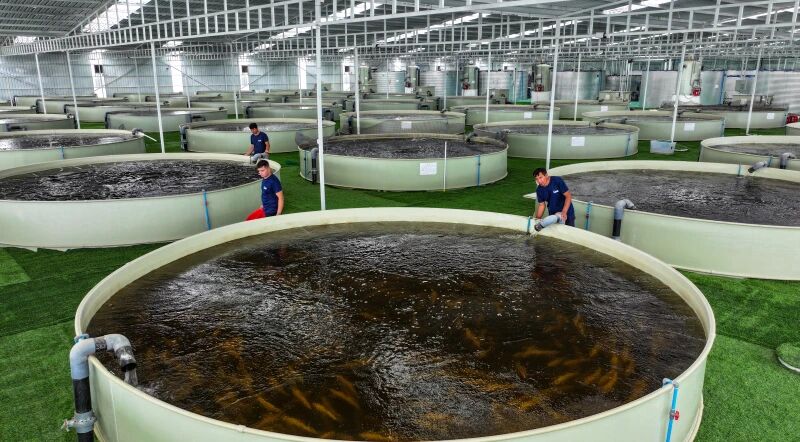
Photo shows an aquaculture base managed by a local aquaculture company in Hetian prefecture, northwest China's Xinjiang Uygur autonomous region. (Photo/Xu Xiaolong)
To further develop the industry, local governments have partnered with universities to establish an aquaculture research institute, which provides support in areas including breeding, technological upgrading, and green development. They have also launched the regional public brand "Kunlun Jade Crab" to enhance product competitiveness and brand recognition. In 2025, the total output value of fisheries in Hetian county increased by 141.2 percent year on year.
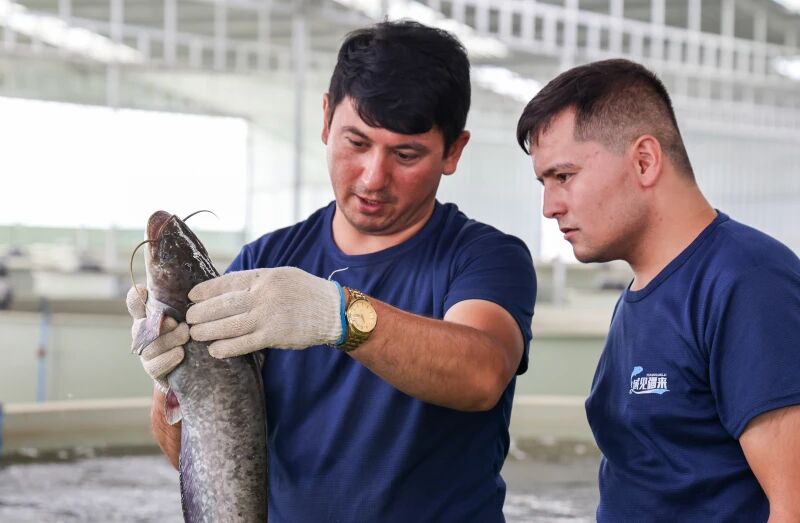
Workers of a local aquaculture company in Hetian prefecture, northwest China's Xinjiang Uygur autonomous region, check the growth of fish. (Photo/Xu Xiaolong)
Photos


Related Stories
- NW China's Xinjiang offers fresh seafood from the heart of desert
- First batch of Norwegian live snow crabs arrives in China, injecting new impetus into bilateral trade
- National competition for seafood cooking skills held in South China's Guangxi
- Trending in China | Sea urchins: a delicious ocean treasure
- Inland seafood farming thrives in Zhangye, NW China's Gansu Province
- 2024 China (Fuzhou) Int'l Seafood &Fisheries Expo kicks off in Fujian
- Feature: Chinese firms eager to showcase new products at Spain seafood fair
- Industry insiders upbeat about seafood trade between U.S., China despite multiple uncertainties
- Seafood trade flourishes in lively border city
- Scientist voices concerns as New Zealand continues to import seafood from Japan
Copyright © 2026 People's Daily Online. All Rights Reserved.
