



A green promise across the ocean kept for 27 years
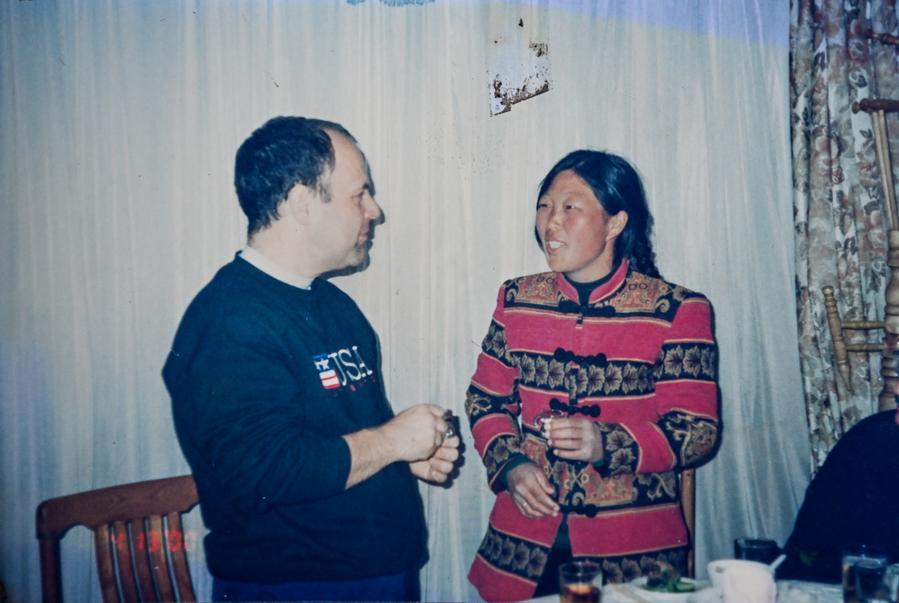
This file photo taken in 2000 shows Yin Yuzhen (R) and Ronald Sakolsky meeting in Uxin Banner, north China's Inner Mongolia Autonomous Region. (Xinhua)
ZHENGZHOU, May 22 (Xinhua) -- Standing on the vast expanse that was nothing but sandy wasteland decades ago, 60-year-old Yin Yuzhen gestured toward the dense woods behind her and said to the camera, "Mr. Sakolsky, if you ever get to see this video, I would like to invite you to China to see this forest planted with the 5,000 U.S. dollars you donated."
The clip, filmed on the edge of Maowusu, the fourth-largest sandy area in China, quickly went viral on social media, revealing a touching tale of a cross-border promise that had been made as long ago as 1999.
In that year, Ronald Sakolsky from the United States arrived in Luoyang, central China's Henan Province, as an exchange program teacher. It was during his time there that he caught sight of Yin Yuzhen in a televised news segment. "I would rather die planting trees than be hounded out of my home by sand," the slender Chinese woman declared on screen, her unyielding resolve against desertification striking a deep chord with Sakolsky.
Sakolsky decided to help her.
Bai Fan, General Principal of Luoyang No.2 Foreign Language School Education Group, remembered the American, who once worked in his school, saying "all human beings share but one earth, which is our common homeland."
Beginning in October 1999, Sakolsky sent emails to multiple institutions across the U.S. in the hope of soliciting donations, before he eventually raised 5,000 U.S. dollars.
That year, the annual per capita disposable income of urban residents in China stood at 5,854 yuan (about 860 U.S. dollars). For Yin, the 5,000 U.S. dollars was a staggering amount, enough to build a house, cover her children's upbringing cost and even completely change the trajectory of her family's life.
"I pulled a stack of unfamiliar foreign banknotes out of the envelope," she recalled. "It was not until I went to exchange them for RMB that I realized just how large the donation was!" Surprised, she made her decision: to keep only one single banknote as a souvenir and invest all the remaining in purchasing saplings.
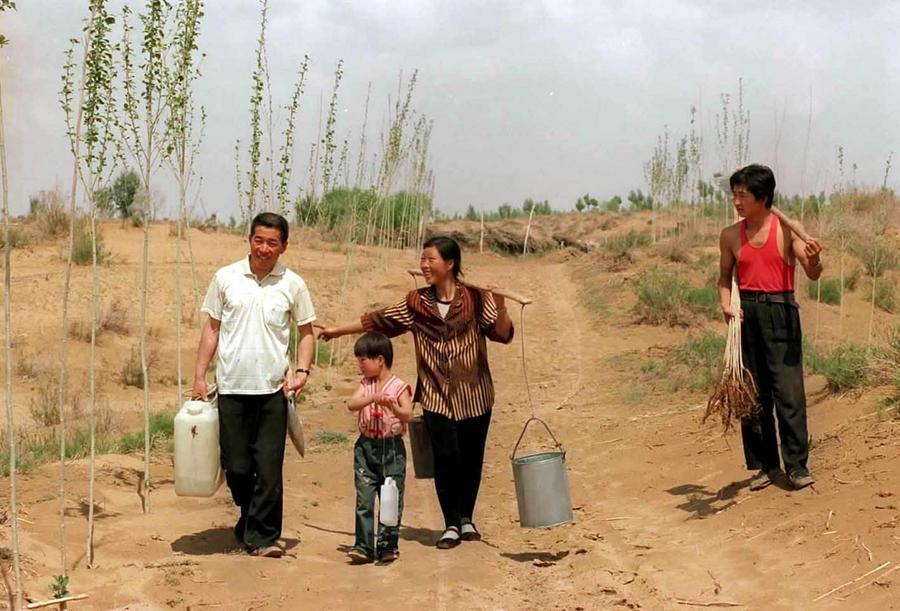
This file photo taken in 2000 shows Yin Yuzhen and her family walking on their way to plant and water trees in north China's Inner Mongolia Autonomous Region. (Xinhua/Li Xin)
In the spring of 2000, Sakolsky visited Yin in the Jingbeitang Village of Ordos, north China's Inner Mongolia Autonomous Region. It was the 14th year of the woman's afforestation efforts.
When 19-year-old Yin Yuzhen married into the sand-blighted local village from neighboring Shaanxi Province in 1985, the couple's wedding home was a crude cellar half-buried in dunes. Overnight, drifting sand would pile so high against the entrance that they could barely open the door.
She used shovels and shoulder poles instead of heavy machinery, and she tied the seedlings with hemp ropes and carried bunches of them on her back. She persevered even though only ten seedlings out of 600 made it through the first planting.
The wind kept blowing and she kept planting.
When Sakolsky visited her reforestation site, he gazed at the boundless dunes dotted with tender young saplings and told her earnestly: "You are incredible." As a token of gratitude, Yin sewed a pair of hand-embroidered cloth insoles and pressed them into his hands the next day.
After the American left, Yin erected a small brick monument at the edge of the growing forest, with the name Sakolsky inscribed on it. "This monument stands for a promise. As these saplings grow, I will never let him down," she said.
Over the past 27 years, more than 50,000 of the saplings have grown into towering trees, and the swathe of green has expanded to cover over 70,000 mu (roughly 4,666.7 hectares) of once-barren land.
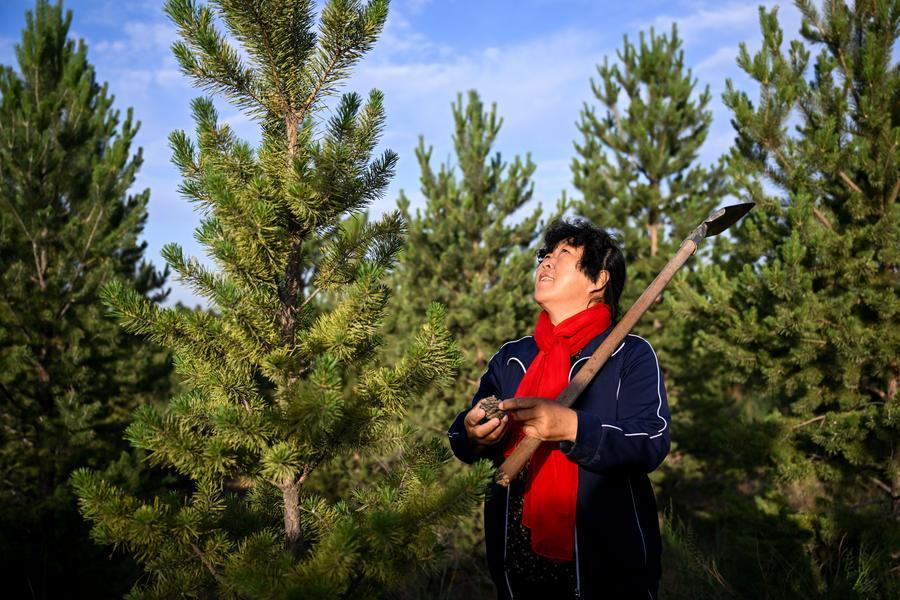
Yin Yuzhen checks trees on her way of patrolling in Salawusu Village, Uxin Banner, north China's Inner Mongolia Autonomous Region, May 20, 2026. (Xinhua/Li Zhipeng)
Her achievement earned her honors, yet a long-held regret has lingered in her heart: she lost contact with Sakolsky after he returned to the U.S. at the end of 2000. All Yin could recall was that Sakolsky once worked at a school in Luoyang, and her only tangible memory of him is preserved in a yellowed, blurry group photo.
"I have spent the past two decades searching for him," Yin told Xinhua, adding that she had asked her friends in the U.S. for assistance, and carried the photo wherever she visited.
She made her public appeal for assistance in locating the American donor last Saturday by uploading the video to the internet.
That very evening, Bai Fan came across the video. He immediately emailed Sakolsky, who responded shortly afterward. "This is amazing," Sakolsky said. Upon learning that the once sand-stricken area has been transformed into lush forest, he expressed his wish to visit the site in person.
Soon Yin was put on a video chat with her American friend. For this occasion she practiced once and again to say "you are my brother". "With the money you gave me, I planted this forest. When are you coming to take a look? I cannot wait to see you," she said emotionally, her voice shaking.
Talking about his benevolent act 27 years ago, Sakolsky said that he just wanted to give back to this country which has accepted him and treated him well. It was the experience in China that made me a better version of myself, he said.
According to their plan, Sakolsky will visit China later this year. He also intends to plant saplings at the area where Yin works.
In that area, the swathe of green is still growing.
Photos


Related Stories
Copyright © 2026 People's Daily Online. All Rights Reserved.
