



China's MIIT to lift standard quality to boost service robots for special needs
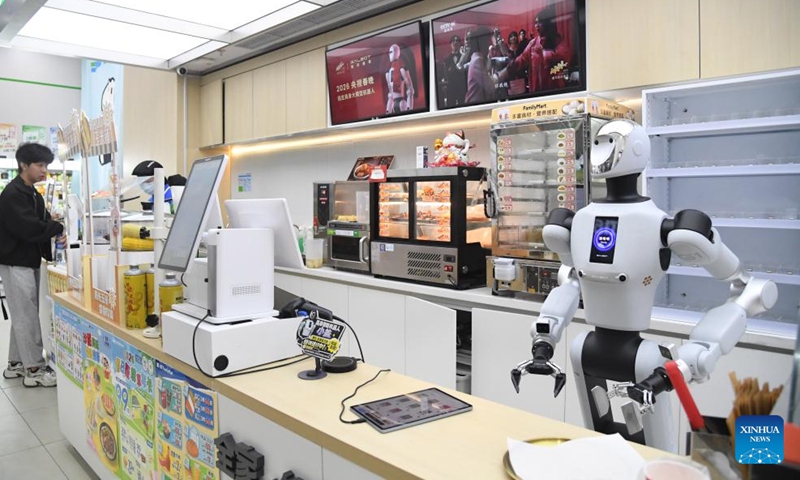
A humanoid robot works at a convenience store in Haidian District of Beijing, capital of China, April 22, 2026. An embodied large model robot has recently been deployed in a convenience store in Haidian District to provide regular service. The robot is responsible for greeting customers, answering product inquiries, providing promotion information, and delivering goods. (Xinhua/Ren Chao)
China's Ministry of Industry and Information Technology (MIIT) has released a draft action plan targeting quality upgrades in light industry products, proposing to formulate new standards for emerging categories such as pet household appliances and service robots designed for special-needs groups.
Standards play a critical supporting and guiding role in expanding product variety, improving quality, and building brands in the light industry sector, the MIIT said. The draft, now open for public consultation, aims to drive the sector's transition toward high-end, intelligent, and green development by elevating standards.
The draft also calls for prioritizing the development of international standards in frontier fields such as smart home systems and intelligent service robots, in a bid to shape new trends in the sectors' global expansion.
China has been ramping up the application of robots in sectors such as services and caring. In June 2025, the MIIT, together with China's Ministry of Civil Affairs, jointly launched pilot programs for the paired development and scenario-based application of intelligent eldercare service robots, with a trial period running from 2025 to 2027, according to the Xinhua News Agency.
The initiative will promote product validation and iterative upgrades across application scenarios including households, communities, and eldercare institutions, aiming to develop a range of robotic products capable of meeting multi-level and diversified eldercare needs, while continuously improving standards, regulatory frameworks, and evaluation systems.
The pilot program targets three major eldercare service models—home-based, community-based, and institutional care—focusing on application scenarios such as disability and dementia care, emotional companionship, and health promotion.
In 2025, the number of domestic whole-machine manufacturers exceeded 140, with more than 330 humanoid robot models launched, official data showed. The MIIT said that alongside efforts to strengthen product quality, it will also advance research and governance frameworks related to the ethical implications of humanoid robotics.
Photos




Related Stories
- China's embodied AI robots take on high-risk industrial frontiers
- China's robot police patrol cities during Labor Day holiday, signaling AI-powered urban governance
- Profile: A Chinese prodigy on a mission to bring robots to life
- Chinese companies roll out human-robot home cleaning services
- Pic story of robot engineer at bionic robot innovation center in Changchun, China's Jilin
- Intelligent robots captivate visitors at 9th Digital China Summit in SE China's Fujian
- Robot industry thrives with policy support in Qinhuangdao, China's Hebei
- China's humanoid robot training centers multiply as sector gains momentum
- China-developed humanoid robot breaks half-marathon record in Beijing
- Unmanned farming highlighted at Shandong's int'l vegetable sci-tech expo
Copyright © 2026 People's Daily Online. All Rights Reserved.
