



Uncovering the systemic conspiracy of Japan's 'neo-militarism'
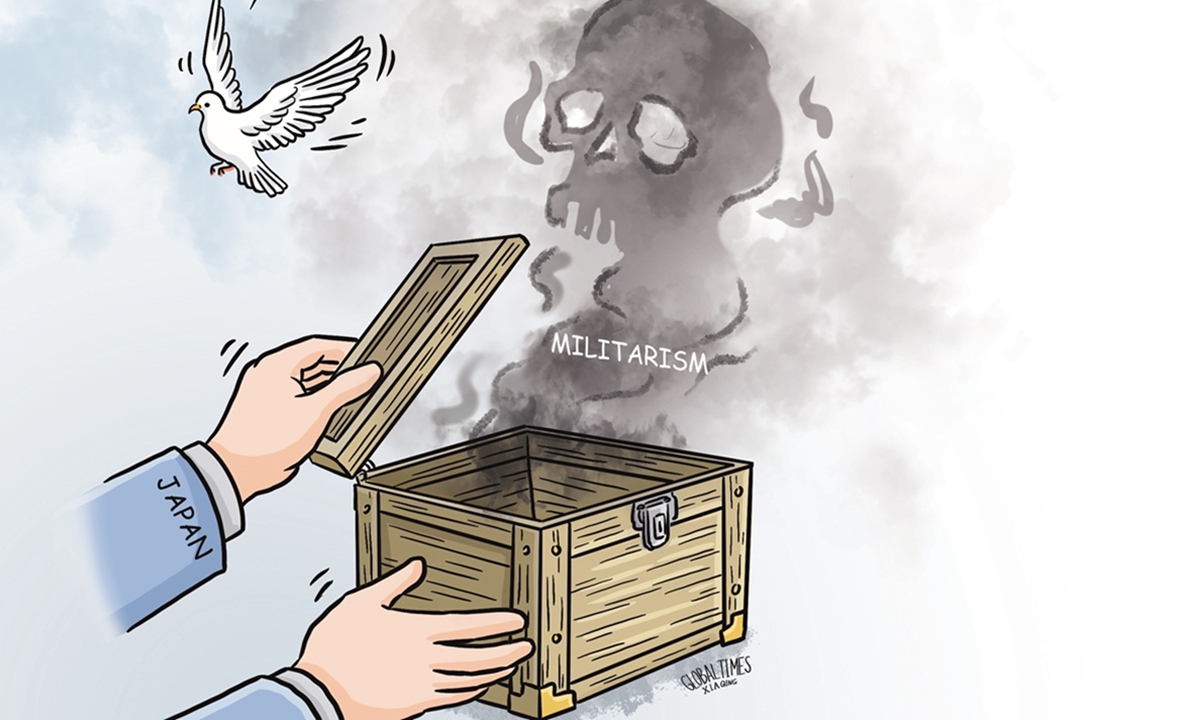
Illustration: Xia Qing/GT
Within just one month, Japan has presented the world with a disturbing picture at an alarming pace: an active-duty officer of the Japan Self-Defense Forces (SDF) broke into the Chinese embassy in Tokyo with a knife and threatened violence; a Japanese destroyer transited the Taiwan Straits on the same day as the signing of the Treaty of Shimonoseki 131 years ago; the Japanese government significantly eased restrictions on arms exports, allowing the export of lethal weapons; Prime Minister Sanae Takaichi offered ritual items and monetary offerings to Yasukuni Shrine for two consecutive days… Meanwhile, Japan is accelerating a major restructuring of SDF, deploying long-range strike missiles, and officially taking part in annual joint military drills conducted by the US and the Philippines for the first time.
Assembled together, these pieces form a picture revealing the menacing face and sharp fangs of "neo-militarism." The Takaichi administration is methodically and systematically attempting to dismantle the post-war peace framework through ideological preparation, policy breakthroughs, public opinion manipulation, and shaping external conditions, thereby altering Japan's path of peaceful development and subverting the international order that Japan, as a defeated nation, has been part of. The facts clearly show that Japan's "neo-militarism" is no longer just a dangerous sign but a real threat.
Historically, the activation of war machine always begins with ideological indoctrination and the distortion of history. Japan's "neo-militarism" inherits pre-war cultural dregs such as the "imperial view of history." Yasukuni Shrine once served as a spiritual tool for Japanese militarism to wage wars of aggression, and today it is again being used by right-wing forces to instill in the public - specially the younger generation - narratives that beautify aggression and glorify war. When a country's leaders can openly pay tribute to war criminals without bearing political consequences, it signals a dangerous qualitative shift in its political ecology - "reflection" on past aggression is being systematically replaced by efforts to "revise" that history. Once the ideological soil is poisoned, the growth of bitter fruits becomes only a matter of time.
While misleading domestic public opinion, Japanese right-wing forces are also vigorously exaggerating external threats, striving to create external conditions for remilitarization. To mask multiple domestic crises such as prolonged economic stagnation, a huge national debt burden, industrial hollowing out, and an aging population with a low birthrate, the Japanese right-wing forces fabricate so-called external threats to divert domestic contradictions. This logic of public opinion manipulation that externalizes internal contradictions and incites hostility toward other countries is fundamentally no different from that of militarist Japan before World War II.
This shift is reflected in a series of troubling, substantive moves. First is the sweeping relaxation of arms export controls. The Japanese government has scrapped the restriction that limited exports to five nonlethal categories, creating room for exporting weapons to countries involved in conflicts. This risks turning Japan into a "merchant of death" that fuels international conflicts. Next, Japan plans to establish a so-called "Japanese version of the CIA," while moving up revisions to its "three security documents." Today, the "pacifist constitution" may still exist on paper, but its spirit has been systematically hollowed out. Japan is sliding from "unable to wage war" to "able to wage war," and from an "exclusively defense-oriented policy" toward "preemptive strike."
At the same time, Japan is pursuing a systematic strategy at both the geopolitical and international order levels. Its aim is no longer simply to adjust defense policy, but to fundamentally reshape the postwar security architecture of East Asia. It is no longer content with being a follower of the US, but is instead seeking to play a dual role as both disruptor and driver. On the Taiwan question, Sanae Takaichi has openly linked a "Taiwan contingency" to a "situation threatening Japan's survival," crafting a legal excuse for military intervention in the Taiwan Straits. In the South China Sea, Japan is drawing in regional countries to deepen defense cooperation, effectively advancing the militarization of the "first island chain."
Globally, Japan is promoting NATO's eastward expansion, attempting to introduce bloc politics into the Asia-Pacific. Meanwhile, domestically, Japan is accelerating the construction of a new "military-industrial complex" integrating government, military, and capital - strikingly similar to the prewar structure in which the military, zaibatsu, and government jointly drove expansionist aggression.
What exactly is Japan trying to do? From ideological revisionism to legal breakthroughs to geopolitical maneuvering, these elements are interconnected and mutually reinforcing. Ideological "reframing" lays the psychological groundwork for legal "loosening"; institutional "breakthroughs" create the conditions for strategic "offense"; and the strategic "manufacturing of tension" in turn feeds ideological narratives of threat. This forms a carefully designed closed loop. A series of moves by the Takaichi administration point to a deeper motive: to fully cast off the political constraints imposed after World War II and push Japan toward becoming a major military power capable of using force abroad, even initiating war.
In the 1930s, Japan's military establishment similarly manufactured "external threats," stirred up nationalism, and hijacked the state apparatus, ultimately dragging the country into the abyss of aggressive war. Today, Japan's right wing may present a more polished fa ade, but the underlying logic remains consistent. The international community must remain clear-eyed: what Japan is doing is not a normal defensive choice of a sovereign state, but a systemic challenge to the postwar international order and a tangible threat to peace and stability in the Asia-Pacific. All forces that value peace must stay highly vigilant, jointly safeguard the outcomes of World War II victory, and ensure that Japanese militarism never resurfaces and that the tragedies of history are not repeated.
Photos
Related Stories
- Commentary: Dangerous agenda behind Japan's move to lift ban on lethal arms exports
- 126 Japanese lawmakers visits notorious war-linked Yasukuni Shrine
- Japanese PM makes monetary offering to notorious war-linked Yasukuni Shrine
- Commentary: The ghosts Japan refuses to lay to rest
- Commentary: Japan's growing military buildup threatens postwar peace order
- Pandora's Box
- Haunted by the past: Japanese PM sends ritual offering to notorious Yasukuni Shrine
- Japan officially eases arms export rules to allow weapons sales despite protests
- How Japan rebrands monument of aggression as 'cultural heritage'
- Japan officially eases arms export rules
Copyright © 2026 People's Daily Online. All Rights Reserved.
