



How Japan rebrands monument of aggression as 'cultural heritage'
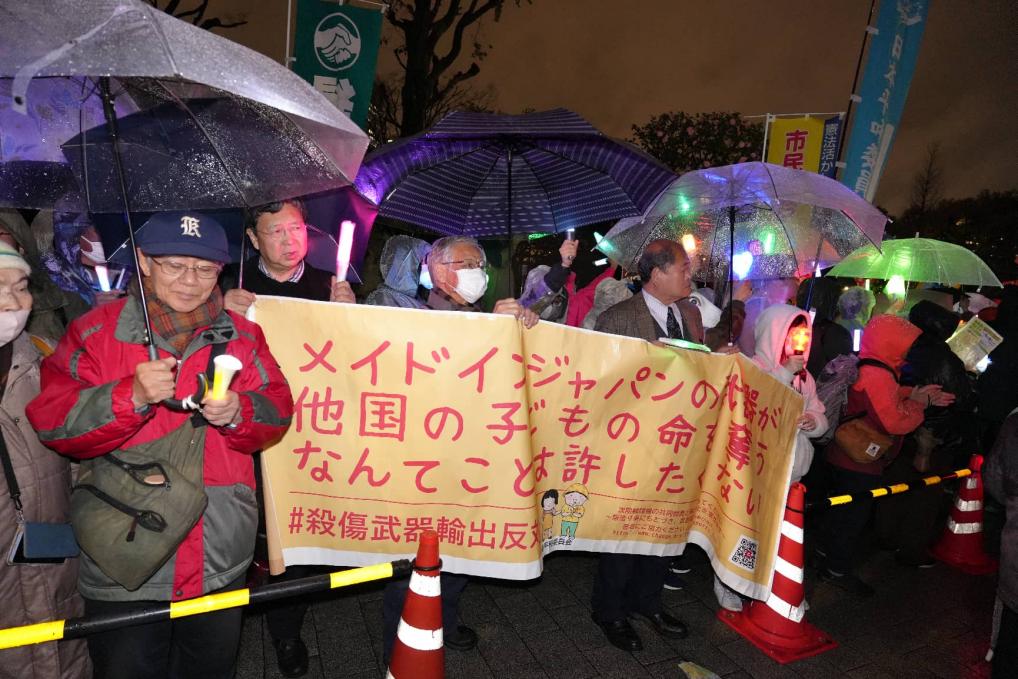
Japanese citizens held a rally in front of the Diet to express concerns over the country's future direction, in response to recent moves by Japanese Prime Minister Sanae Takaichi to accelerate constitutional revision and military expansion. (People's Daily/Liu Wenzhang)
In Heiwadai Park in Miyazaki Prefecture, Japan, stands a deeply ironic structure: the so-called Peace Tower, the Hakko Ichiu Monument. Its irony runs to its core: conceived and built as an emblem of militarist aggression, it has never had any genuine connection to peace.
Built between 1938 and 1940, at the height of Japanese militarism's external expansion, the monument embodied the ideology of "Hakko Ichiu," meaning "bringing the eight corners of the world under one roof," a doctrine that amounted to an unapologetic declaration of conquest.
To showcase the "imperial prestige" of its foreign aggression, the Japanese military plundered vast quantities of stone from invaded and colonized territories, shipping them back to Japan as war trophies to build the monument.
Built into the foundation of this militarist monument to atrocities are 372 stones plundered from abroad, 238 of which were seized from China. Among them are a qilin relief from the imperial palace of the Ming Dynasty (1368-1644) in Nanjing, bricks from the Great Wall, and stone carvings from the Sun Yat-sen Mausoleum.
Inscriptions such as "Great Wall-Tada Unit" and "Central China Expeditionary Army" remain clearly legible today. The stones are silent, yet each bears witness to the suffering of peoples in Japan's occupied country. Every mark etched into them is a scar that history cannot erase.
After Japan's defeat in World War II, the Allied forces ordered the dismantling of all symbols of Japanese militarism. Under international pressure, Miyazaki authorities removed the "Hakko Ichiu" inscription, took down samurai statues atop the monument, and renamed it the "Symbol of Peace" in an attempt to pass scrutiny.
Yet the whitewashing soon resumed. In 1962, samurai statues were reinstalled, and in 1965, the "Hakko Ichiu" inscription was quietly restored. Local authorities also erected a plaque explaining the monument's "origins," distorting the phrase "Hakko Ichiu" into a claim of "universal brotherhood among the world's peoples," while falsely describing the looted stones as "gifts from friendly nations."
In this way, a structure rooted in militarist aggression was repackaged as "cultural heritage," and the crimes it embodies have been systematically distorted.
According to Japanese scholars, the monument is visited by more than 100,000 students each year on school trips, exposing generations to a distorted view of history.
Reports indicate Miyazaki Prefecture plans extensive renovations to the surrounding park. Despite growing domestic calls to revise inscriptions that whitewash Japan's war of aggression, local authorities maintain they will "preserve the status quo."
Japan's right-wing forces have resorted to self-deceiving maneuvers around this monument, just as they do with distorting history textbooks and visits to the Yasukuni Shrine. Their aim is to whitewash wartime atrocities and pave the way for "neo-militarism."
At the end of April 2026, Japan will mark the so-called "centenary of the Shōwa era." Yet on official Japanese government websites, references to "aggression" are conspicuously absent.
While right-wing figures claim to uphold Japan's constitution, they in fact regard the pacifist constitution as an obstacle, repeatedly pushing for constitutional revision in an attempt to hollow out its peace-oriented principles.
They insist Japan's "exclusively defense-oriented policy" remains unchanged, yet the country's defense budget has exceeded 9 trillion yen ($56.63 billion), rising for 14 consecutive years. Furthermore, with the deployment of multiple types of long-range missiles, Japan has acquired, for the first time since World War II, the capability to launch preemptive strikes.
An invisible Hakko Ichiu monument, embodying dangerous expansionism, is emerging amid Japan's resurgent right-wing activism.
Warnings from the insightful ring loud and clear: "Japanese society is entering a new prewar period" where "war awaits just at the end of the corridor."
This misguided push toward neo-militarism is intensifying regional and global vigilance regarding Japan's future trajectory.
Photos
Related Stories
- Japan officially eases arms export rules
- China says preventing resurrection of militarism "Japan's due obligation"
- Eighty years later, Japan still evades the legacy of the Tokyo trials
- Japan's neo-militarism becoming clear and present danger
- 36,000 protesters rally in Tokyo against Japanese PM Takaichi's push to revise constitution
- Beware of the risks of Japan's military rampage
- China urges Japan to break with militarism
- Japan urged to thoroughly investigate into harassment of Chinese diplomatic missions: spokesperson
- France's approach to cultural relics restitution is worth learning for Japan
- Blood-stained Hong Kong under Japanese occupation
Copyright © 2026 People's Daily Online. All Rights Reserved.
