



Beware of the risks of Japan's military rampage
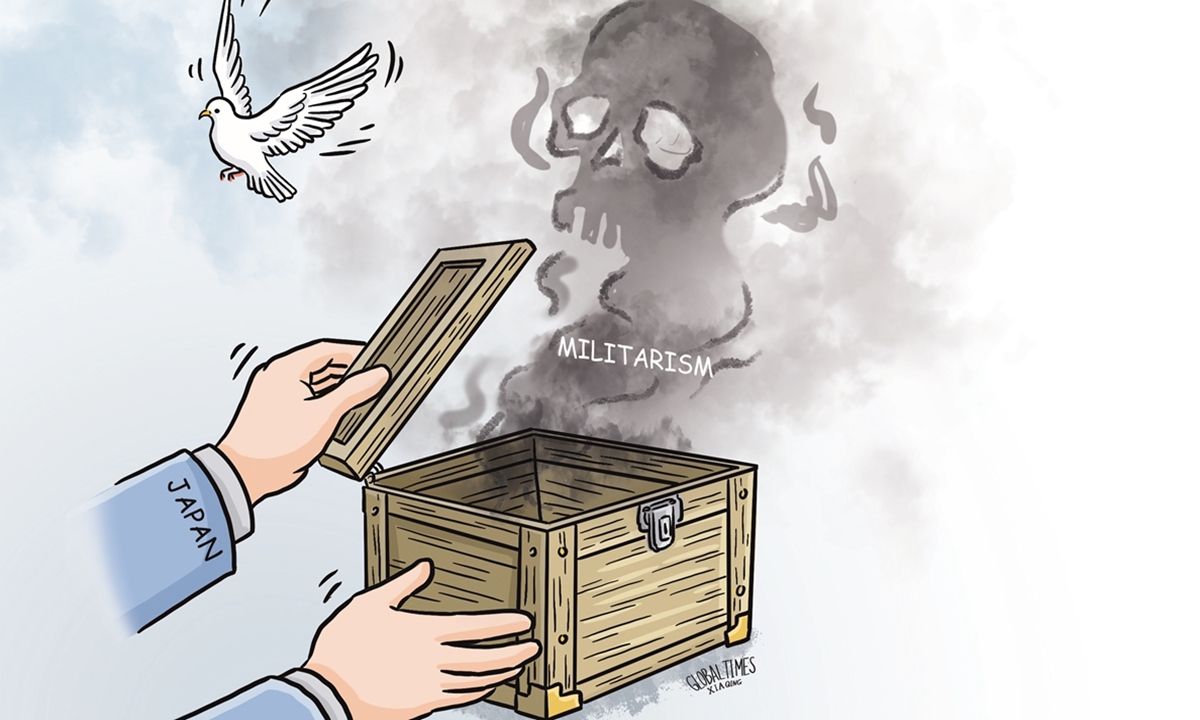
Illustration: Xia Qing/GT
Japan has recently been engaging in reckless rampages in the military and security domain, raising high vigilance within the international community. On Saturday local time, Japan and Australia launched a $7 billion arms deal. This represents Japan's most eye-catching military export since it lifted its weapons export ban in 2014 and marks a key step in Japan's accelerated efforts to break free from its postwar constraints and push forward remilitarization. The militarist genes that were never properly addressed after World War II have risen from the ashes, and Japan's military adventurism risks spiraling out of control.
Japan's push for weapons exports is a long-planned, systematic and legal breakthrough. In 2014, the Abe administration rebranded "Three Principles on Arms Exports" as "transfer of defense equipment and technology" to downplay the military sensitivity of the term. During the Russia-Ukraine conflict, Japan used the pretext of "cooperating with Western partners" to create exceptions for exporting lethal weapons. Now, the Takaichi government is going even further, planning to formally revise the "Three Principles on Transfer of Defense Equipment and Technology" this month, shifting to a policy of "in principle allowing the export of lethal weapons without prior parliamentary approval." This loosening of arms exports is advancing in tandem with record-high increases in defense budgets. Right-wing forces in Japan are systematically dismantling the postwar institutional and legal barriers designed to prevent the resurgence of militarism.
Japan's weapons exports also serve as a powerful lever to revive its domestic military-industrial complex on a full scale. During WWII, the military-industrial complex was a massive machine that sustained Japan's war of aggression. After the war, constrained by the pacifist constitution and the "Three Principles on Arms Exports," Japan's military production capacity was forced into dormancy. Today, under the guise of exports, Japan is laying the industrial groundwork for a new round of large-scale military expansion. When Mitsubishi Heavy Industries and Kawasaki Heavy Industries secure massive orders from Japan's Ministry of Defense and climb into the global top 100 arms-producing companies by revenue, the alarm bells of history ring once again.
Furthermore, Japan's weapons exports represent a dangerous move that spreads instability to the surrounding region. Analysts point out that Japan is eager to supply warships to Australia in order to integrate into the AUKUS framework involving the US, UK, and Australia. Once Australia establishes the necessary support and maintenance systems for the upgraded Mogami-class frigate - coupled with the "quasi-military alliance" relationship in the Japan-Australia Reciprocal Access Agreement - Japanese Maritime Self-Defense Force vessels of the same type will gain seamless access to resupply and maintenance in Australia, effectively paving the way for the Self-Defense Forces to operate farther from home.
Japan's recent series of risky actions forms a clear roadmap for its "remilitarization." At the institutional and legal levels, it is dismantling one postwar pacifist constraint after another. Diplomatically, its ties with NATO are growing ever closer, as evidenced by the rare collective visit to Japan by ambassadors from 30 NATO member states in recent days.
On the Taiwan question, Japan's provocations continue to escalate. On Friday, the Japanese destroyer JS Ikazuchi unilaterally transited the Taiwan Straits. That date marked the 131st anniversary of the signing of the Treaty of Shimonoseki. This move has created a highly negative impact, with Japanese militarist remnants blatantly using the history of their aggression against China from over a century ago to assert their presence in the Taiwan Straits. This is a blatant provocation of China's sovereignty and national sentiments. It also sends a wrong signal to "Taiwan independence" separatist forces.
In response to Japan's egregious actions, China's Ministry of Foreign Affairs and Ministry of National Defense issued strong and solemn protests. China today is no longer the weak and impoverished nation it was 131 years ago. In this latest incident involving the Japanese destroyer's transit through the Taiwan Straits, the Eastern Theater Command of the People's Liberation Army organized naval and air forces to track and monitor the vessel throughout its passage, exercising effective control and deterrence. This shows that today's China has both the firm resolve and the capability to safeguard every inch of its territorial sovereignty. No military adventurism will be allowed to cross the red line.
On the Taiwan question, instead of reflecting on the dangerous consequences of its erroneous words and deeds, the Japanese ruling authorities have chosen to rub salt into the historical wounds of the victim countries and intensify their challenge to China's territorial sovereignty. Such extremely arrogant behavior further exposes the ambition and dangers of Japan's "neo-militarism."
Through these dangerous actions, we can clearly see the perilous logic behind Japan's "re-militarization": using the "China threat" narrative as a pretext, strengthening military alliances for camp confrontation as the main axis, and aiming to break through the pacifist constitution and develop offensive military capabilities in an attempt to achieve rearmament and once again become a "capable fighting nation" with powerful destructive capabilities. However, this chain of logic has been built on a flawed understanding of China and a misjudgment of international trends from the very beginning. A country that is unwilling to face history and even attempts to overturn it is destined to lose the trust of the international community. A country that is superstitious about military force and keen on geopolitical maneuvering is bound to fail in achieving genuine security.
A country that shifts its own problems onto its neighbors and walks the old path of militarism will only slide back into dangerous territory. The Asia-Pacific region is not a testing ground for Japan's revival of militarism. We again urge the Japanese authorities to recognize historical trends, halt their reckless course, deeply reflect on their history of aggression, stop playing with fire regarding the Taiwan question, cease inciting confrontation in the region, and avoid creating division. The international community should also resolutely curb Japan's dangerous trend of military rampages and work together to safeguard the post-WWII peace order from being eroded and dismantled.
Photos


Related Stories
- China urges Japan to break with militarism
- Japan urged to thoroughly investigate into harassment of Chinese diplomatic missions: spokesperson
- France's approach to cultural relics restitution is worth learning for Japan
- Blood-stained Hong Kong under Japanese occupation
- Interview: Japan risks losing "peace state" identity amid military buildup, scholar warns
- Japan's accelerating rightward shift nurtures dangers
- Under the jaw of neo-militarism
- LDP's renewed push for constitutional revision sparks public doubts in Japan
- Japan's military shift toward offensive capabilities undermines pacifist constitution
- Japan's ambition for military expansion laid bare: spokesperson
Copyright © 2026 People's Daily Online. All Rights Reserved.
