



Slow trains help drive rural revitalization in northern China
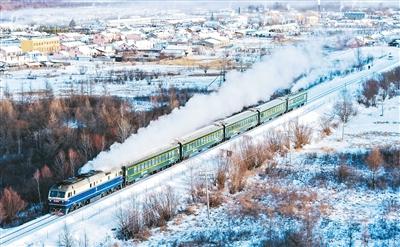
A train runs through the Greater Khingan Mountains near Jinhe town, Genhe, a county-level city under Hulun Buir, north China's Inner Mongolia Autonomous Region. (Photo/Ma He)
A handful of slow trains with an average speed of less than 40 km per hour still crisscross the vast wilderness of the Greater Khingan Mountains in northeast China's Heilongjiang Province and Hulun Buir in north China's Inner Mongolia Autonomous Region. They are slow by design — and indispensable.
Operated by China Railway Harbin Group Co., Ltd. for decades, these public welfare slow trains have become a lifeline for remote villages, supporting livelihoods and rural revitalization. Ticket prices on these trains have held steady for decades, with the cheapest fares ranging from just 5 yuan ($0.73) to 6 yuan.
Train 4181/4184 runs between Hailar district in Hulun Buir and Mangui town in Genhe, a county-level city under Hulun Buir. It covers 523 kilometers and stops at 26 stations — seven of which are little more than trackside halts with no platforms.
The journey cuts through Genhe, known as China's "Pole of Cold," where winter temperatures plunge to minus 30 or 40 degrees Celsius. The train, averaging under 40 kilometers per hour, has been running this route for 46 years and has become a fixture of daily life for locals along the route.
"When heavy snow blocks the roads, the train is the only way in or out. People rely on it for school, medical care and shopping," said Ye Long, a train conductor who has worked on the slow train for 12 years.

Passengers interact with a service robot aboard train 4181, which runs between Hailar district in Hulun Buir and Mangui town in Genhe, a county-level city under Hulun Buir, north China's Inner Mongolia Autonomous Region. (Photo courtesy of China Railway Harbin Group Co., Ltd.)
With road access limited across forest and pastoral areas and courier services rarely reaching these parts, the slow train has stepped in as a mobile delivery hub for local residents. Ye has fashioned wooden signboards and placed one at each trackside halt. Whenever the train pulls in, anyone needing something sent along the line simply leaves it beside the sign with the recipient's name and details — the crew takes it from there.
"We drop the items off at the signboard of whichever halt they're headed to, and the recipient comes to collect them. Over time, the train has become a trusted free relay station and a kind of mobile mailbox for people out here," Ye said.
Train 4170/4169 links Hailar district to Moerdaoga town in Ergun, a county-level city in Hulun Buir. In continuous operation since 1975, the train covers 441 kilometers, with the cheapest ticket starting at just 6 yuan. Deep in the Greater Khingan Mountains, where settlements are few and far between, it doubles as a school bus for children traveling between home and school.
To meet the needs of students commuting through the forest region, the train has been fitted with bookcases, power strips, and small study tables where children can do their homework, along with a supply of stationery and other learning materials.
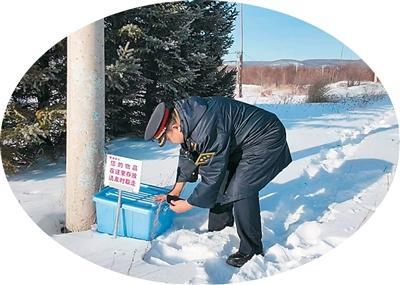
Ye Long, conductor of train 4181, places items at a trackside halt to be collected by a resident along the line. (Photo courtesy of China Railway Harbin Group Co., Ltd.)
"We have also set up a dedicated reading carriage, where crew members help students with their questions during breaks — turning the train into a mobile classroom for the kids," said Han Dan, the train conductor.
Over the decades, the slow trains themselves have been transformed. Coal-fired carriages have given way to air-conditioned ones that maintain a steady 20 degrees Celsius inside, even as blizzards rage outside the windows. Crew teams have set up onboard service stations stocked with hot-water bottles, heat pads and portable chargers. Removable commodes are available for passengers with mobility difficulties, and a dedicated nursing room has been installed for mothers with infants.
In addition, dedicated WeChat groups allow passengers to book tickets, arrange ambulances at destination stations or adjust their travel plans.
During the Spring Festival this year, train 4187 — running between Qiqihar city in Heilongjiang Province and Manzhouli in Hulun Buir — was decked out in New Year decorations as vendors filled the carriages with vegetables, fruits, local specialties, leaf carvings and paper-cuts. Northeast folk songs played over the speakers.
According to train conductor Zhao Jian, passengers could shop for Spring Festival goods, access medical services, watch yangge dance performances, and enjoy intangible cultural heritage showcases on the train.
Since 2023, China Railway Harbin Group Co., Ltd. has run "mobile markets" for Spring Festival goods on its slow trains, letting passengers shop for affordable items during the journey. Now in its third year, the service expanded this spring to Inner Mongolia for the first time.
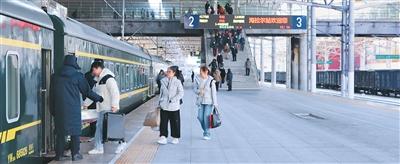
Passengers board train 4170 at Hailar Railway Station in Hailar district, Hulun Buir, north China's Inner Mongolia Autonomous Region. (Photo/Zhang Cheng, Xu Fanglue)
"This year we wanted to take it further by turning the train into a 'mobile clinic' and a 'mobile intangible cultural heritage exhibition hall,'" Zhao said.
Cheng Yongliang, 43, who lives in Longjiang county, Qiqihar city, took this train to school. Today, he works as a duty officer at Longjiang Railway Station, overseeing grain shipments. The county is home to more than 50 grain processing enterprises, and their managers regularly take the slow train to negotiate deals and open new markets.
"Take this bag of Longjiang millet — it's one of our local specialties. Being able to show my hometown's specialties to passengers from all across the country, right here on this train, fills me with real pride," Cheng said.
No longer simple means of transport, these slow trains have grown into multipurpose platforms that weave together social welfare, cultural outreach, tourism promotion and economic development, helping advance rural revitalization.
Photos



Related Stories
- Furry companions welcome: China launches upgraded pet travel service on bullet trains
- Slow train connects rural residents to vital services in N China's Inner Mongolia
- Feature: Spring Festival rush fills Vietnam-China passenger train
- Senior train technician focuses on skilled workforce development
- Slow train serves as "mobile market" for villagers in SW China
- Eastern corridor of China-Europe freight train service witnesses over 1,000 trips in 2026
- Slow train service helps residents travel, commute along Hunan, Guizhou and Chongqing
- High-speed trains ready to roll
- 1st direct high-speed train linking Yan'an, Beijing begins operation
- Record-breaking smart train convoy transforms heavy freight transport
Copyright © 2026 People's Daily Online. All Rights Reserved.
