



Hangzhou emerges as a hub for open-source AI innovation
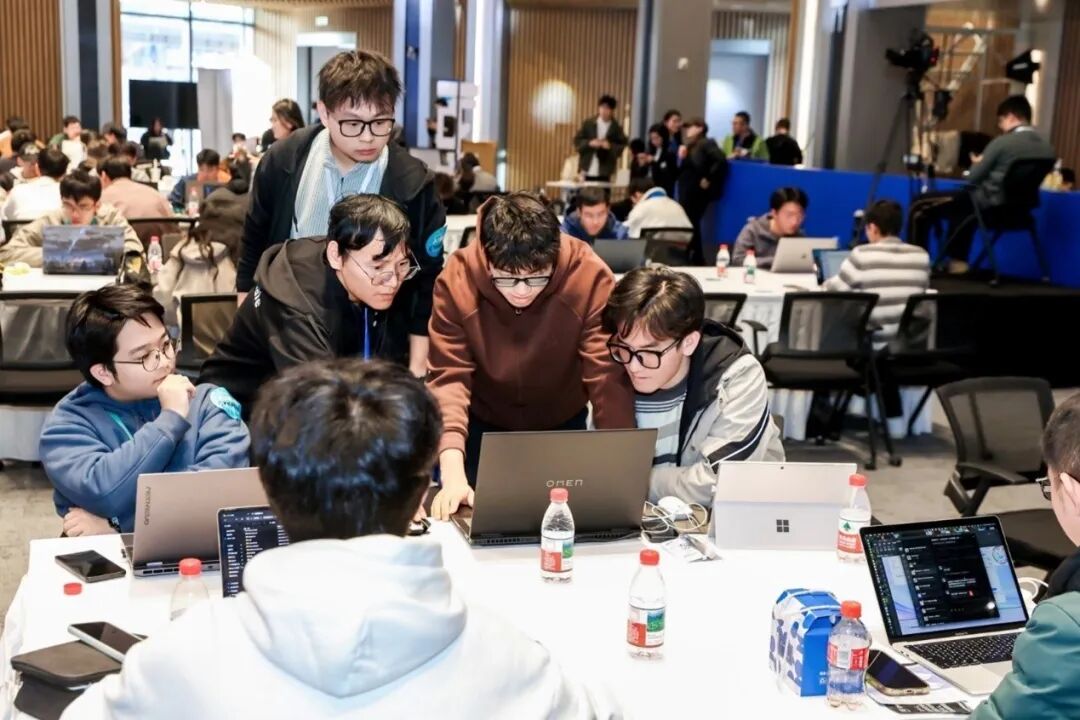
Developers discuss with each other at the ModelScope Developer Center in Xihu district, Hangzhou, east China's Zhejiang province.
Hangzhou, in eastern China's Zhejiang province, is rapidly developing a thriving open-source AI community. This ecosystem connects developers, startups, and industry resources, accelerating the transformation of ideas into real-world applications.
At the center of this ecosystem is the ModelScope community, one of China's largest open-source platforms for AI large models. Jointly initiated by the China Computer Federation's Opensource Development Committee and Chinese multinational conglomerate Alibaba, the platform hosts more than 170,000 open-source models and serves over 25 million developers worldwide.
Covering areas such as conversational AI, text-to-image generation and video synthesis, it provides one-stop services including model downloading, fine-tuning and training.
Online collaboration is now being reinforced by offline interaction. In November last year, a ModelScope Developer Center opened in Xihu district, Hangzhou. Spanning more than 10,000 square meters, the center offers a physical space where developers exchange ideas, collaborate on projects and even find partners to launch startups.
For 25-year-old entrepreneur Zhou Jie, the center functions as both a workplace and a springboard. After lunch, he headed to a shared desk where he and his partner Liu Xuannan run their startup.
On his screen, a humanoid robot moved agilely through a "cyber ruins" game environment, responding to voice commands to jump over obstacles.
The game, developed by Zhou and Liu during a global hackathon in January, progressed from concept to a playable version in under 48 hours.
The process was smoother than they expected, Zhou said. Open-source models eliminated costly licensing fees, computing power was covered by ModelScope's free quota, and cloud-based tools were readily available. Together, these factors significantly reduced development costs.
Zhou, who previously worked in game development for an internet company, decided to start his own business after recognizing AI's rapid advancement. He has since developed several AI tools and plans to upload them to the ModelScope platform to benefit more users.
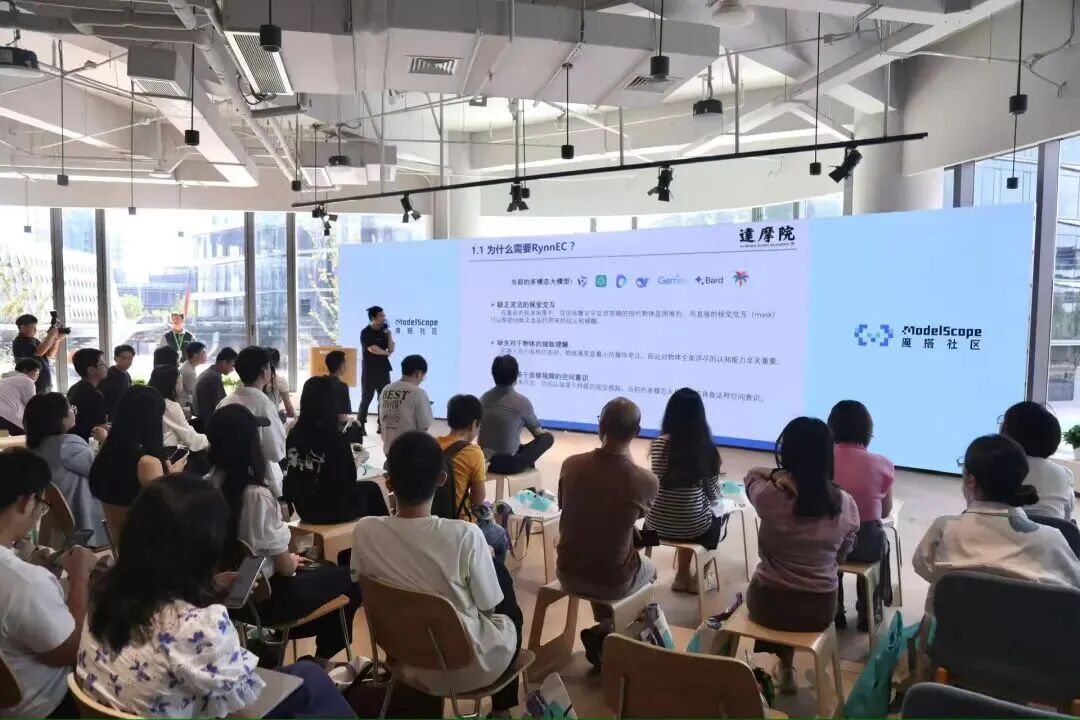
An exchange session is held at the ModelScope Developer Center in Hangzhou, east China's Zhejiang province.
The community's open and collaborative approach has attracted a growing number of participants. Model downloads have exceeded 100 million, while the ModelScope Developer Center in Hangzhou has already signed contracts with over 50 companies and brought in more than 100 resident developers.
Technical exchange events are commonplace within the center. At a recent seminar on multimodal models, the venue was filled to capacity. Zhou noted that face-to-face interaction has helped transform loose online connections into deeper, more effective collaboration.
The center integrates multiple functions, including AI application experience zones, seminar rooms, demo halls and startup incubation spaces, aiming to provide a full-cycle support system -- from idea generation to product deployment.
Beyond workspace and networking, practical support is also a key attraction. When Zhou first launched his business, he was unfamiliar with administrative procedures. "From submitting documents to getting a business license, it took less than a day," he said. "Staff guided me through everything, freeing me to focus on the product."
The benefits extend further. With the center's matchmaking services, Zhou's game technology—combining voice interaction and scene generation—is now being integrated into a local cultural tourism project, turning innovation into commercial orders.
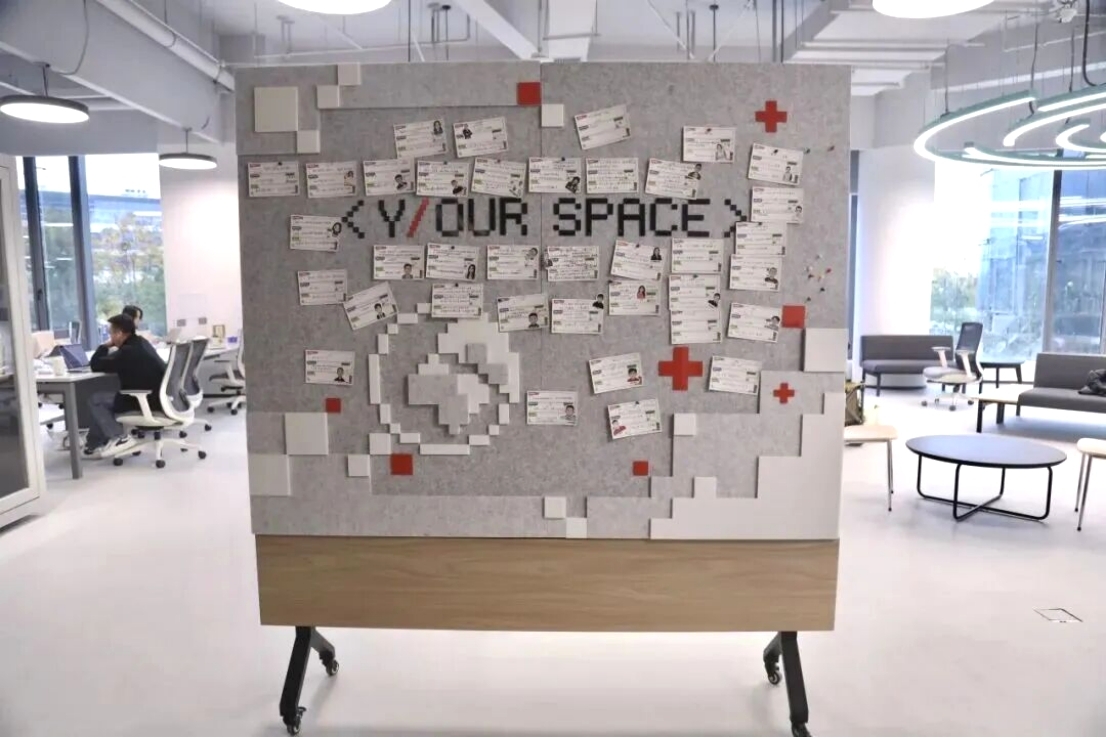
Developers pin their information on an exhibition board so they can easily find partners.
Such connections are becoming routine. According to Rao Siyi, deputy general manager of matchmaking company Hangzhou Scene, the company has cataloged 292 industry demands and 362 technical capabilities. "Previously, technologies often remained theoretical while enterprises struggled to find solutions. Now, we provide both online matching tools and offline meeting spaces to connect them directly," Rao said.
Policy support adds further appeal. Qualified talent at the center can receive subsidies for housing and other incentives, while resident companies are eligible for rent-free office space of up to 200 square meters.
By linking a vibrant online open-source ecosystem with offline collaboration and real industrial demand, Hangzhou is building a comprehensive support system covering the full lifecycle of innovation. So far, the ModelScope "innovation space" has incubated more than 10,000 AI applications, with over 1.6 billion calls made through its model context protocol services.
(Photos from the official account of the media center of Xihu district, Hangzhou on WeChat)
Photos


Related Stories
- Tourists enjoy scenery of West Lake in Hangzhou
- UN honors 3 Chinese cities for advancing sustainable waste management
- Millennium-old tea gardens in east China meet the age of drones, automation
- Tea farmers harvest West Lake Longjing tea in China's Hangzhou
- Special night tour event featuring plum blossoms held at Chaoshan scenic area in E China's Hangzhou
- UN names Hangzhou leader in 'zero waste'
- China's Hangzhou among UN's top 20 zero-waste cities globally
- Pan Tianhong: Helping people explore the world through a tiny screen
- Yuhang district of Hangzhou strengthens services for its growing international community
- Hangzhou's Lingyin Feilai Peak Scenic Area launches free admission service
Copyright © 2026 People's Daily Online. All Rights Reserved.
