



Lincang in SW China's Yunnan cultivates thriving coffee industry
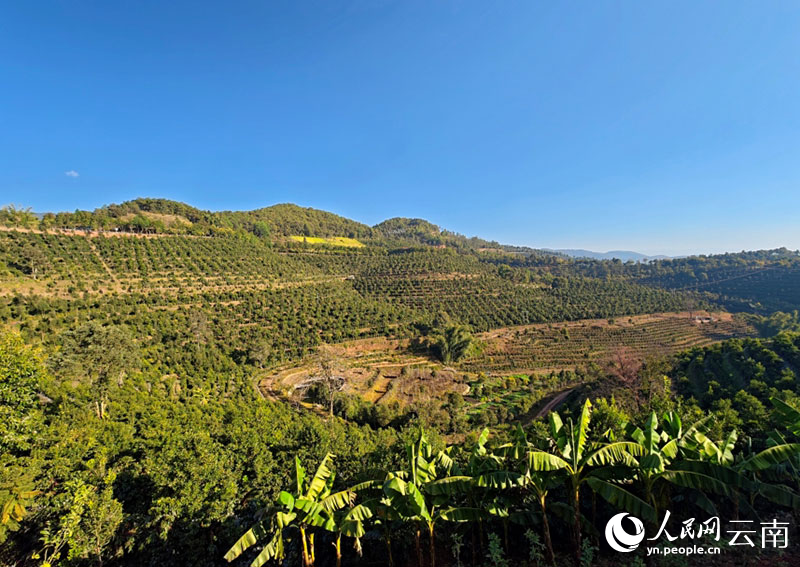
Photo shows Rongkangda coffee estate in Shuangjiang county, Lincang city, southwest China's Yunnan Province. (People's Daily Online/Yin Xin)
Located in the global golden belt for coffee cultivation, Lincang city in southwest China's Yunnan Province has built a booming coffee industry.
By the end of 2025, Lincang's coffee-growing area had reached 290,000 mu (19,333 hectares) across 50 towns and townships in all eight counties and districts, supporting 63,000 farming households. Annual output stood at 25,000 tonnes of coffee beans, valued at 992 million yuan ($144 million).
The city's coffee has also made its mark in prestigious competitions at home and abroad, racking up seven championship titles, two runner-up finishes, two third-place awards and numerous quality prizes. At the 2025 First Gems of Yunnan Green Coffee Competition (Yunnan CoE Pilot Program), coffee beans from Lincang swept the top two spots.
In Quannei township, Linxiang district of Lincang, farmer Wang Ruwei was busy pruning his coffee trees and applying fertilizer.
"With proper care this year, next year's harvest is bound to be good," he said. Behind him, a 1,000-mu standardized coffee plantation followed the contours of the hillside, fed by an underground pipe network delivering precisely calibrated water and fertilizer to each tree.
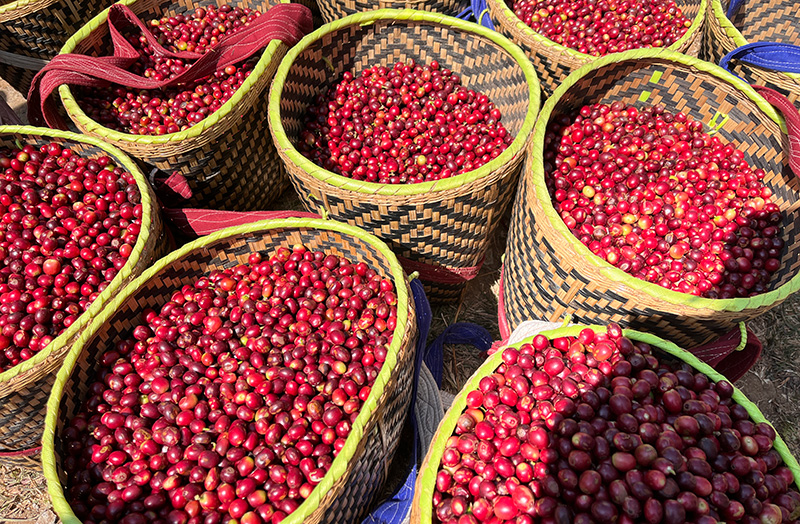
Photo shows coffee cherries in Lincang, southwest China's Yunnan Province. (Photo courtesy of the Publicity Department of the Communist Party of China Lincang Municipal Committee)
In 2021, Lincang prioritized varietal improvement, introducing premium cultivars such as Geisha, Sarchimor and Batian for trial cultivation at higher elevations. More than 10 disease-resistant, distinctively flavored varieties suited to local conditions were eventually selected, giving the industry a much-needed genetic upgrade.
Technical guidance followed swiftly. Luo Zhongwei, an agricultural technician from the city's Yunxian county, regularly teaches farmers soil-testing and formula-based fertilization on-site in the fields.
"The flowering period is critical. Soil moisture must be kept between 50 and 60 percent, and nutrition needs to be boosted while pest and disease prevention is stepped up to improve fruit set," Luo said.
Green pest-control methods such as yellow and blue sticky traps and insect-killing lamps have gradually replaced conventional pesticides, and standardized cultivation practices have steadily improved coffee bean quality.
Estate managers have also stepped in as instructors. During the planting season, Zhu Hong, head of Xigui Coffee Estate, shared techniques for soil testing, moisture management, pest control and pruning with neighboring growers. Wang Jiaqiang of Lincang Yunjia Coffee Co., Ltd. took the lead in establishing the Lincang Specialty Coffee Association, which holds regular training sessions and technical exchanges.
Thanks to technical guidance, Wang Ruwei renovated older plots, grafted new varieties and adopted integrated water-fertilizer management. As quality improved, the purchase price for his fresh coffee cherries rose severalfold. Last year, he expanded his planting by an additional 2 mu.
Today, Lincang is home to more than 140 contiguous standardized coffee plantations of 100 mu or larger, with premium-variety coverage rising sharply.
At Qiupo Estate in Cangyuan Wa Autonomous County, estate owner Sai Min has fitted her coffee trees with Internet of Things sensors to monitor soil moisture and other conditions in real time.
The estate has built a dedicated research team to refine processing techniques and minimize the impact of climate and other external variables on flavor, ensuring consistent quality across every batch. The precision-driven approach has earned repeated recognition at international competitions.
In the past, Lincang's coffee industry lacked the capacity for deep processing, relying mainly on selling unprocessed beans. To break out of that mold, the city pooled financial resources to build standardized fresh-cherry processing centers in key production areas and encouraged enterprises to upgrade their equipment.
Working with experts from China Agricultural University and the Yunnan Academy of Agricultural Sciences, local researchers developed a new drying method and introduced related techniques. This addressed long-standing quality-control challenges in the drying stage while raising processing consistency and overall quality.
Today, a crop of homegrown coffee brands has emerged. With 34 primary processing lines and 11 deep-processing lines now in operation, Lincang coffee has completed its transformation from raw-material supplier to quality-standard setter. Drip bags, cold-brew concentrates, capsule coffee and other attractively packaged products are reaching consumers across China through both online and offline channels.
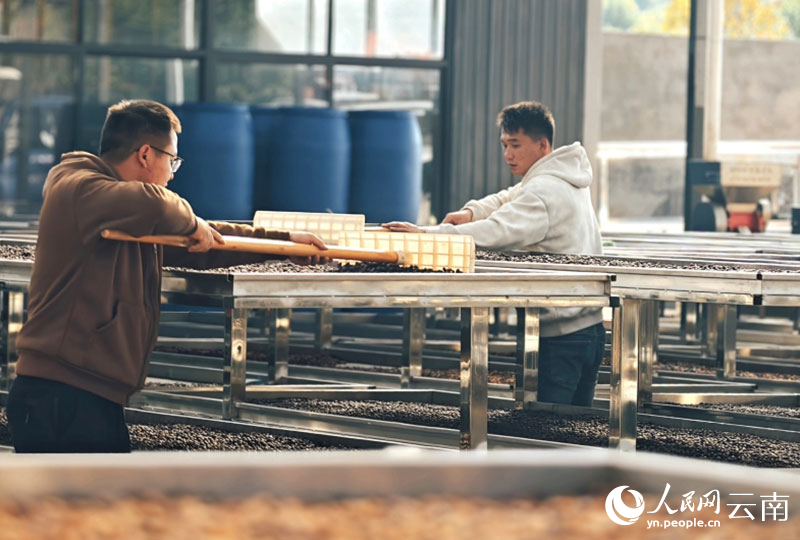
Workers dry coffee beans at Rongkangda coffee estate in Shuangjiang county, Lincang city, southwest China's Yunnan Province. (People's Daily Online/Yin Xin)
Local financial institutions have channeled funds along the coffee industry chain, extending a cumulative 135 million yuan in loans to the sector by end-2025 and benefiting 659 business entities.
Boutique coffee estates integrating cultivation, processing, experiential activities and sightseeing have become a familiar sight in Lincang. Capitalizing on its climate and cultural assets, the city has steered the industry toward premium, branded and estate-based development, giving rise to new business models such as "coffee plus tourism," "coffee plus study tours" and "coffee plus creative cultural products." In 2025, coffee estates across Lincang received more than 230,000 tourist visits.
Underpinning this growth is a steadily improving benefit-sharing mechanism. A model involving cooperation among Party organizations, leading enterprises, bases and farmers has been widely adopted across Lincang's coffee-growing areas, embedding growers firmly in the value chain.
Wei Xuefang, a resident of Nuoliang township in Cangyuan Wa Autonomous County, leased her 10 mu of land to Qiupo Estate and stayed on as a worker, earning over 100 yuan a day.
"I used to grow corn. Now, with rent and wages combined, I make more than 50,000 yuan extra every year," she said.
In 2025, Cotti Coffee, a Chinese private coffeehouse brand, broke ground on a coffee industrial park in Lincang, backed by an investment of 500 million yuan, including a fully automated hulling production line. The company has brought stable orders, rigorous quality standards and stronger benefit-sharing arrangements, opening up far broader market access for local growers.
Photos

Related Stories
- 4th Jiangmen Coffee Culture Festival kicks off in China's Guangdong
- China's Puyang develops full-industry-chain coffee production system
- New platform facilitating Ethiopian coffee entry into Chinese market launches in central China
- Hillside cafe wins viral fame as farmer becomes coffee "flame brewer"
- China's zero-tariff policy opens new doors for Ugandan coffee exports: entrepreneur
- Coffee plants enter harvest season in Baoshan, China's Yunnan
- China becomes fourth-largest importer of Ethiopian coffee
- China's coffee boom spawns new professions
- PD Vlog | A journey into Yunnan coffee
- Chinese coffee chain launches Brazilian coffee-themed store in Greater Bay Area
Copyright © 2026 People's Daily Online. All Rights Reserved.
