



Harnessing Xizang's high-plateau environment to build greener, more efficient data centers
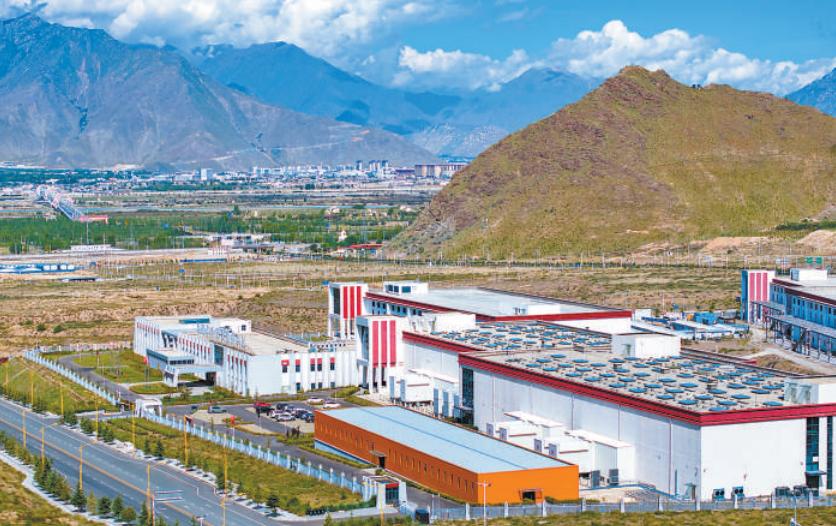
Photo shows a data center managed by Ningsuan in Xizang autonomous region. (Photo/Xu Yuyao)
On the outskirts of Lhasa, capital of southwest China's Xizang Autonomous Region, a giant complex with local architectural features stands nestled among the mountains. It is a data center operated by local computing company Ningsuan, with a total capacity of 140,000 server racks.
Inside the server halls, a notable feature is the absence of noisy air-conditioning systems.. Despite this, the environment remains cool. What enables this efficient cooling?
"Data centers are major heat generators, and at many facilities a large portion of energy is consumed by cooling systems," explained Tao Changjun, vice president of Ningsuan. "Here on the plateau, we harness the region's exceptionally dry air to naturally reduce temperatures and minimize energy consumption."
Compared to other high-altitude regions such as Yunnan and Guizhou, the air here is even drier; compared to other arid regions, the average temperature is lower. This combination creates ideal conditions for natural cooling.
A key indicator is the wet-bulb temperature, the lowest temperature possible using evaporative cooling. In Lhasa, summer wet-bulb temperatures are significantly lower than in most parts of the world.
"In simple terms, making use of 'dry air energy' means maximizing cooling through evaporation, using temperature differences to create pressure differences, and ultimately achieving natural ventilation," Tao said. Based on this principle, the company designed a system that allows fresh air to circulate through the data center to quickly carry heat away.
Overall, this approach expands how widely natural cooling can be applied in data centers and delivers significant energy savings. It not only ensures stable operations but also reduces total energy consumption by around 30 percent.
While the concept is straightforward, implementation was complex. Data centers require highly stable temperatures, necessitating precise control over evaporation rates, internal temperature gradients, and airflow to mitigate instability from weather fluctuations.
To address this, Ningsuan worked with Xi'an Polytechnic University in northwest China's Shaanxi province to develop a heat-matching algorithm. By fine-tuning airflow patterns and water evaporation cycles, the system maximizes thermal efficiency and keeps temperatures stable year-round.
Building the cooling equipment also brought challenges. Tao recalled that the first-generation units were designed and manufactured in other provinces before being transported to Lhasa. Initially, they operated normally, but soon began to report frequent errors.

Photo shows a cloud computing center managed by Ningsuan in Xizang autonomous region. (Photo/Li Haixia)
Analysis revealed the issue: while the equipment was adapted for high-altitude conditions like low air pressure and specific thermal properties, certain unique environmental factors, such as intense ultraviolet radiation accelerating material aging, had been overlooked -- posing a significant challenge for systems requiring precise control.
Engineers then launched a new round of technical upgrades. By improving operating modes and using advanced composite materials including synthetic fiber-based high-molecular fillers, they significantly enhanced the stability and safety of the equipment in plateau conditions.
Beyond economic efficiency, developing data centers in high-altitude regions demands careful ecological consideration.
To answer these concerns, the center uses heat recovery. Next to the data center sits a large greenhouse that remains warm throughout the year, heated entirely by recycled waste heat. Inside, warm-water fish can be farmed, and crops can be grown.
"Driven by technological innovation, Xizang's resource advantages can be effectively transformed into economic strengths," said Jiang Ning, president of Ningsuan. "In the future, data centers here may even generate revenue through carbon credit trading and heat recovery sales."
Photos
Related Stories
- Rapeseed flowers, peach flowers in full bloom in Bomi County of China's Xizang
- World Day for Glaciers: Wild yaks at Zangser Kangri Glacier in China's Xizang
- Foreign trade of China's Xizang jumps in Jan.-Feb.
- White-lipped deer population increases in Xizang as ecological environment improves
- Ceremonies marking start of spring farming held across China's Xizang
- Snow scenery of ancient white castles on Mt. Dzongri in China's Xizang
- Ranger's 14-year watch over greening mountain on "roof of world"
- Smart system powers plateau farming in Lhasa, SW China's Xizang
- Xizang Story: Ranger's 14-year watch over greening mountain on "roof of world"
- Xizang aims to better preserve ethnic culture
Copyright © 2026 People's Daily Online. All Rights Reserved.
