



China's senior citizens embrace lifelong learning as elderly education expands
With more "silver-haired" individuals returning to the classroom, learning has become a vital way for older adults to enrich their lives and enhance their sense of self-worth. Elderly education is evolving into a widespread social phenomenon, taking diverse forms.
Data shows that by the end of 2024, China's population aged 60 and above reached 310 million, accounting for 22 percent of the total population. As the elderly population continues to expand, growing numbers of older adults are choosing to devote greater attention to planning their post-retirement years in pursuit of a fulfilling later life.
Many older adults are redefining their roles in retirement with unprecedented initiative. Rather than settling for traditional eldercare services centered mainly on daily care, they are stepping into classrooms to find joy in learning and a renewed sense of purpose.
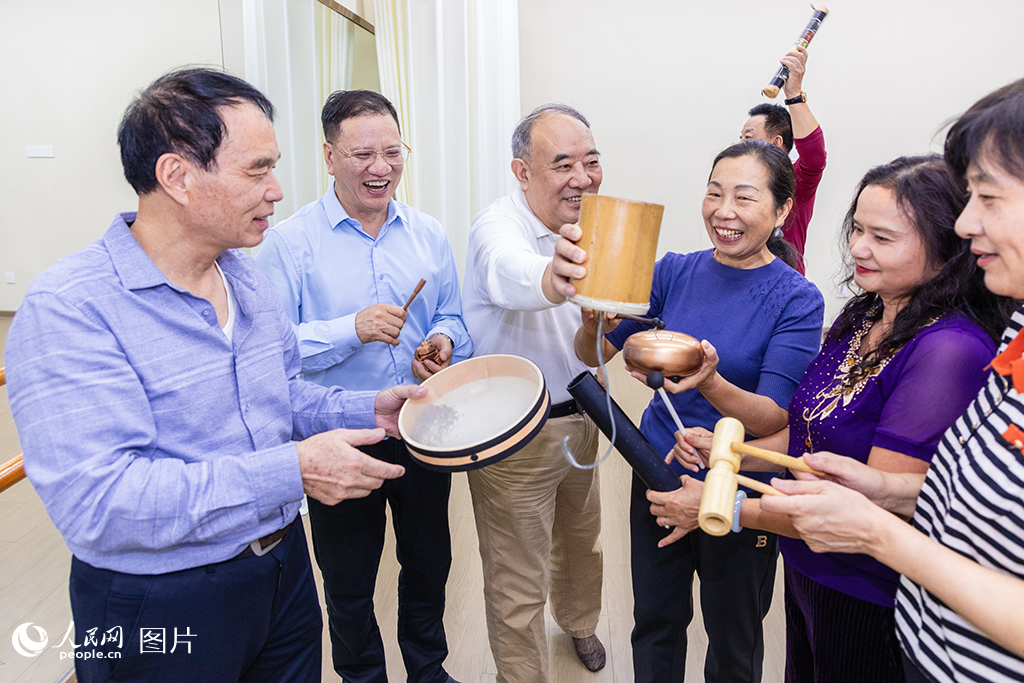
Elderly students try out fun instruments during a music therapy session at Fujian Open University (National Open University for the Elderly, Fujian Branch) in Fuzhou, southeast China's Fujian Province on Oct. 24, 2025. (People's Daily Online/Jiao Yan)
For He Changmei, 59, retirement has opened the door to long-held interests. "Learning has never been a stage-specific task, but a lifelong state of being," she said. After retiring from the China National Committee on Ageing, she studied nutrition, psychology, and other subjects while rekindling her interests in calligraphy and classical poetry.
"While the body inevitably ages, wisdom can continue to develop through learning," He said.
Like her, an increasing number of elderly people are actively pursuing education after retirement, incorporating learning into their daily routines. Behind this active choice lies the combined effect of personal motivation and social support.
On the one hand, this trend reflects distinct generational characteristics among older adults. Chen Gong, director of the Institute of Population Research at Peking University, noted that today's older people generally have higher levels of education, better health, and greater autonomy. They are no longer satisfied with basic eldercare services focused solely on meeting daily needs; instead, they pursue spiritual enrichment, the continuation of social value, and high-quality life experiences. Learning has become the most direct path to achieving these goals.
Data shows that spending on "developmental" and "enjoyment-oriented" items such as cultural entertainment and educational training is taking up a growing share of elderly consumption, reflecting an overall upgrade in their consumption needs.
On the other hand, learning has become an important channel through which older people can reintegrate into society.
"After entering the classroom, they rediscover life's rhythm and purpose," observed Tian Na, business director at Qianchixuetang, a Beijing-based interest-focused learning platform for seniors. Learning not only gives older adults a vibrant new identity — that of a student — but also helps them build new social circles through classroom interaction, reconnecting them with others and with society.
"The current elderly education market is in an initial stage where supply seriously lags behind demand," Tian acknowledged. The rise of online education platforms has provided important support in addressing this structural gap.
"We hope to deliver diverse courses directly to seniors' homes through the internet," Tian said. Online course models have reached seniors who might otherwise be overlooked, especially those living outside city centers or those with limited mobility.
From traditional cultural arts such as calligraphy and Chinese painting, to digital skills including smartphone use and short video production, to health and wellness courses such as Baduanjin and Tai Chi, a wide range of online courses offers seniors greater choice, allowing them to select courses according to their interests and needs.
"Users' learning continuity and engagement far exceed expectations, with course completion rates surpassing 90 percent, which greatly encourages us," Tian said. The platform's elderly education segment has served nearly 10 million trainees, maintaining an average annual growth rate of around 20 percent.
For retirees like He, the most direct benefit of participating in elderly education is a renewed connection with society.
"On a calligraphy study tour I attended in 2025, I not only connected with like-minded companions but also reintegrated into a vibrant cultural and social circle through our shared interest," He said. "Retirement is not an endpoint but a brand-new starting point. Age has never been a barrier, and retirement is certainly not a label that defines us."
Photos



Related Stories
- Bridging life and death, resolving the final dilemmas of vulnerable seniors
- China introduces national subsidy for elderly care services to foster senior-friendly society
- "Train of migratory birds" brings winter sunshine to elderly Chinese travelers
- China to promote tech-enabled elderly care to enhance seniors' well-being
- Elderly care economy to get a fillip
- Pursuit of 'silver dividends' redefines seniors' golden years
- Paid companionship for the body and mind
- Chinese seniors making their mark in digital world
- Aging in style: China's new silver generation spends more on joy
- Robotics eldercare expands amid aging population challenge
Copyright © 2026 People's Daily Online. All Rights Reserved.
