



Over 1,000 student teachers help transform education in SW China's Xizang
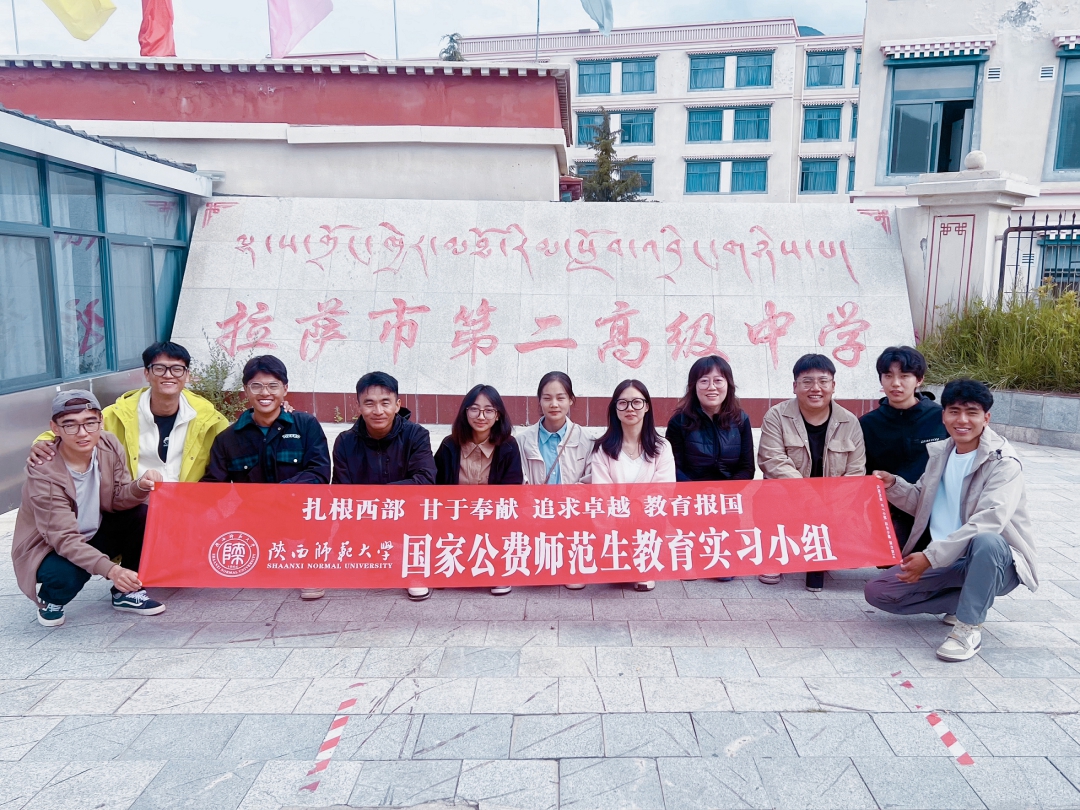
Interns from SNNU pose for a photo at the No. 2 Senior High School in Lhasa, southwest China's Xizang Autonomous Region. (Photo/China Education Daily)
Over the past 15 years, Shaanxi Normal University (SNNU), based in Xi'an, northwest China's Shaanxi Province, has organized more than 1,000 students to undertake teaching internships at over 20 schools across southwest China's Xizang Autonomous Region.
More than 80 percent of these interns have voluntarily chosen to remain in the region and take up teaching posts. The program began in 2010, when SNNU sent its first group of publicly funded normal university students to the region.
Fu Yu, a member of the university's first cohort of students, still remembers the autumn of 2010. As part of the university's inaugural internship team bound for Xizang, he and 80 other students departed from Xi'an carrying teaching plans and medication to combat altitude sickness. After a 48-hour journey by train and bus, they finally reached the region. At the time, Xizang faced a severe shortage of educational resources and qualified teachers, and their arrival, Fu recalled, was like "timely rain" for local schools.
The 2010 internship program was never intended as a one-off assignment, said Zhang Yaze, director of the Academic Affairs Office at SNNU. That year, the university signed a cooperation agreement with the Department of Education of the Xizang Autonomous Region, establishing principles of discipline alignment and sustained collaboration. Through the continuous placement of professionally trained teachers, SNNU has helped quality educational concepts and effective teaching methods take root in the region.
In Lhari county, Nagqu city, situated at an average altitude of 4,500 meters, Tashi Namgyal, a publicly funded normal university student who enrolled at SNNU in 2019, was unable to travel to his internship school because of the pandemic. Every day, he got up at 5 a.m. to help his family herd yaks and then made his way to the village cultural center, one of the few places with a stable signal, to teach his students online.
As a native of Xizang, Tashi Namgyal was keenly aware of the difficulties faced by students in pastoral areas. "Many students didn't have internet access at home, so I recorded the lessons in audio and video format and sent them to the students," he said.
Pang Wei, an associate professor at SNNU, has led internship teams to Xizang for many consecutive years. Through this work, she has witnessed generation after generation of student teachers make the journey to the plateau for internships and eventually join the ranks of educators serving the region.
One such example is Kelzang Dorje, a student from the 2021 cohort at SNNU. During his internship at No. 2 Senior High School in Lhasa, he consistently incorporated elements of local Tibetan culture into his lesson plans, helping students cultivate a deeper sense of cultural identity connected to their hometowns.
In 2023, the Education Bureau of Ngari Prefecture partnered with seven universities in Shaanxi Province to establish a teacher training facility. As a key participant, SNNU developed the guidelines for educational internships in Xizang Autonomous Region, which emphasize designing curricula grounded in local culture and adapting teaching methods to the unique conditions of pastoral areas.
"My own internship mentor graduated from SNNU, and now I've become an internship mentor myself," said Shi Lei, a teacher at Lhasa Middle School. Over more than a decade of teaching in Xizang, he has grown into an outstanding educator. He also founded the public WeChat account "Shi Talks English," which curates a wide range of teaching resources and has supported more than 10 schools across the region.
In recent years, SNNU has steadily advanced its practice-oriented reforms in teacher education, expanding internship opportunities in Xizang and refining training programs tailored to local needs. As a result, an increasing number of graduates are discovering both purpose and fulfillment on the snow-covered plateau.
Photos

Related Stories
- Panchen Rinpoche concludes Xizang tour
- Trans-Himalaya Tibetan medicine research center opens in China's Xizang
- Devoted guardians make protection efforts more engaging
- Xizang conducts 42 archaeological excavations over past five years
- Lhalu Wetland in China's Xizang confirmed as world's highest altitude natural urban wetland
- Residents celebrate traditional "Gutu Eve" ahead of Tibetan New Year in SW China's Xizang
- Xizang's first ultra-high voltage power link begins operations
- New fish species discovered in China's Xizang
- Wild animals thrive at Changtang National Nature Reserve in China's Xizang
- Scenery of lake in Maizhokunggar County, China's Xizang
Copyright © 2026 People's Daily Online. All Rights Reserved.
