



Chinese-made robotics show strength on world stage
Chinese-made robots are expanding globally at an unprecedented pace. Industrial robot output continues to grow, service robot shipments are accelerating, humanoid robots are being deployed in multiple countries, and core component manufacturers are integrating into global supply chains.
The overseas expansion of Chinese-made robots is marked by higher technological sophistication, more complex engineering systems, and stronger demand for localized services.
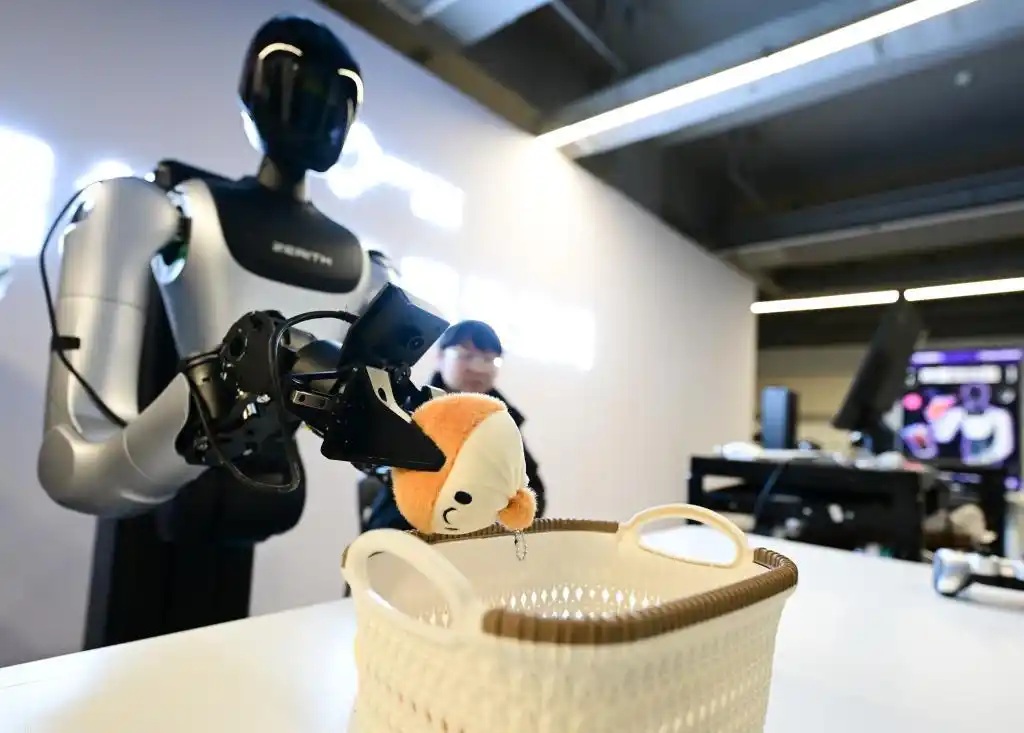
A staff member trains a robot to fetch a toy for data collection. (Xinhua/Zhou Mu)
At the opening ceremony of the 2025 RoboCup Asia-Pacific in Abu Dhabi, the United Arab Emirates (UAE), the Booster K1 humanoid robots from Beijing-based Booster Robotics presented a dance performance alongside a local band. A video of the robots dancing with human performers quickly went viral on international social media.
Chinese-made robots are increasingly appearing in real-world settings around the globe. In Singapore, cleaning robots quietly glide through a shopping mall, performing precise dusting and floor cleaning. In Madrid, Spain, coffee robots brew cups in tens of seconds. At Dubai International Airport, the UAE, self-service check-in robots assist travelers with steady precision.
The World Robotics 2025 Report shows that China has been the world's largest industrial robot market for 11 straight years and now holds more than 190,000 valid robotics patents, nearly two thirds of the global total.
Data from China's General Administration of Customs (GAC) shows that in the first half of 2025, China exported 94,200 industrial robots, valued at $746 million, a year-on-year increase of 59.74 percent.
Chinese brands dominate the global home cleaning robot market. A report shows that four of the top five vacuum robot brands in the first half of the year were Chinese. Together, the four brands accounted for 57 percent of the global market.
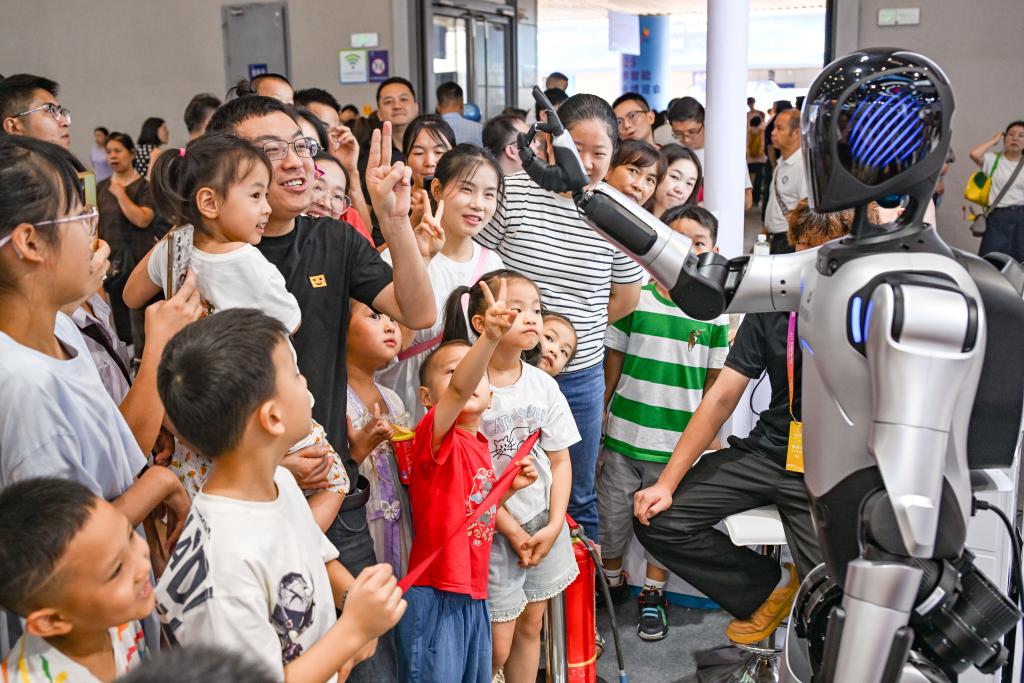
A humanoid robot interacts with audiences at the World Smart Industry Expo 2025 in southwest China's Chongqing Municipality. (Xinhua/Wang Quanchao)
Keenon Robotics, with 15 years of experience, has deployed its embodied AI robotics solutions in over 60 countries and regions of the world, covering scenarios such as delivery, cleaning, and reception. Products from Chinese robotics company Pudu are sold in more than 80 countries and regions.
Unitree Robotics has launched products on international e-commerce platform AliExpress and walmart.com, expanding its international reach. Unitree Robotics founder Wang Xingxing said that overseas sales have accounted for 50 percent of the company's revenue over the past years.
Some Chinese humanoid robot manufacturers plan to produce key components in ASEAN countries, extending their supply chains and scaling humanoid robot production overseas.
Chen Bing, vice dean and professor at the Law School of Nankai University, and a contract research fellow at the Chinese Institute of New Generation Artificial Intelligence Development Strategies, sees a complete supply chain as the foundation for Chinese robots abroad.
Policy support is another major driving force. The "robotics+" action, jointly launched by the Ministry of Industry and Information Technology and 16 other government departments to expand the use of robotics, calls for a focus on key application areas and promotes coordinated progress from product R&D and technological innovation to real-world application.

Humanoid robotic bartenders interact with customers. (Xinhua/Ju Huanzong)
According to Wei Xiang, a researcher at the Chinese Academy of Social Sciences, mass production remains a core challenge for robotics companies worldwide. He noted that overseas demand for high-end robots is also strong. International customers are more diverse and have greater purchasing power, which helps companies accelerate mass production, reduce costs, and drive the industry toward real commercial breakthroughs.
Chinese robotics companies are also gaining ground in both cost and performance. According to Li Tong, founder and CEO of Keenon Robotics, Chinese robots used to offer 70 percent of the performance of leading international products at half the price. Today, they deliver 150 percent of that performance while costing 80 percent, making them far more competitive and cost-effective.
Photos


Related Stories
- Data collection pre-training center helps robots adapt to diverse tasks in Hefei, China's Anhui
- Humanoid robot industry booms in central China's Hubei
- BRI media representatives explore robotics tech in Shenzhen, S China's Guangdong
- Romantic yet hardcore! This dancing butterfly is actually a robot?!
- Slipknots designed to give surgical robots sense of touch
- Research team from USTC in E China's Hefei dedicated to developing humanoid robot
- Hefei in China's Anhui promotes development of intelligent robot industry
- China to promote sound, orderly development of embodied intelligence industry
- Chinese scientists develop artificial tongue to measure spiciness
- Robotics eldercare expands amid aging population challenge
Copyright © 2025 People's Daily Online. All Rights Reserved.
