The average daily online leisure time for Chinese people has reached 4.9 hours in the past year, with an average annual leisure consumption of 5,647 yuan (about $863), according to a report recently released.
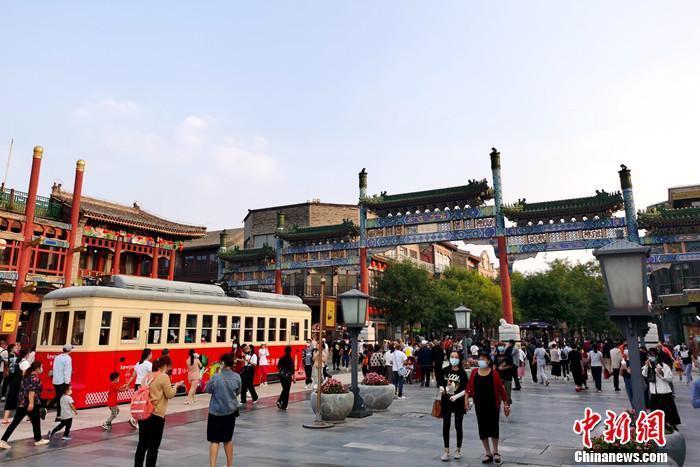
Tourists crowd Qianmen Street in Beijing, Sept. 26, 2020. (Photo/Chinanews.com)
The National Academy of Economic Strategy of the Chinese Academy of Social Sciences, the Tourism Research Center of the Chinese Academy of Social Sciences and the Social Science Literature Publishing House jointly issued the "Leisure Green Paper: China's Leisure Development Report from 2019 to 2020" on Dec. 9.
The Green Paper points out that with the development of the Internet and the enrichment of recreational modes, mobile entertainment that transcends the limitations of time and space have become increasingly vital for Chinese people's leisure life.
The average daily online leisure time in the past year was 4.9 hours, according to the "China National Leisure Survey (2020)," conducted by the Tourism Research Center of the Chinese Academy of Social Sciences in conjunction with Tencent and other institutions.

Tourists choose products at a duty-free shop in Haikou, capital of south China's Hainan Province. (Photo/Chinanews.com)
The survey results further showed that 27.3 percent of the respondents spent 1-3 hours on online leisure activities per day; 25.6 percent of them spent 3-5 hours of online leisure every day and 16.2 percent of the respondents spent 5-8 hours on cyber entertainment every day.
The survey indicated that in the past year, the average annual leisure consumption was 5,647 yuan for Chinese people.
Among them, 22.7 percent of the expenditure on personal leisure consumption fell within the range of 1,001-3,000 yuan; 44.4 percent of the respondents' annual leisure consumption expenditure equaled to 1,000 yuan or less, while 11.8 percent of the people spent more than 10,000 yuan on leisure every year.
The results of the "China National Leisure Survey (2020)" show that China's national leisure still faces some restrictive factors. Compared with the results of the National Leisure Survey conducted by the Tourism Research Center of the Chinese Academy of Social Sciences in 2013, the main obstacles restricting national leisure have changed greatly.
According to the 2013 survey, the main constraints affecting national leisure activities are personal views, economy and time.
This year's survey found that, nowadays, the factors that have the greatest impact on national leisure activities are time (such as too little holiday time, unable to arrange holidays freely, etc.) and space (such as overcrowding, poor conditions, poor service, insecurity, etc.).
 Fire brigade in Shanghai holds group wedding
 Tourists enjoy ice sculptures in Datan Town, north China
 Sunset scenery of Dayan Pagoda in Xi'an
 Tourists have fun at scenic spot in Nanlong Town, NW China
 Harbin attracts tourists by making best use of ice in winter
 In pics: FIS Alpine Ski Women's World Cup Slalom
 Black-necked cranes rest at reservoir in Lhunzhub County, Lhasa
 China's FAST telescope will be available to foreign scientists in April
 "She power" plays indispensable role in poverty alleviation
 Top 10 world news events of People's Daily in 2020
 Top 10 China news events of People's Daily in 2020
 Top 10 media buzzwords of 2020
 Year-ender:10 major tourism stories of 2020
 No interference in Venezuelan issues
 Biz prepares for trade spat
 Broadcasting Continent
 Australia wins Chinese CEOs as US loses