

The COVID-19 epidemic has driven Chinese museums to rely more on digital means, including online exhibitions and livestreaming shows to connect with people and protect cultural relics.
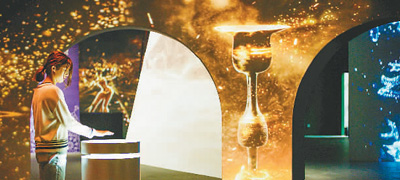
A visitor tries a digital interactive device during the Internet plus Chinese Civilization Exhibition in the Capital Museum in Beijing. (Photo courtesy of the organizer)
The online campaign “Treasure Hunt Relay: Global Museum Director’s Choice,” initiated by the National Museum of China in collaboration with another 15 museums from various countries, kicked off in early September. Attracting about 200 million audiences worldwide, during the nine-day event the National Museum of China offered audiences an immersive experience through 8K videos of its collections, augmented reality (AR) technology, animation, and 5G-based live broadcast.
Wang Chunfa, director of the museum, shared some treasures during a livestreaming show, including a Tang Dynasty (618-907) portrait depicting Fuxi and Nyuwa, considered the originators of human society in Chinese mythology, and a bronze life-size human figure with acupuncture points made in the Ming Dynasty (1368-1644).
In recent years, major museums in China have accelerated their digital transformation by means of virtual reality.
“Technology has brought a tremendous change in experience for people,” said Yu Kailiang, a professor with the School of Philosophy at Renmin University of China, adding that the application of technologies in museums can bring high-definition, three-dimensional, interactive and virtual experiences for people.
The development of digital means has spurred a new idea for the protection of cultural relics and inheritance of fine traditional culture.
“Digital technologies will play a vital role in the recording of exhibitions, the digital preservation of cultural relics, and the protection and restoration of cultural relics,” said Yan Yan, deputy curator of Beijing’s Today Art Museum.
Tianjin Museum has launched a digital protection project for cultural relics in recent years, completing the digital image of cultural relics, including 25 porcelain ware, jade ware, bronze ware, and inkstones, as well as silk fabrics and 100 calligraphy and painting works.
Some museums have also worked with internet companies in the process of their digital development. A WeChat mini-program offering online tours of China’s Dunhuang Mogao Grottoes has recorded about 19 million visits since it was launched by Dunhuang Academy China and Chinese internet giant Tencent in late February.
With the mini-program, people can not only enjoy frescoes and learn cultural stories behind the relics, but also design silk scarves with fresco elements and “try them on” using the artificial intelligence technology of Tencent Cloud, the cloud computing arm of Tencent.
 Fire brigade in Shanghai holds group wedding
 Tourists enjoy ice sculptures in Datan Town, north China
 Sunset scenery of Dayan Pagoda in Xi'an
 Tourists have fun at scenic spot in Nanlong Town, NW China
 Harbin attracts tourists by making best use of ice in winter
 In pics: FIS Alpine Ski Women's World Cup Slalom
 Black-necked cranes rest at reservoir in Lhunzhub County, Lhasa
 China's FAST telescope will be available to foreign scientists in April
 "She power" plays indispensable role in poverty alleviation
 Top 10 world news events of People's Daily in 2020
 Top 10 China news events of People's Daily in 2020
 Top 10 media buzzwords of 2020
 Year-ender:10 major tourism stories of 2020
 No interference in Venezuelan issues
 Biz prepares for trade spat
 Broadcasting Continent
 Australia wins Chinese CEOs as US loses