

The second phase of the Belo Monte ultrahigh voltage power project in Brazil has brought real benefits to people in Brazil, such as sufficient and clean power supply as well as thousands of job opportunities.
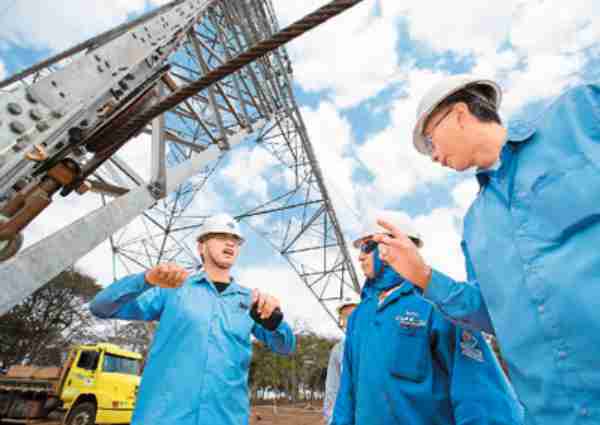
Chinese workers exchange views with their Brazilian counterparts at the construction site of the 9th section of the second phase of the Belo Monte ultrahigh voltage power project in the state of Minas Gerais, Brazil. (Xinhua/Li Ming)
The project spans more than 2,500 kilometers and was contracted by the State Grid Corporation of China (SGCC). It has been in operation for nearly half a year and generated 7.2 billion kilowatt-hours of electricity. The company’s subsidiary, State Grid Brazil Holding (SGBH), won the bid for the project in July 2015.
The electricity transmission line crosses 81 cities of five states in Brazil, bringing clean energy from the Amazon rainforest in the north to major energy consumption areas in the southeast of the country, including Rio de Janeiro, benefiting about 20 million people.
At the same time, the project was also designed to leave a smaller carbon footprint. “We started construction of the project in September 2017, two years after winning the bid, during which we assessed the project’s environmental impact,” said Zhang Zhe, a staff member with State Grid International Development Co., Ltd., another of SGCC’s subsidiaries.
Environmental protection efforts include planting about 6,678 hectares of trees, carrying out surveys on 936 species of animals, and saving 60 types of plants in danger of extinction. To safeguard local forests, high transmission towers were used so that the power line would hover over tree canopies.
The project not only provides long-distance and high-efficiency power transmission, a lack of which has plagued Brazil for a long time, but also boosted local economic development by creating 16,000 job opportunities.
SGBH has also undertaken a number of social projects along the power line, for example digging wells for drinking water and establishing a fruit juice plant in a poor community. The company has also helped to build a poultry farm and a milk factory, and donated medical equipment to local hospitals along the line.
Furthermore, it announced it would invest in efforts to preserve the Valongo Wharf, an archeological site of great historical importance in Brazil, which was also designated as a UNESCO World Heritage Site.
SGBH president Cai Hongxian said the company has always taken its social responsibilities seriously and made sure to bring benefits to local people while improving its own corporate performance.
 Fire brigade in Shanghai holds group wedding
 Tourists enjoy ice sculptures in Datan Town, north China
 Sunset scenery of Dayan Pagoda in Xi'an
 Tourists have fun at scenic spot in Nanlong Town, NW China
 Harbin attracts tourists by making best use of ice in winter
 In pics: FIS Alpine Ski Women's World Cup Slalom
 Black-necked cranes rest at reservoir in Lhunzhub County, Lhasa
 China's FAST telescope will be available to foreign scientists in April
 "She power" plays indispensable role in poverty alleviation
 Top 10 world news events of People's Daily in 2020
 Top 10 China news events of People's Daily in 2020
 Top 10 media buzzwords of 2020
 Year-ender:10 major tourism stories of 2020
 No interference in Venezuelan issues
 Biz prepares for trade spat
 Broadcasting Continent
 Australia wins Chinese CEOs as US loses