A rescue team in the Pearl River Estuary Chinese White Dolphin National Nature Reserve in southern China’s Guangdong province has rescued various whales and dolphins more than 200 times and sent more than 190 Chinese white dolphins, a national first-class protected species in China, back home safely, during the last 10 years.
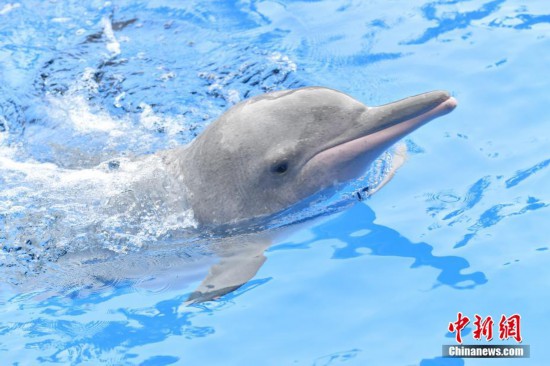
A Chinese white dolphin plays in a park in Zhuhai, Guangdong province. (Photo/Chinanews.com)
The rescue team in the nature reserve, which covers an area of 460 square meters, is the only professional rescue team in China that mainly focuses on Chinese white dolphins.
Saving and protecting stranded whales and dolphins is an important part of the work of the rescue team. Whales and dolphins usually get stranded in shallow water and can’t swim back to deep water because they are sick or in poor health, or lose their ways, according to the rescue team.
Whales and dolphins have strayed into rivers and gotten stranded many times in Guangdong province in recent years, said the rescue team.
Besides rescuing whales and dolphins, the team also takes part in international cooperation, academic exchanges, scientific research projects, and regular science popularization activities.
The Chinese white dolphin, nicknamed “giant panda in the sea,” is “fatty” in dolphins, as it is usually two to three meters in length, but could weigh more than 200 kilograms, according to Gao Guangyin, a marine biology engineer in the administration of the reserve, who is also a member of the rescue team for whales and dolphins.
Since the efforts to protect and rescue whales and dolphins usually mean great demand for physical strength, most of the members of the rescue team are young people under the age of 35, Gao disclosed.
“When injured Chinese white dolphins receive treatment in the rescue center, our team members often need to dive into water to apply medicine to it, or need to help offer the animals B-scan ultrasonography examinations and blood routine examinations,” said Gao, adding that it usually takes the teamwork of several people to turn the body of a dolphin or feed it as it receives treatment in a dedicated pool.
“It’s not only an occupation for me, for I like being involved with marine environmental protection, and it’s meaningful to integrate species protection and environmental protection, especially the protection of the Chinese white dolphin, which is very popular with coastal residents,” said Gao.
“On-site treatment is the most difficult task since the locations where whales and dolphins get stranded are usually remote shores,” said Chen Xi, head of the rescue team and director of the technical department of the administration of the Pearl River Estuary Chinese White Dolphin National Nature Reserve.
“A dolphin would be in critical condition if it were to get stranded along the course of the river,” said Chen, recalling the case of a Chinese white dolphin they called Lao Bai (old white) that got stranded in the flow of a river in the Luocun neighborhood of Shishan town in Nanhai district of Foshan in Guangdong province.
“It was freshwater, and there was a lot of sludge in the river. Lao Bai was having difficulty breathing. It’s hardly easy to drive a live dolphin out of the course of a river. Such a situation is difficult to handle,” Chen stressed.
The spiracle of a dolphin is on its head, said Chen, explaining that the stranded Lao Bai needed to be watched 24 hours a day. Otherwise it might have turned over and not been able to breathe, and then it would be choked to death, for it was too weak at that time.
Luckily, Lao Bai was taken good care of by Chen and his colleagues, who eventually took it to the dedicated pool in the nature reserve for treatment.
Chinese white dolphins have less and less space to live, due to multiple reasons, including decline in fishery resources, water pollution, and reproductive rates.
“Based on the sphere of activities of Chinese white whales and the frequency of them being spotted, scientific research teams found that the number of Chinese white whales is constantly decreasing and that their sphere of activities is shrinking. The Chinese white dolphin has been included in the International Union for Conservation of Nature (IUCN) Red List of Threatened Species,” disclosed Chen.
The rescue team compiled an analysis report for every stranded dolphin that they met and established archives for them.
In recent years, the Pearl River Estuary Chinese White Dolphin National Nature Reserve has recruited volunteers constantly and created a WeChat group for volunteers who are keen on protecting Chinese white dolphins, disclosed Chen Hailiang, head of the administration of the reserve.
More and more people are taking part in the protection of Chinese white dolphins, according to Chen, adding that “we also give presentations in colleges and universities, hoping that more young scientific research personnel can take part in the research work occurring at the nature reserve.”
 Fire brigade in Shanghai holds group wedding
 Tourists enjoy ice sculptures in Datan Town, north China
 Sunset scenery of Dayan Pagoda in Xi'an
 Tourists have fun at scenic spot in Nanlong Town, NW China
 Harbin attracts tourists by making best use of ice in winter
 In pics: FIS Alpine Ski Women's World Cup Slalom
 Black-necked cranes rest at reservoir in Lhunzhub County, Lhasa
 China's FAST telescope will be available to foreign scientists in April
 "She power" plays indispensable role in poverty alleviation
 Top 10 world news events of People's Daily in 2020
 Top 10 China news events of People's Daily in 2020
 Top 10 media buzzwords of 2020
 Year-ender:10 major tourism stories of 2020
 No interference in Venezuelan issues
 Biz prepares for trade spat
 Broadcasting Continent
 Australia wins Chinese CEOs as US loses