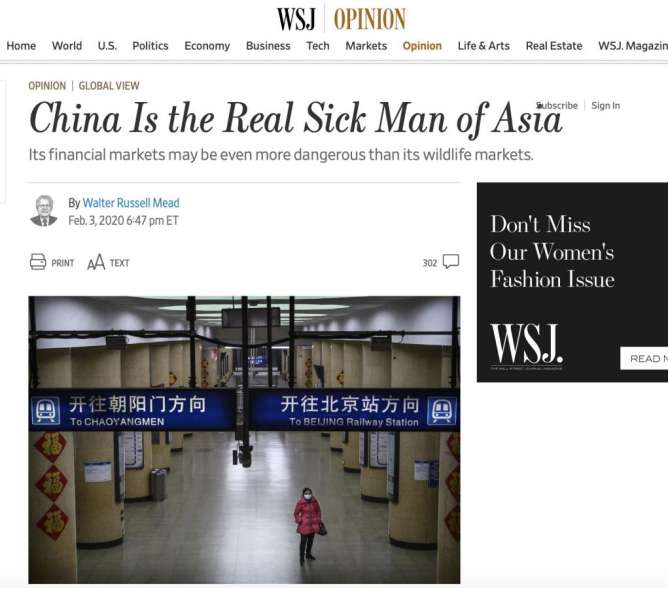
A racially discriminatory article published by the Wall Street Journal has recently triggered a battle against xenophobia and discrimination. (Screenshot of the WSJ website)
A racially discriminatory article published by the Wall Street Journal has recently triggered a battle against xenophobia and discrimination amid China’s ongoing efforts to fight against the virus.
Many Chinese nationals abroad, who felt insulted by the WSJ article "China Is the Real Sick Man of Asia" written by Walter Russell Mead, launched an online petition on the White House’s website on Feb. 7, demanding a formal apology from WSJ to the Chinese community and either a retraction of the article or a rectification of the title. As of press time, the petition had solicited 115,543 signatures, reaching the 100,000-signature threshold required to receive an official response from the White House.
“Such reckless comments against innocent Chinese citizens will only encourage racism and incur repercussions against Chinese or other Asian ethnicities,” the petition read, stressing that racism cannot be tolerated.
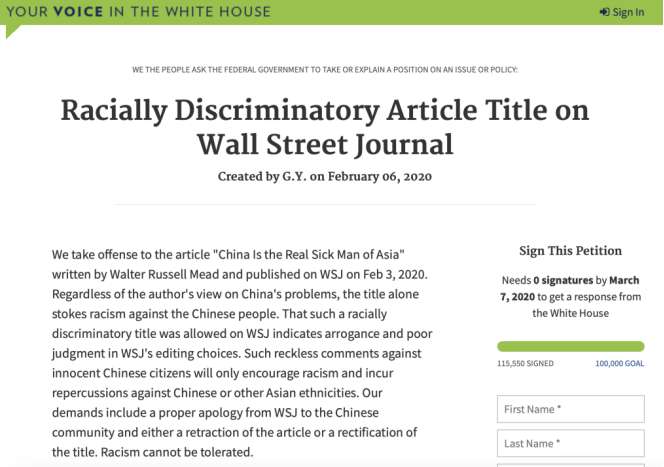
Chinese nationals have launched an online petition on the White House’s website on Feb. 7. (Screenshot of the White House website)
“I'm all for freedom of speech, but not for fake news or smears with political purposes,” Chinese American Wang Tian, a Chinese community leader, told People’s Daily Online.
The offensive op-ed has also caused a public uproar in China, with China’s Ministry of Foreign Affairs demanding an apology from WSJ on several occasions. “Regrettably, what the WSJ has done so far is nothing but parrying and dodging its responsibility,” Foreign Ministry spokesman Geng Shuang said at a daily news briefing on Feb. 19, followed by the revocation of the press credentials of three WSJ correspondents.
The Foreign Ministry’s decision was applauded by many netizens on Chinese social media, with waves of supportive comments filling the comment sections on Sina Weibo, China’s Twitter-like platform.
“China is open to the media and institutions that abide by Chinese laws and respect national sentiments, but not those who smear and throw mud at China,” one comment on Sina Weibo read. So far, WSJ-related hashtags on Sina Weibo have garnered over 67 million views.
On the same day, an op-ed article entitled “Banished in Beijing” published by the WSJ justified the usage of the headline and described the expulsion as “bullying” for the purpose of changing the subject from the Chinese public’s anger about the government’s management of the coronavirus scourge. “The government’s default defense is to play the nationalist card and blame foreigners for its home-grown troubles,” the article read.
The day after China’s announcement, dozens of journalists at the WSJ criticized the newspaper’s response to the fallout from the headline in a letter that was sent to top executives, urging the leaders “to consider correcting the headline and apologizing to our readers, sources, colleagues and anyone else who was offended by it.” Currently, 53 of the paper’s China team have signed the letter.
“The consequences of publishing an opinion like this by mainstream media include stoking more fear and anxiety, and increasing hostility against Chinese and other Asians throughout the world,” Catherine Ceniza Choy, a professor of ethnic studies at the University of California, Berkeley, said in an interview with NBC News, adding that it was “extremely harmful and wrong”.
“I hope China and the US can be mutually beneficial in a peaceful manner. We should respect each other's differences and learn from each other's strengths so as to solve problems from a positive perspective,” Wang said.
As of press time, the White House had yet to offer a formal response and the WSJ has not apologised or rectified the title.
 Fire brigade in Shanghai holds group wedding
 Tourists enjoy ice sculptures in Datan Town, north China
 Sunset scenery of Dayan Pagoda in Xi'an
 Tourists have fun at scenic spot in Nanlong Town, NW China
 Harbin attracts tourists by making best use of ice in winter
 In pics: FIS Alpine Ski Women's World Cup Slalom
 Black-necked cranes rest at reservoir in Lhunzhub County, Lhasa
 China's FAST telescope will be available to foreign scientists in April
 "She power" plays indispensable role in poverty alleviation
 Top 10 world news events of People's Daily in 2020
 Top 10 China news events of People's Daily in 2020
 Top 10 media buzzwords of 2020
 Year-ender:10 major tourism stories of 2020
 No interference in Venezuelan issues
 Biz prepares for trade spat
 Broadcasting Continent
 Australia wins Chinese CEOs as US loses