

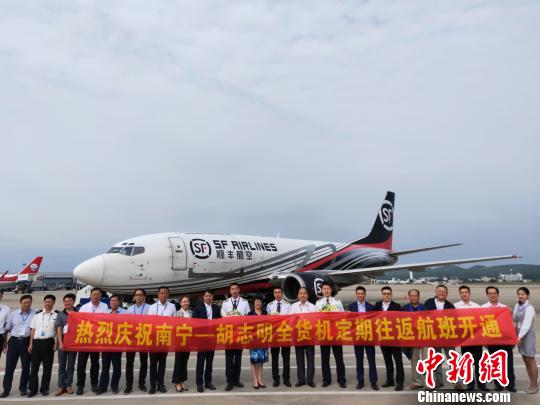
(Photo/Chinanews.com)
SF Airlines, the aviation branch of China's express giant SF Express, officially launched a new direct all-cargo flight service linking Nanning in south China's Guangxi Zhuang Autonomous Region with Ho Chi Minh City, Vietnam, on Oct. 15.
The maiden flight left Nanning Wuxu International Airport at 10:30 a.m. and landed at Ho Chi Minh's Tan Son Nhat International Airport 2 hours and 15 minutes later.
The new cargo route is the autonomous region's first round-trip all-cargo flight service to the Association of Southeast Asian Nations (ASEAN).
The route, operated by B737-300/400 all-cargo freighters, is run by Guangxi Airport Management Group and SF Airlines. Under regular operation, the new route is expected to hold a payload of 14 tonnes on each flight, and will run five flights each week.
Chen Weiguo, deputy director of Nanning's commerce department, said the launch of the new cargo route would boost exports of Guangxi's products and imports of distinctive aquatic products from ASEAN countries, including Vietnam.
Vietnam has been the autonomous region's largest trading partner for years. In 2018, Guangxi's import and export value to Vietnam totaled 174.9 billion yuan, accounting for 42.5 percent of the total of the China-ASEAN Free Trade Area.
 Fire brigade in Shanghai holds group wedding
 Tourists enjoy ice sculptures in Datan Town, north China
 Sunset scenery of Dayan Pagoda in Xi'an
 Tourists have fun at scenic spot in Nanlong Town, NW China
 Harbin attracts tourists by making best use of ice in winter
 In pics: FIS Alpine Ski Women's World Cup Slalom
 Black-necked cranes rest at reservoir in Lhunzhub County, Lhasa
 China's FAST telescope will be available to foreign scientists in April
 "She power" plays indispensable role in poverty alleviation
 Top 10 world news events of People's Daily in 2020
 Top 10 China news events of People's Daily in 2020
 Top 10 media buzzwords of 2020
 Year-ender:10 major tourism stories of 2020
 No interference in Venezuelan issues
 Biz prepares for trade spat
 Broadcasting Continent
 Australia wins Chinese CEOs as US loses