

(Photo/Xinhua)
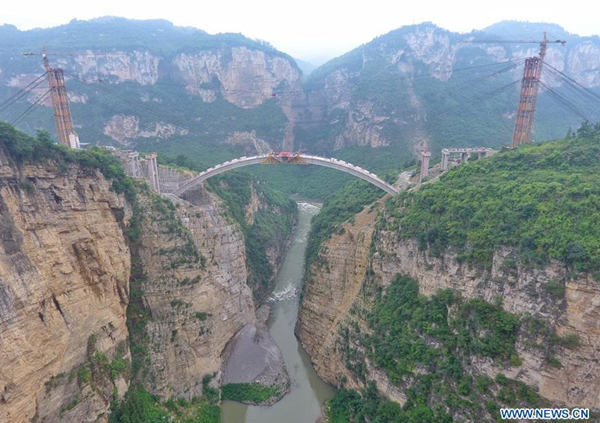
The main arch of a bridge on the border of southwest China's Sichuan, Guizhou and Yunnan provinces was completed on July 7. Once opened, the bridge will make travel more convenient and help to alleviate poverty within the local community.
The construction began in 2016. Built across the Chishui River, the arch bridge measures 286.4 meters long with a span of 180 meters. With a total investment of about 59 million yuan, it’s designed as a two-lane, two-way bridge with sidewalks on both sides.
Since the construction site was located in a canyon scenic area, constructors had to lift the concrete 150 meters above the river with baskets so as to reduce damages to the vegetation, said Jiang Zhongqiao, project manager of Sichuan Road and Bridge Group, contractor of the bridge.
The bridge connects two poverty-stricken counties in Sichuan and Yunnan. Upon opening, it will take one minute to drive across the bridge from one province to the other, while the travel time beforehand was normally 1.5 to 2.5 hours.
This means it will be more convenient to transport Yunnan's coal, Sichuan's tobacco, and other economic crops outside of the mountains. Moreover, the bridge will boost canyon tourism, helping to get rid of local poverty.
 Fire brigade in Shanghai holds group wedding
 Tourists enjoy ice sculptures in Datan Town, north China
 Sunset scenery of Dayan Pagoda in Xi'an
 Tourists have fun at scenic spot in Nanlong Town, NW China
 Harbin attracts tourists by making best use of ice in winter
 In pics: FIS Alpine Ski Women's World Cup Slalom
 Black-necked cranes rest at reservoir in Lhunzhub County, Lhasa
 China's FAST telescope will be available to foreign scientists in April
 "She power" plays indispensable role in poverty alleviation
 Top 10 world news events of People's Daily in 2020
 Top 10 China news events of People's Daily in 2020
 Top 10 media buzzwords of 2020
 Year-ender:10 major tourism stories of 2020
 No interference in Venezuelan issues
 Biz prepares for trade spat
 Broadcasting Continent
 Australia wins Chinese CEOs as US loses