

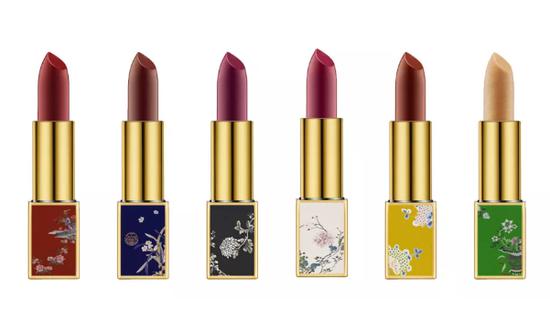
The full collection of the lipsticks released by the Palace Museum, December 9, 2018. /Photo courtesy of the Palace Museum Cultural and Creative Store
Crossover marketing is making big changes to China's consumer market, becoming a vital link in the marketing strategies of many enterprises.
Multiple brands have launched crossover products in China, and many of them have since achieved greater success.
For instance, Starbucks launched a limited edition cat paw glass in February, which set off a violent craze among Chinese Starbucks fans.
The cup was just one product in the Starbucks’ spring lineup, and the response was beyond the brand's expectation, with one person even camping outside a store overnight to get their mitts on one.
As a coffee shop, Starbucks routinely sells reusable cups, and this crossover model is spreading to more enterprises and brands.
In recent years, China’s Palace Museum has also made efforts to create and sell crossover products ranging from stationery to cosmetics.
“I have been a history enthusiast since childhood, and I love products related to Chinese history,” said a man surnamed Di who studies in the UK.
“The advertisement of cosmetics produced by the Palace Museum is attractive to me, and each product has a story,” Di noted.
Zhang Ying, a professor with Guanghua School of Management at Peking University, introduced that crossover marketing is indeed a way of branding, or can be used as an extension of branding.
“The sensation of the cat paw cups reflected the influence of both Starbucks and cats, and things would have been different had the cat paw been replaced with a bear claw,” Zhang explained.
Nekonomics, or the cat economy, is a term that originated in Japan several years ago. It suggests that irrespective of the state of the economy, people will always have a keen interest in cute cats and cat-related products.
Zhang noted that whether the brands and crossover products co-relate is vital for the success of crossover marketing. Additionally, a brand's charm is also important.
According to Zhang, the craze for crossover marketing reflected the change in consumer spending habits in China. “Economic development has improved people’s livelihood, which has further changed their consumption psychology. People are now more willing to buy novel items,” Zhang said.
 Fire brigade in Shanghai holds group wedding
 Tourists enjoy ice sculptures in Datan Town, north China
 Sunset scenery of Dayan Pagoda in Xi'an
 Tourists have fun at scenic spot in Nanlong Town, NW China
 Harbin attracts tourists by making best use of ice in winter
 In pics: FIS Alpine Ski Women's World Cup Slalom
 Black-necked cranes rest at reservoir in Lhunzhub County, Lhasa
 China's FAST telescope will be available to foreign scientists in April
 "She power" plays indispensable role in poverty alleviation
 Top 10 world news events of People's Daily in 2020
 Top 10 China news events of People's Daily in 2020
 Top 10 media buzzwords of 2020
 Year-ender:10 major tourism stories of 2020
 No interference in Venezuelan issues
 Biz prepares for trade spat
 Broadcasting Continent
 Australia wins Chinese CEOs as US loses