

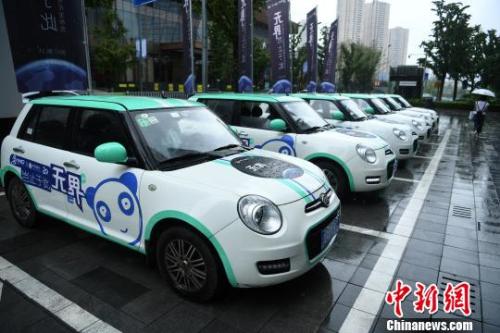
(Photo/Chinanews.com)
As the fever surrounding bike-sharing services experiences a cooling-off period, it seems that China’s shared automobile industry will also experience a "cold winter."
Multiple Chinese auto-sharing service providers announced a halt in operation last year, including the leading vehicle-sharing venture, Togo. As one of the largest car-share companies in China, Togo now has less than 300 vehicles in Beijing - one of its largest user bases, where the company used to hold over 1,800 shared automobiles.
Founder and CEO of the company, Wang Lifeng, disclosed that Togo would make major changes to the company's structure and business model. However, the company is not able to handle the trust crisis it's currently facing, and there are still vast numbers of users applying for a deposit refund.
Compared with internet-based car sharing companies, those backed by auto giants are under much less pressure. For instance, EVCARD, an auto-sharing service provider financed by Shanghai Automotive Industry Corporation had 42,000 shared cars in operation in 2018, and the EV rental operator Panda-Auto under the Chongqing-based automaker Lifan Group also had 20,000 vehicles in service last year. These two companies are still expanding rapidly.
However, auto-share services, according to insiders, are still in a preliminary stage that “burns” investment, and it's unrealistic to expect to make a short-term profit.
Over past years, electric vehicles (EV) were being mass-produced by Chinese automakers because of a dual-credit regulation that encourages the production of new energy vehicles thanks to abundant governmental subsidies.
The sluggish EV market resulted in a considerable inflow of such vehicles into the sharing sector, said Jiang Chao, CEO of Chinese auto-sharing service provider Ola Sharing.
According to incomplete statistics, China is home to some 400 auto-sharing companies, and many of them were established to obtain governmental subsidies, Jiang added.
“The shared mobility industry is facing many issues, such as high acquisition and maintenance costs. Additionally, capital shortage restricted sufficient and effective deployment of the vehicles, which further resulted in a low usage rate,” noted analyst Yu Mu from Analysys, a Chinese big-data analysis provider.
The key to the development of the industry is a sustainable business model.
Once these service providers lose their source of capital, they will face problems, said Yu, adding that this is especially true for startups. Compared with traditional automakers, startups have no advantages in vehicle ownership or capital, and they are not able to independently finance themselves. Therefore, they would be the first to experience the drawbacks of the industry reshuffle, Yu said.
 Fire brigade in Shanghai holds group wedding
 Tourists enjoy ice sculptures in Datan Town, north China
 Sunset scenery of Dayan Pagoda in Xi'an
 Tourists have fun at scenic spot in Nanlong Town, NW China
 Harbin attracts tourists by making best use of ice in winter
 In pics: FIS Alpine Ski Women's World Cup Slalom
 Black-necked cranes rest at reservoir in Lhunzhub County, Lhasa
 China's FAST telescope will be available to foreign scientists in April
 "She power" plays indispensable role in poverty alleviation
 Top 10 world news events of People's Daily in 2020
 Top 10 China news events of People's Daily in 2020
 Top 10 media buzzwords of 2020
 Year-ender:10 major tourism stories of 2020
 No interference in Venezuelan issues
 Biz prepares for trade spat
 Broadcasting Continent
 Australia wins Chinese CEOs as US loses