

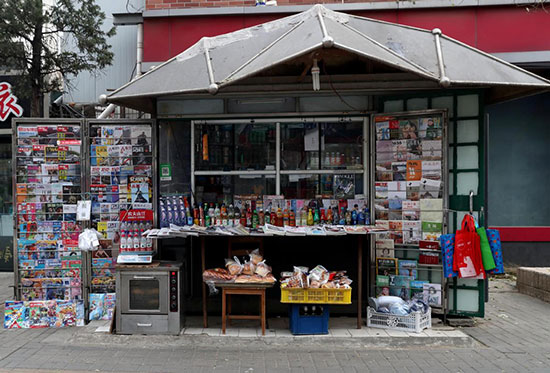
This newsstand in Chaoyang district, Beijing, is one of the few remaining in the city. Many have closed because of falling demand for newspapers and magazines. WANG JING/CHINA DAILY
Arrival of iPhone
On Jan 9, 2007, Steve Jobs, chairman, CEO and co-founder of Apple Inc, announced the arrival of the iPhone at his company in the United States.
Since then, smartphones and the mobile internet have rapidly changed the reading habits of people worldwide.
Yang said: "From 2009, business started to decline. And it's never picked up again."
During a one-hour interview with Yang at her newsstand, seven customers arrived to buy drinks; four bought cigarettes and only one bought a newspaper.
The man who bought the paper said: "It's very convenient to have newsstands. I hope they will be kept by the authorities. As for food and drinks, I don't care. If they want to ban them for safety reasons, this is fine by me."
A customer who bought cigarettes said he had not bought any newspapers or magazines at this stand for years, adding, "It's just a cigarettes stand for me."
Yang said she might start another small business, or retire if she cannot continue to run her newsstand.
"If there is a chance, I hope I can continue my newsstand business because I have been doing this for so long and many people living nearby come to buy newspapers or magazines regularly. We have become friends despite only exchanging a few words over the years. People know me," she said.
More important, Yang said business is not as bad as some people think. As long as she can continue to sell food, drinks and cigarettes, the income can sustain her in Beijing, despite the high cost of living.
According to China Post Group, the country had 30,506 newsstands at the end of 2014 - 20,000 fewer than in 2008.
With the rise of the internet, and with newsstands starting to create problems such as obstructing roads and sidewalks, some cities have taken strict and quick action.
In 2009, Wuxi city, Jiangsu province, removed 1,241 newsstands. In 2012, Zhengzhou, capital of Henan province, dismantled all 421 stands in the city and authorities said newspapers and magazines could only be sold in stores.
Reading never dies
Luo Ping, a writer who lives in Beijing's Tongzhou district, wrote to the authorities last year, saying that newsstands are still an important part of the city's public cultural system and should not be neglected.
She received a reply thanking her for her letter, and saying her views would be taken into account. However, she still fears for the stands' future.
"It is not easy to build a network of newsstands in a city. They are the closest cultural facilities to ordinary people," Luo said. "They have a reason to exist."
Luo suggested that newsstand owners could try to sell innovative cultural products such as paper cuts and needlework to make up for the losses from selling newspapers.
However, all items sold at newsstands need to be approved by the authorities.
Ding Xiaozhe, 43, an accountant, said of the disappearance of newsstands near his home in Dongcheng district: "It's a natural choice. Things that no longer fit with the times will be abandoned or fade away, which is reasonable."
Ding loves to read and was a loyal buyer of the magazines National Geographic and Chinese National Geography at newsstands.
"Every time I moved apartments, I had to carry several heavy boxes of my prized magazines," he said.
"I love good memories, but times change. We can read so much information on cellphones, and order digital magazines online. There's really no need to keep that many newsstands. Generally speaking, it's a waste of social resources to keep something that's old-fashioned."
Despite differing opinions about newsstands, the Beijing municipal government has decided to find a way to keep streets clean while allowing some of the stands to remain with upgraded facilities.
In 2014, the central government outlined the capital's core functions as the country's political, cultural, international communications, and scientific and technological innovation center.
Since then, as an ancient and traditional city, Beijing has started to use its advantages to strengthen its position as a cultural center.
Measures have been introduced to protect old streets and relics, build new cultural landmarks, improve the libraries' network and service, host cultural activities and provide subsidies to support bookstores.
Meanwhile, in Russia, the government has drafted a plan, suggesting there should be a newsstand for every 1,500 residents.
In Paris, the authorities have attempted to expand the business scope of newsstands and reduce rents to help the owners. They allow the stands to sell food, drinks, souvenirs and candies to increase income.
In Japan, there are convenience stores on nearly every street. Each community has more than one such store, which sell newspapers and magazines.
Wang Hui, 33, the mother of a 6-year-old boy in Beijing, said she often buys cartoon and other magazines at a newsstand for him on her way home.
"I want to protect his eyes by reducing the time he spends on his cellphone and other digital devices. He likes reading magazines. It's better to buy them at newsstands, because in that way I don't need to subscribe for a whole year," she said.
"I think that reading decides our kids' futures. No matter whether there are newsstands or other places selling newspapers and magazines, reading will always continue in some way."
 |
 Fire brigade in Shanghai holds group wedding
 Tourists enjoy ice sculptures in Datan Town, north China
 Sunset scenery of Dayan Pagoda in Xi'an
 Tourists have fun at scenic spot in Nanlong Town, NW China
 Harbin attracts tourists by making best use of ice in winter
 In pics: FIS Alpine Ski Women's World Cup Slalom
 Black-necked cranes rest at reservoir in Lhunzhub County, Lhasa
 China's FAST telescope will be available to foreign scientists in April
 "She power" plays indispensable role in poverty alleviation
 Top 10 world news events of People's Daily in 2020
 Top 10 China news events of People's Daily in 2020
 Top 10 media buzzwords of 2020
 Year-ender:10 major tourism stories of 2020
 No interference in Venezuelan issues
 Biz prepares for trade spat
 Broadcasting Continent
 Australia wins Chinese CEOs as US loses