

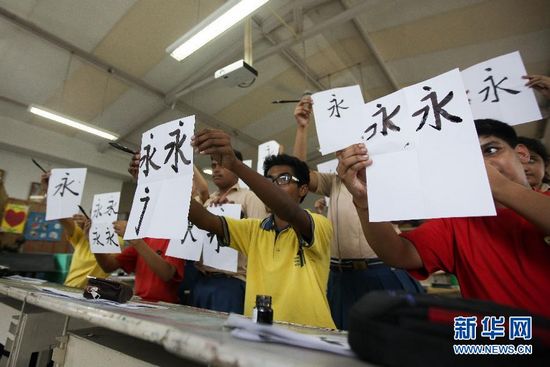
Indian students show their Chinese calligraphy works. (Xinhua/Zheng Huansong)
As a conventional symbolic resource within a cultural system, language is the ultimate tool to decipher foreign culture, as well as a key to communicate with foreigners. Following China’s swift development and the revival of traditional Chinese culture, educational authorities in many countries have decided to include Mandarin as part of their college curriculum, to help the younger generation comprehend the rising power that is China.
Russia
As of 2019, Mandarin will be included in Russia’s Unified State Exam, a national exam that every student must pass after school to enter a university or a professional college. Anzul Muzayev, deputy director of Federal Service for Supervision of Education and Science, told Russia Today that currently, over 17,000 students are learning Mandarin as their second language, while in 2019, hundreds of students will pass the Mandarin test in their Unified State Exam.
According to Russia Today, the exam will include 42 questions and will be divided into four sections to focus on listening, reading, grammar and vocabulary, and writing, and those taking the exam will have three hours to complete it.
Over the past 10 years, the number of Mandarin learners in Russia has grown significantly. In 1997, around 5,000 Russians chose to study Mandarin, while in 2017, that number stood at 56,000.
UK
Although Mandarin has long been offered as an A-level, which is a standardized examination in secondary schools across the UK, minus Scotland, this year Mandarin “bucked the trend” in regards to the falling popularity of language learning in the UK. According to the Telegraph, the number of students taking an A-level in Chinese has overtaken German for the first time this year, becoming the UK’s third most popular language.
Governmental statistics have shown that 3,334 British students took an A-level in Chinese in 2018, while the number of students signing up for Chinese as a subject has increased by 8.6 percent year-on-year.
Mark Herbert, director of schools and skills at the British Council, told the Telegraph that the increasing popularity of Chinese with the young British public is welcomed.
“Our research shows that Mandarin will be one of the most important languages for the UK’s future prosperity and global standing,” he added.
Ireland
Irish Minister for Education and Skills, Richard Brunton, launched the Irish government’s Strategy for Foreign Languages in Education 2017-2026, which sets out a roadmap to promote Ireland as a top nation in Europe for the teaching and learning of foreign languages. According to the plan, Mandarin will be introduced in high schools as a leaving certificate subject, while the subject will be officially included in the Leaving Certificate Examination, the university matriculation exam of Ireland, in 2020.
Richard Brunton told media sources that several short-term Mandarin teaching programs had started since 2014, to help Irish students further understand Chinese language and culture. The inclusion of Mandarin in the Leaving Certificate Examination will further strengthen such a goal.
 Fire brigade in Shanghai holds group wedding
 Tourists enjoy ice sculptures in Datan Town, north China
 Sunset scenery of Dayan Pagoda in Xi'an
 Tourists have fun at scenic spot in Nanlong Town, NW China
 Harbin attracts tourists by making best use of ice in winter
 In pics: FIS Alpine Ski Women's World Cup Slalom
 Black-necked cranes rest at reservoir in Lhunzhub County, Lhasa
 China's FAST telescope will be available to foreign scientists in April
 "She power" plays indispensable role in poverty alleviation
 Top 10 world news events of People's Daily in 2020
 Top 10 China news events of People's Daily in 2020
 Top 10 media buzzwords of 2020
 Year-ender:10 major tourism stories of 2020
 No interference in Venezuelan issues
 Biz prepares for trade spat
 Broadcasting Continent
 Australia wins Chinese CEOs as US loses