

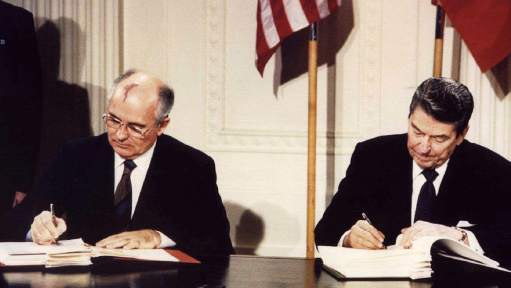
The INF Treaty was signed between the United States and the Soviet Union on December 8, 1987. (Photo/haiwainet.cn)
US President Donald Trump announced Saturday that his country is pulling out of the Intermediate-Range Nuclear Forces Treaty (INF), citing Russian violations. In response, Russian Deputy Foreign Minister Sergei Ryabkov said that if the United States continues to withdraw unilaterally from agreements, then Russia will adopt a range of retaliatory measures, including military ones.
According to reports, Trump accused Russia of violating the agreement for many years and threatened to pull out, which would allow the United States to develop new weapons.
Russian media quoted Russian Deputy Foreign Minister Sergei Ryabkov as saying that it "would be a very dangerous step" if the United States exits from the agreement, slamming it as an attempt to achieve concessions through blackmail. Ryabkov said that the accusations seem to be aimed at concealing US violations. According to Russian media, the US missile defense system deployed in Eastern Europe to protect against a potential Iranian attack can be adapted to fire medium-range ballistic missiles at Russia.
The Russian Deputy Foreign Minister said that the United States has no reason to accuse Russia of violating the treaty, adding that all of the accusations against Russia are unsubstantiated. However, Ryabkov stressed, Russia will continue to insist on resolving any issues with the treaty through dialogue.
Earlier, Russian media quoted the country's Ministry of Foreign Affairs as saying that the true motive of the US withdrawal from the treaty is the US dream of a unipolar world. However, some analysts point out that pulling out of the treaty with Russia could worsen the arms race between the two countries.
Alexey Pushkov, who heads the Russian Federation Council's Temporary Commission on Information Policy and Communications, wrote on Twitter that if the United States does exit from the treaty, then "a powerful blow will be delivered to the whole system of strategic stability in the world."
Recently, Russian President Vladimir Putin said that Russia adopts a "no first use" policy on nuclear weapons, adding that the country would only tap its nuclear arsenal in response to an attack involving nuclear or other weapons of mass destruction.
The INF Treaty, formally the "Treaty Between the United States of America and the Union of Soviet Socialist Republics on the Elimination of Their Intermediate-Range and Shorter-Range Missiles," was signed between the United States and the Soviet Union on December 8, 1987. The treaty bans all short- and medium-range nuclear and non-nuclear missiles and was designed to reduce the risk of outbreak of nuclear war.
 Fire brigade in Shanghai holds group wedding
 Tourists enjoy ice sculptures in Datan Town, north China
 Sunset scenery of Dayan Pagoda in Xi'an
 Tourists have fun at scenic spot in Nanlong Town, NW China
 Harbin attracts tourists by making best use of ice in winter
 In pics: FIS Alpine Ski Women's World Cup Slalom
 Black-necked cranes rest at reservoir in Lhunzhub County, Lhasa
 China's FAST telescope will be available to foreign scientists in April
 "She power" plays indispensable role in poverty alleviation
 Top 10 world news events of People's Daily in 2020
 Top 10 China news events of People's Daily in 2020
 Top 10 media buzzwords of 2020
 Year-ender:10 major tourism stories of 2020
 No interference in Venezuelan issues
 Biz prepares for trade spat
 Broadcasting Continent
 Australia wins Chinese CEOs as US loses