
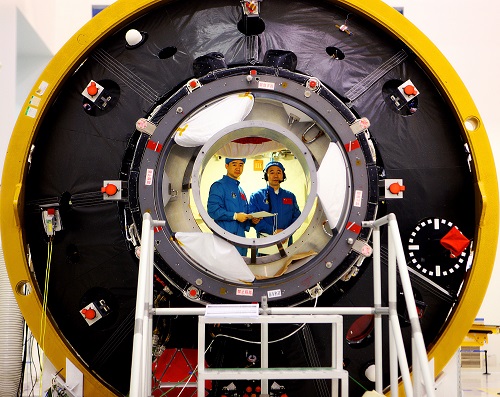
Chinese space laboratory Tiangong-2 (File photo)
The experiment module of China’s space station completed propulsion tests in a trial launch on July 31, according to China Aerospace Science and Technology Corporation (CASC), Science and Technology Daily reported on Thursday.
The tests were conducted in the western suburb of Shanghai, by the 801 research institute of CASC 6th Academy. The main components of the experiment module’s propulsion system were installed to work in space. The engines and parts all performed well in the trial and no malfunctions were recorded, further proving the accessibility of the design.
Engines for a space station experiment cabin must work for at least 15 years. Besides guaranteeing the longevity, designers must strictly abide by the total weight restriction of the 36 engines required.
For instance, scientists had to devote great time and effort to reduce the weight of one engine unit from the designed 16 kilograms to 10 kilograms in order to make it perform better. The final product passed the trial without issue.
The propulsion system will be manufactured according to the current design. According to the country’s manned space program, Chinese scientists will launch a core cabin of the space station in around 2020.The experiment module will be sent into space in 2022.
 Fire brigade in Shanghai holds group wedding
 Tourists enjoy ice sculptures in Datan Town, north China
 Sunset scenery of Dayan Pagoda in Xi'an
 Tourists have fun at scenic spot in Nanlong Town, NW China
 Harbin attracts tourists by making best use of ice in winter
 In pics: FIS Alpine Ski Women's World Cup Slalom
 Black-necked cranes rest at reservoir in Lhunzhub County, Lhasa
 China's FAST telescope will be available to foreign scientists in April
 "She power" plays indispensable role in poverty alleviation
 Top 10 world news events of People's Daily in 2020
 Top 10 China news events of People's Daily in 2020
 Top 10 media buzzwords of 2020
 Year-ender:10 major tourism stories of 2020
 No interference in Venezuelan issues
 Biz prepares for trade spat
 Broadcasting Continent
 Australia wins Chinese CEOs as US loses