

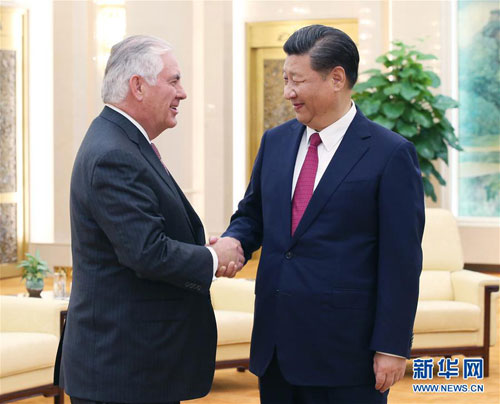
Chinese President Xi Jinping meets at the Great Hall of the People with Secretary of State Rex Tillerson of the US on September 30, 2017.
On October 18, while delivering a speech to the Center for Strategic and International Studies (CSIS), US Secretary of State Rex Tillerson made some remarks on China-US relations. Tillerson touched on the South China Sea issue, China’s model of economic cooperation with other countries, and the international order.
Mentioning China 13 times in his speech on the future of US relations with India, Tillerson accused China of “undermining the international, rules-based order,” argued China’s “provocative actions” in the South China Sea “directly challenge” the US, and said China’s economic cooperation model “saddles” developing economies with enormous levels of debt.
During a regular press conference on Thursday, October 19, Chinese Foreign Ministry spokesman Lu Kang hit back at the criticism, stressing that China steadfastly upholds the international order with the UN at the core and based on the purposes and principles of the UN Charter. Lu stressed that China will “by no means” pursue its own development at the expense of other countries’ interests, or give up its own legitimate rights and interests.
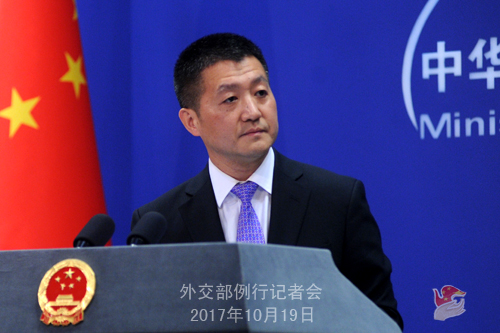
Chinese Foreign Ministry spokesman Lu Kang
Lu said that China is committed to the development of China-US relations, but called on the US to abandon its bias. “We hope that the United States can put China’s development and China’s positive role in the world into perspective, abandon its biased views of China, and make concerted efforts with China to focus on cooperation, properly handle differences, and maintain the momentum of the steady growth of China-US relations,” Lu said.
In a commentary piece published in USA Today before Tillerson’s speech, Cui Tiankai, the Chinese Ambassador to Washington, also highlighted the importance of having a clear view of the China-US relationship, stressing the need to give up the ideological bias that clouds Western views. “The zero-sum mentality is outdated, and it is misleading to interpret the relationship between China and the U.S. through the lens of the power shifting theory,” he wrote, adding later that a “sound and robust relationship” will benefit not only the Chinese and American peoples, but also world peace, stability, and prosperity.
Tillerson will pay his first visit to India next week, during which he will elaborate on President Donald Trump’s new South Asia policy. In addition, he is also scheduled to visit Pakistan.
Lu added that China welcomes the development of normal and friendly state-to-state relations between the US and other countries “as long as it is conducive to regional peace and stability and enhancing mutual trust between regional countries.”
 Fire brigade in Shanghai holds group wedding
 Tourists enjoy ice sculptures in Datan Town, north China
 Sunset scenery of Dayan Pagoda in Xi'an
 Tourists have fun at scenic spot in Nanlong Town, NW China
 Harbin attracts tourists by making best use of ice in winter
 In pics: FIS Alpine Ski Women's World Cup Slalom
 Black-necked cranes rest at reservoir in Lhunzhub County, Lhasa
 China's FAST telescope will be available to foreign scientists in April
 "She power" plays indispensable role in poverty alleviation
 Top 10 world news events of People's Daily in 2020
 Top 10 China news events of People's Daily in 2020
 Top 10 media buzzwords of 2020
 Year-ender:10 major tourism stories of 2020
 No interference in Venezuelan issues
 Biz prepares for trade spat
 Broadcasting Continent
 Australia wins Chinese CEOs as US loses