

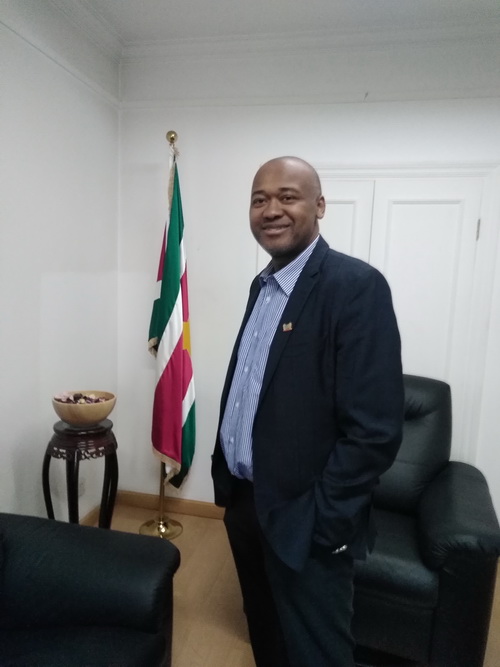
According to Ambassador Lloyd L. Pinas, people should be continuously sensitiszed on the significance of their culture. Photo by Kimeng Hilton
The Surinamese Embassy in China on October 10, 2017 marked Maroons’ Day in remembrance of the struggle by African slaves for freedom during colonial times. The day is one of Suriname’s five national holidays for its five major ethnic groups. The country’s main ethnic groups include people of Asian, African, native Indian, Indian, Dutch and mixed descent. The official language is Dutch since the country had been colonized by Holland or The Netherlands.
Retracing the origin of the celebration, Ambassador Lloyd L. Pinas said Dutch colonial masters and run-away African slaves on October 10, 1740 signed a peace treaty. The slaves fled plantations in the south into the interior of the country where they settled in the pristine Amazon Forest and led their lives with little outside interference for about 300 years.
“Maroons’ Day is for people to feel proud and be rejuvenated about their culture, common history and the struggle that sent them fleeing into a strange forest where they survived. Surinamese descendants of African slaves are still around today because their ancestors survived the ordeal, showing that as a people, they were quite innovative. To me, this is the essence of the celebration,” Pinas explained.
According to the Ambassador, though they were from different parts of Africa, these slaves managed to maintain their languages, cultures and traditions. “For example, they made good use of forest herbs and tree barks to treat themselves, including broken bones. They did not copy European style of dressing. With little Western influence, they developed their spirituality, which is still in practice today,” he noted.
“Culture is a perception on which our people need to be educated, given that Dutch is foreign to them. This demands deeper understanding and perception of culture by paying greater attention to local languages. Language is a product – with producers and consumers. If people never rise above the level of being consumers, they will be in trouble,” Lloyd L. Pinas cautioned.
At 43, Suriname looks forward to more ethnic balancing through continuous awareness, Pinas said. Apart from intermarriages, the people have a common unwritten language (lingua franca), the Surinama Tomo or Taki-Taki, which is not used in education. It is spoken across the board by all ethnic groups, though with only about 600 lexicon (vocabulary). However, Pinas thinks that developing Taki-Taki’s vocabulary, standardizing it and getting a script will be long and costly.
African slaves were brought to New World after Dutch plantation owners discovered that local Indians could not stand the hard labour. Amongst Africans shipped to Suriname were tribal warriors who later rose up against their slave masters. Heroes like Kodjo, Mento, Asant, Bonny, etc., led the struggle against colonial oppression. These people wanted the freedom they enjoyed before in Africa. They fled from the coast into the interior behind waterfalls where no one could capture them.
Surinamese people of African descent can be grouped into five major language groups. Those who fled into the forest were derogatorily referred to as “Bush Negroes” in Dutch by the colonial masters and were often discriminated against or treated as lesser citizens. Meanwhile, African slaves who remained in the coastal city eventually lost their language and cultural identity under Dutch influence.
It must be noted that Dutch slavery in Suriname was one of the toughest in the New World, resulting in the deaths of many. There was harsh punishment to scare slaves from escaping. Today, people of African descent make up about 40 per cent of the total population of 550,000 people – though about half a million others live in Holland. Emancipation or the abolition of slavery in Suriname only came in 1863 – 30 or 40 years after neighbouring countries. Suriname began experimenting self-rule in 1957, before actual independence on November 25, 1975 without any struggle.
China and Suriname established diplomatic relations in 1976, 100 days after independence in 1975, though it was only in 1998 that Suriname opened its embassy in China. Associations of people of Chinese descent in Suriname strongly supported the opening of the Chinese Embassy and the teaching of Chinese. The Confucius Centre was established in Suriname in 2016, helping in the learning of Mandarin. People of Chinese descent in Suriname speak a dialect of Cantonese having come from Indonesia where they fled from southern China during the Opium Wars between China and Britain.
*Kimeng Hilton Ndukong, a contributor to People’s Daily Online, is Sub-Editor for World News with Cameroon Tribune bilingual daily newspaper in Cameroon. He is currently a 2017 China-Africa Press Centre, CAPC fellow.
 Fire brigade in Shanghai holds group wedding
 Tourists enjoy ice sculptures in Datan Town, north China
 Sunset scenery of Dayan Pagoda in Xi'an
 Tourists have fun at scenic spot in Nanlong Town, NW China
 Harbin attracts tourists by making best use of ice in winter
 In pics: FIS Alpine Ski Women's World Cup Slalom
 Black-necked cranes rest at reservoir in Lhunzhub County, Lhasa
 China's FAST telescope will be available to foreign scientists in April
 "She power" plays indispensable role in poverty alleviation
 Top 10 world news events of People's Daily in 2020
 Top 10 China news events of People's Daily in 2020
 Top 10 media buzzwords of 2020
 Year-ender:10 major tourism stories of 2020
 No interference in Venezuelan issues
 Biz prepares for trade spat
 Broadcasting Continent
 Australia wins Chinese CEOs as US loses