

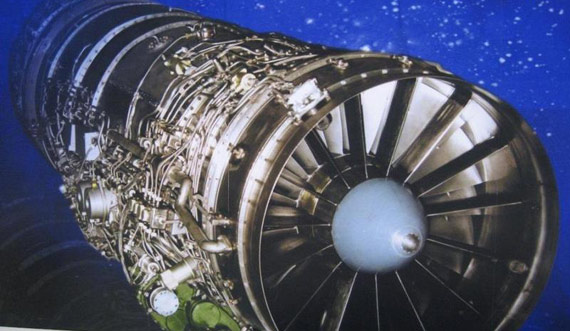
(File photo)
“China plans to catch up with the advanced aero engine producers in 20 years,” said Cao Jianguo, chairman of the Aero Engine Cooperation of China (AECC).
Only five countries in the world – the five permanent members of the United Nations Security Council - are able to produce aero engines, Cao noted. Though being in this group, China is still hindered by out-of-date technologies.
With the development of aero engines and improved research cycle time, it is possible for China to accomplish this mission, Cao added.
It takes more than 20 years to develop a new-generation aero engine, which is the world’s most complicated machinery system, and which combines multiple disciplines.
In addition, the technical barriers also require astronomical amounts of capital. A medium-large sized aero engine costs around $2-3 billion for research and development, and the figure doubles when it comes to more advanced machines.
“Design capability is China’s biggest weakness,” remarked Yin Zeyong, a member of the Chinese Academy of Engineering and head of AECC’s science and technology commission. Design, tests, and trial flights all contribute to the time it takes to develop aero engines, but enhancing design capability is the only way to smooth the development, Yin said.
Besides, China now lacks a standardized code system, which forms the basis of the most advanced aero engine producers, noted Wang Yingjie, director of the management innovation department of the AECC. “We still have a long way to go in this regard,” he stressed.
However, China’s state-run system is a key factor that drives the development of the country’s aero engines. “Related enterprises are sparing no efforts to support us,” said Luo Ronghuai, vice chairman of the AECC. “They are supporting us even at their own losses when we need specific steels in very limited amount,” he added.
China will establish a development and research system for aero engines before 2020. According to Wang, the AECC is currently planning on a comprehensive operation and management system covering four major aspects: research, manufacture, supplier management, and service assurance. In addition, a self-developed standardized code system for research and development will be completed.
 Fire brigade in Shanghai holds group wedding
 Tourists enjoy ice sculptures in Datan Town, north China
 Sunset scenery of Dayan Pagoda in Xi'an
 Tourists have fun at scenic spot in Nanlong Town, NW China
 Harbin attracts tourists by making best use of ice in winter
 In pics: FIS Alpine Ski Women's World Cup Slalom
 Black-necked cranes rest at reservoir in Lhunzhub County, Lhasa
 China's FAST telescope will be available to foreign scientists in April
 "She power" plays indispensable role in poverty alleviation
 Top 10 world news events of People's Daily in 2020
 Top 10 China news events of People's Daily in 2020
 Top 10 media buzzwords of 2020
 Year-ender:10 major tourism stories of 2020
 No interference in Venezuelan issues
 Biz prepares for trade spat
 Broadcasting Continent
 Australia wins Chinese CEOs as US loses