

Some Chinese boxing fans still take delight in talking about the match between Yang Jianping and Kozan Nobu, the “best karate player from Okinawa” in April 2015. The aggressive Nobu provoked Yang with a hard nudge before the match, which ended two minutes later when Yang used a rear naked choke on Nobu.
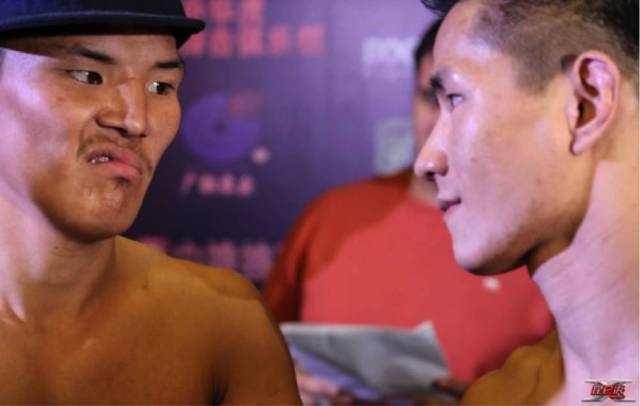
(Screenshot from Kunlun Fight shows Kozan Nobu on the left and Yang Jianping on the right)
Nobu gave up and Yang took home the golden belt and a 1 million yuan cash prize from the show Kunlun Fight, which boasts fights featuring kickboxing, mixed martial arts, Muay Thai, and Chinese martial arts.
However, the match has since been doubted by many people, who raised questions as to why Nobu was able to suddenly release Yang when the Chinese young boxer was pinned down in a choke hold. Many even pointed out that the “best karate player” has no match results online.
Somewhat different to many people’s expectations, it turned out the “invincible” Japanese fighter came from Mongolia and goes by the name of Duru, Dongshi Sports, a WeChat public account, revealed this July, shedding light on a growing industry that shows Chinese fighters easily knocking out foreign challengers.
Many of those beautiful knockouts were scripted by organizers to arouse attention. With the increasing popularity of commercial fighting games, more and more foreign fighters have come to China, some of whom would are targeted by organizers to “act” in some matches, several business insiders noted.
“You can easily find a foreigner who is willing to fight a Chinese boxer at 3,000 yuan per match,” an anonymous insider noted.
Fighters from Japan, Europe, and Mongolia are recruited through personal connections or even Weibo, China’s version of Twitter. The fighters are amateur or junior level fighters, but their identities are fabricated by organizers. They will then be introduced as foreign champions with excellent match results, Phoenix Weekly reported.
Zou Guojun, a former combat athlete, observed as a former consultant on some combat sports shows that more than 70 percent of the foreign boxers could not be introduced into Chinese shows as the gap remained huge.
The matches are fixed to please the audience and usually end with injured Chinese fighters triumphing over the foreigners.
One notorious case of match-fixing happened when a “Battle of the Century” broke out between Chinese self-claimed monk Yi Long and Thai boxer Buakaw Banchamek in June 2015 on the combat sports show Wu Lin Feng. The first match, with international referees, ended with an obvious defeat of Yi Long, while the second match some three months later ended with all four Chinese referees judging Yi Long as the winner, even though the Thai boxer was the most effective, according to Phoenix Weekly.
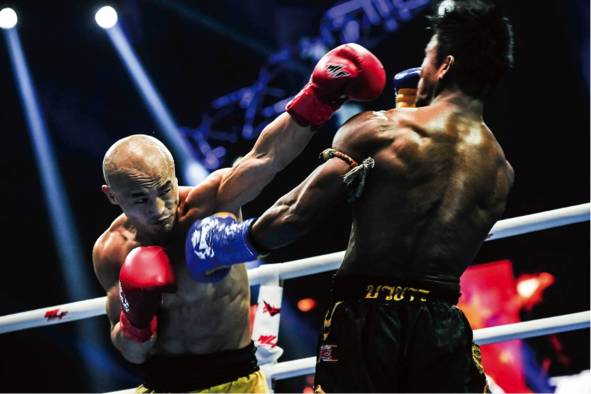
(Yi Long fights Thai boxer Buakaw Banchamek)
“We have failed to understand the fair, just, and open principle in sports. Neither have we taken sports as a cultural activity. Sport is a special product. One must include one’s values and soul in it so sport can touch hearts,” Zou was quoted as saying.
 Fire brigade in Shanghai holds group wedding
 Tourists enjoy ice sculptures in Datan Town, north China
 Sunset scenery of Dayan Pagoda in Xi'an
 Tourists have fun at scenic spot in Nanlong Town, NW China
 Harbin attracts tourists by making best use of ice in winter
 In pics: FIS Alpine Ski Women's World Cup Slalom
 Black-necked cranes rest at reservoir in Lhunzhub County, Lhasa
 China's FAST telescope will be available to foreign scientists in April
 "She power" plays indispensable role in poverty alleviation
 Top 10 world news events of People's Daily in 2020
 Top 10 China news events of People's Daily in 2020
 Top 10 media buzzwords of 2020
 Year-ender:10 major tourism stories of 2020
 No interference in Venezuelan issues
 Biz prepares for trade spat
 Broadcasting Continent
 Australia wins Chinese CEOs as US loses