

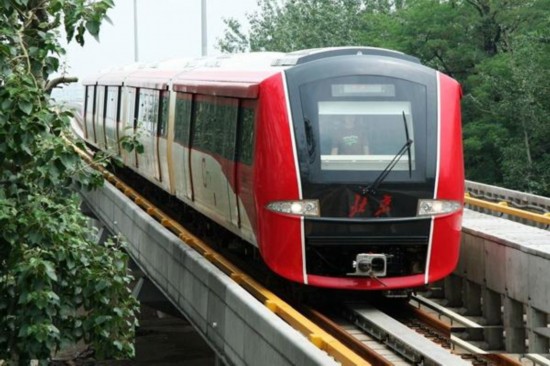
(file photo)
The total track length of Beijing's rail transit network will exceed 1,500 kilometers, Chinanews.com reported on Aug. 7.
Beijing plans to increase the number of rail transit lines to 35. This will include 21 subways, seven regional rapid rails, five medium-to-small-capacity rails, and two airport express trails. In 2017, the city will push for the construction of 20 central subway lines and sections, stretching some 350 kilometers. Two additional lines and sections will start construction, and 34.6 kilometers will be put into operation.
Beijing was China's first city to have a subway. It has the largest number of rail transit lines and the largest passenger flow among all cities across the country. China's State Council Information Office released a whitepaper in December 2016, stating that the country will speed up construction of rail transit lines in urban areas with a population of more than three million during the 13th Five-Year Plan period (2016-2020), adding 3,000 kilometers of lines in operation.
By the end of 2016, there were 128 rail transit lines operating in 29 Chinese mainland cities, reaching a total length of 3,832 kilometers. Eleven more cities are building urban rail transit systems and another 17 cities have plans.
 Fire brigade in Shanghai holds group wedding
 Tourists enjoy ice sculptures in Datan Town, north China
 Sunset scenery of Dayan Pagoda in Xi'an
 Tourists have fun at scenic spot in Nanlong Town, NW China
 Harbin attracts tourists by making best use of ice in winter
 In pics: FIS Alpine Ski Women's World Cup Slalom
 Black-necked cranes rest at reservoir in Lhunzhub County, Lhasa
 China's FAST telescope will be available to foreign scientists in April
 "She power" plays indispensable role in poverty alleviation
 Top 10 world news events of People's Daily in 2020
 Top 10 China news events of People's Daily in 2020
 Top 10 media buzzwords of 2020
 Year-ender:10 major tourism stories of 2020
 No interference in Venezuelan issues
 Biz prepares for trade spat
 Broadcasting Continent
 Australia wins Chinese CEOs as US loses