
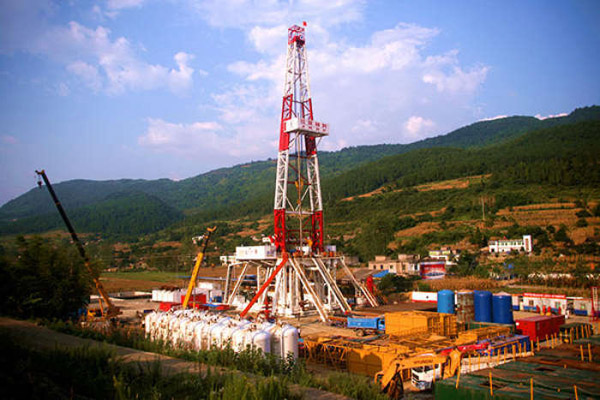
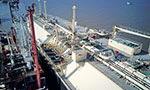
Fuling Shale Gas Field (Photo/Xinhua)
China's first large-scale shale gas field, Fuling Shale Gas Field, has proven reserves of 600,814 million cubic meters, China Petrochemical News reported on Wednesday.
The biggest difference between shale gas and natural gas is the state of their reserves. If natural gas mining can be compared to drawing blood from the veins, the mining of shale gas would be more like getting blood from the capillaries. Large-scale commercial development of shale gas is difficult.
Sinopec has developed a technical system to assist with the process of shale gas exploration and development, such as fast drilling of horizontal wells, green exploration, and development support. The company has also developed its own machinery and equipment, and more than 100 technical standards, providing reference for China's large-scale development of shale gas.
As of June 30, 2017, the Fuling Shale Gas Field in southwest China has produced 11.8 billion cubic meters of gas, equivalent to the one-year gas demand of 64 million households. At present, 16 million cubic meters of gas from the field are sold each day.
Sinopec expects its project in Fuling to reach a production capacity of 10 billion cubic meters a year by the end of 2017.
 Fire brigade in Shanghai holds group wedding
 Tourists enjoy ice sculptures in Datan Town, north China
 Sunset scenery of Dayan Pagoda in Xi'an
 Tourists have fun at scenic spot in Nanlong Town, NW China
 Harbin attracts tourists by making best use of ice in winter
 In pics: FIS Alpine Ski Women's World Cup Slalom
 Black-necked cranes rest at reservoir in Lhunzhub County, Lhasa
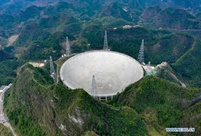 China's FAST telescope will be available to foreign scientists in April
 "She power" plays indispensable role in poverty alleviation
 Top 10 world news events of People's Daily in 2020
 Top 10 China news events of People's Daily in 2020
 Top 10 media buzzwords of 2020
 Year-ender:10 major tourism stories of 2020
 No interference in Venezuelan issues
 Biz prepares for trade spat
 Broadcasting Continent
 Australia wins Chinese CEOs as US loses